FEATUREDAugust 24, 2026Thomson Reuters and Solve Intelligence Partner to Deepen AI Adoption Across Leading Patent PracticesSolve Intelligence’s partnership with Thomson Reuters brings together Solve’s patent and IP platform and practitioner-led support with Thomson Reuters’ longstanding experience helping global law firms adopt professional technology.
Solve Intelligence brings patent-specific AI capabilities to Google Cloud's Gemini Enterprise for LegalSolve Intelligence is pleased to announce that it is a launch partner for Google Cloud’s Gemini Enterprise for Legal.
Page White Farrer Adopts Solve Intelligence for AI-Assisted Patent DraftingPage White Farrer Adopts Solve Intelligence and Solve's AI Templates Page White Farrer ("PWF"), a specialist intellectual property firm with a longstanding focus on technology-driven innovation, has selected Solve Intelligence to support patent application drafting following an extensive evaluation of available AI tools. The firm has initially deployed the platform within its technology-focused patent teams, supporting work across sectors such as AI, software, telecommunications, electronics, semiconductors and engineering. The firm's objective was not to automate legal judgement or replace attorney expertise, but to accelerate the preparation of high-quality first drafts of patent applications. By combining AI-assisted drafting with custom templates tailored to the firm's preferred drafting approaches, Solve Intelligence helps attorneys move from an initial claim set to a reviewable first draft more efficiently while maintaining consistency and technical accuracy. For this partnership, PWF's primary focus was on configuring the platform around the firm's own drafting conventions, client preferences and established best practices, ensuring that the technology supports the way its attorneys already work.
Maiwald Chooses Solve Intelligence for Selected AI-Supported IP WorkflowsSolve Intelligence is proud to share that Maiwald, one of Germany’s largest and most progressive intellectual property firms, works with Solve Intelligence on selected AI-supported workflows in its patent and legal practice groups. Following an evaluation period during which selected functionalities were assessed for approved internal use cases, Maiwald and Solve have formed an enterprise partnership for 2026. The rollout reflects the same careful approach Maiwald brings to its client work. Solve enables customers in Europe to process data on servers located within Europe and holds recognized information-security certifications. In addition, Solve offers contractual commitments designed to protect confidential professional information in line with applicable statutory confidentiality obligations and professional conduct requirements. Against that background, any use of AI-supported tools took place only within approved governance structures and under applicable professional, contractual, confidentiality and data-protection requirements. That balance of innovation and professional judgment is characteristic of Maiwald. The firm has spent decades setting a standard for IP work in Europe: rigorous prosecution, a formidable contentious practice, and interdisciplinary teams of patent attorneys and attorneys-at-law working side by side. The firm approached AI the same way, methodically, with a clear sense of where it adds leverage and where an experienced attorney’s judgment remains irreplaceable.
PTAB Case Studies of AI Disclosure Requirements: Part IIThis article is the second of a series of Patent Trial & Appeal Board (PTAB) case studies (see Part I ), which aims to inform applicants’ approach to satisfying the written description and enablement requirements for patenting artificial intelligence (AI) and machine learning technologies.
How Successful Patent Practitioners Are Putting AI to WorkThe most effective patent practitioners are already using AI patent drafting to draft faster, catch claim inconsistencies earlier, and free up hours for the strategic work that actually wins allowances. Key takeaways AI patent drafting tools can reduce application drafting time by up to 80 percent, with Solve Intelligence customers consistently reporting 50 percent or greater efficiency gains across drafting and prosecution Roughly 9 out of 10 utility patent applications receive at least one office action rejection, so prosecution efficiency matters as much as drafting speed Solo attorneys use AI to match larger law firms on turnaround speed and client capacity The strongest reported results come from iterative AI–attorney collaboration, with practitioners directing the process and owning the final work product
Adopting AI in Patent Work: A Practical Playbook for IP TeamsSolve Intelligence works with over 700+ patent teams as they bring AI into daily practice, and the same pattern shows up again and again: recognising that AI helps is easy, but building consistent, team-wide use is not. Adoption tends to stall for a handful of reasons, from informal early experiments to unclear decision making, and a promising trial can fade out without anyone establishing whether the tool or the rollout was at fault. This playbook lays out the process that gets a team from first experiment to settled habit, with the attorney's judgment in control at every step.
What the 2026 AI and IP Forum concluded on AI patentsAI inventorship is now settled law across major jurisdictions, and inventive step is the new battleground for AI patents. These were some of the central conclusions of the 2nd AI & IP Forum in Munich. The full-day programme tackled the most pressing questions at the intersection of artificial intelligence and intellectual property. Our CEO, Chris Parsonson , joined a panel on Technology and Security Considerations for AI Systems. Chris leads Solve Intelligence, the purpose-built AI platform for patent professionals, so the panel's themes around sovereign AI, confidentiality , and human-in-the-loop control sit at the centre of our daily work.
Patents to Trademarks: What INTA 2026 Revealed About the Future of AI in IP PracticeINTA's 148th Annual Meeting brought nearly 10,000 IP professionals from over 145 jurisdictions to London May 2 to 6. The question at the conference was no longer whether AI belongs in IP practice. Here are three key observations from the week that we think matter for where the profession is heading.
Reflections from Auto IP USA: Standards, Software, and the Shape of Modern Automotive IPA day in Detroit with the people protecting the next generation of vehicles, and what their conversations say about where automotive IP is heading.
Teva v. Eli Lilly: The Four Drafting Choices That Won $176.5MThe Federal Circuit Panel's April 16, 2026 decision in Teva v. Eli Lilly reinstates a $176.5M verdict and draws a clear distinction under §112 between method-of-treatment and composition claims. The decision highlights the importance of drafting choices, like those made by Teva 2006. Teva shows how much §112 outcomes turn on drafting choices rather than the volume of disclosure. From a specification describing a single humanized antibody, the patentee framed the invention as a method of treatment, anchored the genus to a known biological target, and relied on humanization as routine art within the POSA's knowledge. These are structural choices, made years before litigation, that shape how a patent reads in enforcement decades later. These choices are exactly what purpose-built tools like Solve Intelligence are designed to surface early on, during drafting, when they can be considered consciously and proactively. The alternative may be that issues only become apparent during litigation, when it is often too late to change a decision that was made previously, whether intentionally or not. Key takeaways Teva v. Eli Lilly (Fed. Cir. Apr. 16, 2026) marks the first clear limit on Amgen v. Sanofi. Amgen's §112 calculus does not extend to method-of-treatment claims reciting an antibody genus. Same specification, same genus, yet the antibody claims failed in IPR while the headache claims won at trial. One humanized antibody, a known biological target, and routine humanization techniques were enough to satisfy §112. Four drafting choices won the case: claim category, functional anchoring, routine art, one embodiment. Teva is a re-opening event for life sciences portfolios with genus claims.
Solve Intelligence acquires ClaimWise to strengthen European workflows Solve Intelligence has acquired ClaimWise, an AI start-up for European patent attorneys. With the acquisition of ClaimWise, Solve Intelligence is bolstering its support for European prosecution, opposition and litigation workflows, cementing its place as the go-to AI platform for European patent practice. ClaimWise is our second acquisition this year, following Palito earlier in 2026 . With this acquisition, Solve Intelligence now serves over 600 firms and in-house teams.
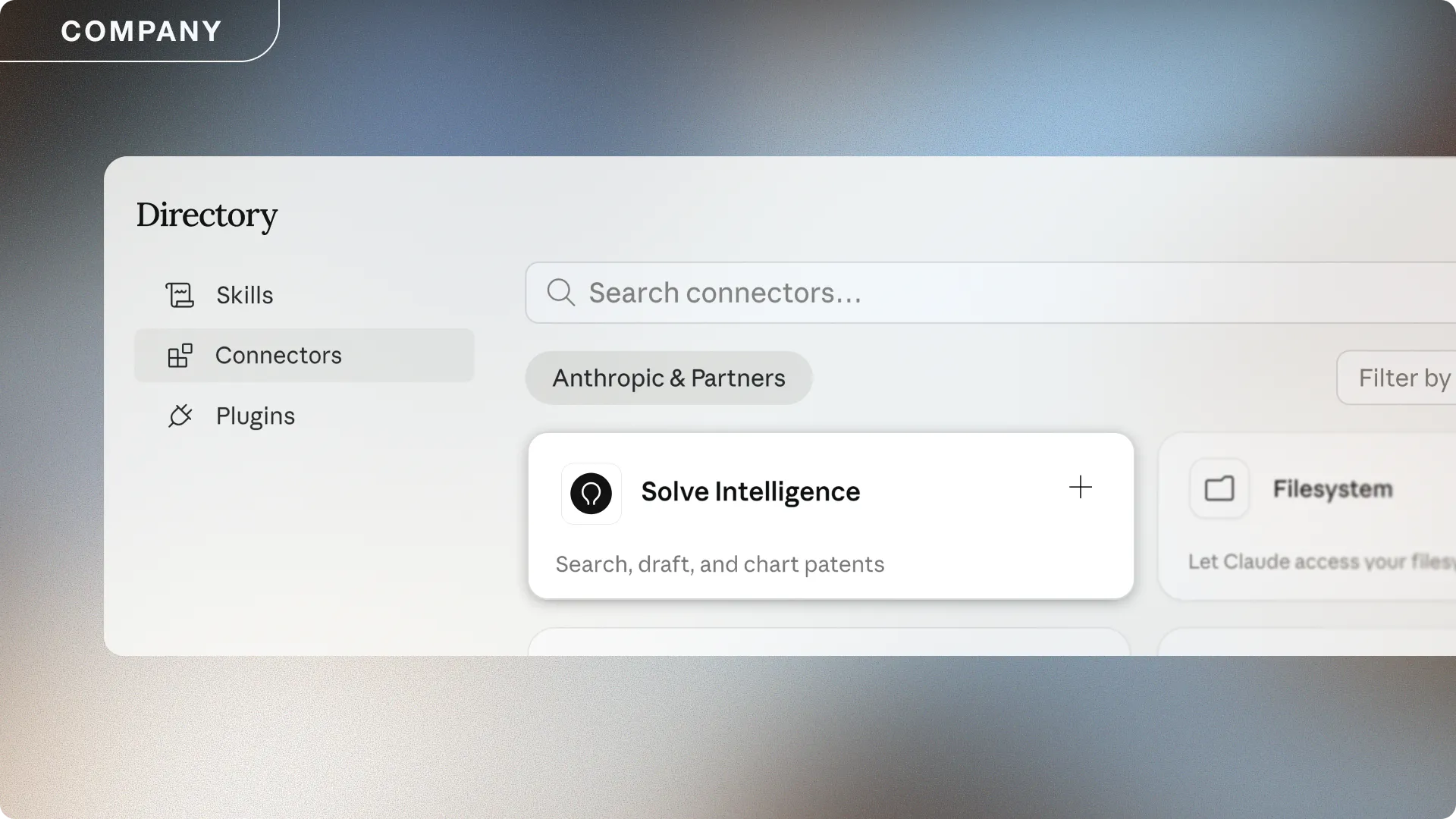
Solve Intelligence MCP server now available in ClaudeLast week, we shared how Solve Intelligence is powered by Claude across our platform, from patent application drafting to office action responses and claim chart generation. We’re now taking the next step: making a selection of Solve Intelligence’s capabilities accessible inside Claude through our new MCP server , available from today. This MCP connection means that users who have both a Solve Intelligence subscription and a Claude subscription can use some basic Solve features directly within Claude, so long as the connection is enabled. Claude gains access to global patent literature across every major jurisdiction; non-patent literature including scientific papers, books, theses, datasets, and journals; patent legal texts and case law across key jurisdictions including the US, Europe, Japan, and Australia; and SEP technical standard documentation. A Solve subscription is still required to use this integration.
Solve Intelligence Awarded Technology Solution of the YearThe leading in-house and outside counsel life sciences patent teams have voted Solve Intelligence as the winner of the Technology Solution of the Year Award at the 2026 Life Sciences Patent Network (LSPN) Spring Meeting in Boston, recognising our impact on the way life sciences and chemistry IP teams draft, prosecute, and analyse patents.
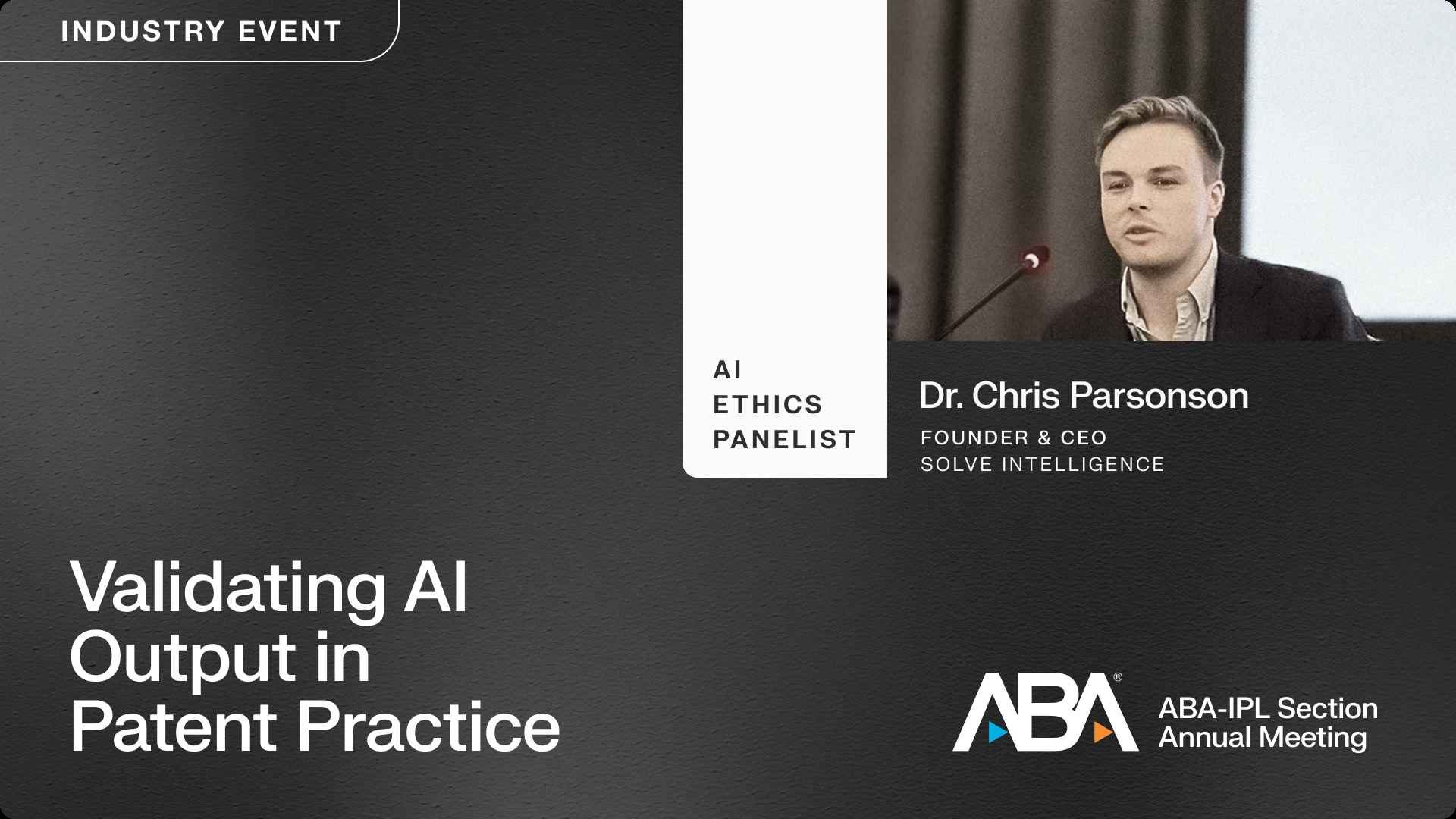
Validating AI Output in Patent Practice: Solve Intelligence at ABA-IPL 2026The American Bar Association’s Intellectual Property Law Section Spring Conference (ABA-IPL) remains one of the premier annual gatherings for IP professionals, bringing together practitioners, in-house counsel, academics, and policymakers to explore the latest developments shaping the field. Solve Intelligence was invited not only to attend, but to share their expertise on the concluding panel as leaders in AI.
Sughrue Mion Integrates Solve Intelligence into Patent PracticeSughrue Mion has always set the standard for what patent prosecution looks like. Founded in 1957, the firm has obtained more U.S. patents than any other law firm in the world. That record is built on deep technical expertise, disciplined prosecution strategy, and a culture that takes the quality of every work product seriously. When Sughrue decided to integrate AI into patent workflows for select clients, their approach reflected that culture. Sughrue thoughtfully structured its implementation, and demonstrated a clear vision of where technology and AI adds value and where attorney judgment remains irreplaceable. Key Insights Sughrue adopted Solve Intelligence's platform for certain clients across Drafting, Prosecution, and Charts following firm-wide testing, culminating in an enterprise partnership. The rollout was driven by Firm leadership prioritising practitioner education and a structured implementation framework from day one. Solve Intelligence is now integrated into numerous preparation and prosecution workflows, helping Sughrue's attorneys work faster, think more expansively, and deliver higher-quality outcomes for a global client base.
Solve Intelligence, Powered by ClaudeAt Solve Intelligence, we believe the future of intellectual property belongs to professionals who can combine deep legal expertise with the most capable AI available. That's why our platform is powered by Claude, and why we're expanding what's possible for patent professionals and inventors worldwide.
The Speed-Quality Trade-Off in UPC Provisional MeasuresPreliminary injunctions, or “provisional measures” in Unified Patent Court (UPC) terminology, have become the most consequential procedural tool in European patent litigation. In under three years, the UPC has issued 63 decisions across 88 cases , with filings accelerating year on year. The analytical rigour courts demand has increased at precisely the moment timelines have compressed. For patent teams on both sides, the procedural reality is stark: court-ready claim analysis that once took months must now be produced in days, at a depth that no longer rewards manual workflows. Tools like Solve Intelligence’s Charts are emerging as a response to that structural pressure, compressing the mechanical phases of claim charting while preserving the practitioner-led judgment that courts expect.
Prompt Engineering Masterclass – German Patent WorkflowsSolve Intelligence is co-hosting a live webinar with Patenza on Thursday, 30 April 2026 at 11:00 AM CEST . The session is a hands-on masterclass on prompt engineering, tailored specifically to the workflows, drafting conventions, and procedural realities of German patent practice. Interested attendees are encouraged to register in advance to secure their spot and to submit questions ahead of the live Q&A. Register here.
Shumaker Leverages Solve Intelligence to Enhance Service for Intellectual Property ClientsShumaker is reinforcing its commitment to innovation and client service with Solve Intelligence. By integrating Solve Intelligence, Shumaker is strengthening its ability to help clients move from invention to protection faster while maintaining the precision required for successful patent prosecution. Solve Intelligence allows Shumaker’s IP lawyers to focus more on crafting strong claims, identifying potential risks, and aligning patent strategy with each client’s broader business objectives. As innovation accelerates across industries, companies are under increasing pressure to protect their IP quickly and effectively. Patrick Horne, Partner and Intellectual Property National Service Line Leader at Shumaker, describes the value of Solve Intelligence. “Solve Intelligence provides our team with powerful tools that enhance the patent drafting process. This technology allows us to focus even more of our time on strategy, claim development, and protecting our clients’ innovations, while improving efficiency in the preparation of high-caliber patent applications.”
Drafting for the UPC: What Early Equivalents Decisions Tell Us About Claim ScopeThe Unified Patent Court (UPC) has been open since June 2023, but how far claim scope extends beyond literal wording is only now taking shape. The UPC Agreement says nothing about equivalents; Article 2 of the Protocol on Article 69 EPC provides the only legal hook, and what it means in practice is being written case by case, across local divisions with no binding Court of Appeal ruling to anchor them. For practitioners drafting claims today, this is not abstract: it shapes claim structure, functional language choices, and whether your description helps or hurts at enforcement. Solve Intelligence helps practitioners navigate this uncertainty before cases reach court.
How Solve Intelligence Handles Invention Disclosures and Unstructured DataIf you've been drafting patents for any length of time, you know the real bottleneck is often not the drafting itself. It's the messy inputs that precede it: partial forms, internal review decks, or email threads where the inventive aspects are buried. Getting from that to a coherent starting point for a draft consumes time most practices simply can't afford. AI can perform much of that translation work: extracting what matters, flagging what's missing, and generating the necessary follow-up questions based on holes and shortcomings. But it must operate inside proper confidentiality controls, and its output requires attorney review before going near a draft. This guide covers how that works in practice in Solve Intelligence's platform . Key takeaways The disclosure bottleneck is upstream; AI structures messy inputs before the drafting phase begins. AI extracts features, normalises terminology, surfaces gaps, and generates inventor questions, but attorney review is mandatory. The danger is plausible but fabricated detail, not obvious errors. Watch for AI-generated parameters or 'helpful' specifics. Disclosures contain trade secrets and unpublished IP. Use only tools with verified zero-training, zero-retention policies and enterprise-grade security. A sensible pilot, without client approval, uses anonymised or historical disclosures to define 'good' output and track key metrics over limited timeframe.
How Nielsen Is Scaling Patent Operations with AINielsen, a global leader in media audience measurement operating in over 50 countries, manages an industry-leading patent portfolio protecting innovations across a variety of fields, including data science, media measurement technology, and viewer analytics. Operating at the intersection of data science and an ever-changing media landscape requires constant innovation to keep pace. Supporting this innovation velocity requires IP operations that can scale without compromising quality. Nielsen's in-house team adopted Solve Intelligence as their AI patent platform following a comprehensive evaluation process in Q4 2025. The partnership between Nielsen and Solve Intelligence reflects a shared commitment to precision and enabling practitioners to do their best work more efficiently.
Solve Intelligence Acquires Palito.ai to Unify AI Patent Litigation and Prosecution in One PlatformSolve Intelligence has acquired Palito.ai, a Munich-based startup specialising in AI-powered patent litigation and prior art analysis. The acquisition deepens Solve’s investment in patent litigation, adding Palito's strengths in validity analysis, case law research, and European patent workflows to Solve’s existing Charts product. The result is a single platform where IP professionals can handle invalidity claim charts, SEP claim charts, freedom-to-operate and clearance analyses, infringement mappings, claim construction analyses, portfolio analyses, and more. Solve Intelligence is an AI platform for IP professionals, covering patent drafting, prosecution, and litigation. Palito.ai is a Munich-based startup specialising in AI-powered validity analysis and European patent litigation workflows. At a glance: Solve Intelligence acquires Munich-based Palito.ai Adds validity analysis, prior art research, EPO/UPC/German court workflows New Munich office established Existing Charts users get expanded litigation capabilities
The Shift Has Already Happened: How Legal's Relationship with AI ChangedTwo years ago, the dominant argument in the legal industry was whether AI had any place in the profession at all. That debate is over. Analysts are now calling 2026 the year AI moves from an “interesting tool” to “operational infrastructure” . The speed at which that narrative has changed tells you everything about where the industry is heading. Key takeaways The legal profession's central question has moved from "can we trust this?" to "how do we integrate this properly?" AI adoption across IP practice has risen from 57% in 2023 to 85% in 2025. Firms are not just trialling AI tools, they are expanding its use across full workflows. Practitioners using Solve Intelligence grew ~560% in 2025 alone. Clearer regulatory guidance has removed one of the most significant psychological barriers to adoption. The profile of firms now adopting AI has changed: these are not early experimenters, but some of the most demanding legal professionals in the world.
Solve Intelligence Ranked #1 IP Platform by the World's Leading Law FirmsSolve Intelligence has been ranked the number one intellectual property platform in the latest Legal AI survey published by SKILLS (the Strategic Knowledge & Innovation Legal Leaders Summit). The study surveyed 130 leaders at the world's top law firms about their legal AI product usage across every major practice area, scoring platforms based on live deployments, active pilots, and tools under consideration. In the Patents/IP category, Solve Intelligence placed first with a weighted score of 67, making it the most widely-used platform in the category. See the full report here .
The Hidden Cost of Ignoring AI in Patent PracticeAs patent practitioners, the choice to “do nothing” about AI is not a neutral act. Law firms or in-house counsel that delay the adoption of AI may believe they are minimizing risk, but oftentimes they are taking on a different set of less visible, long-term risks. These hidden costs can accumulate quickly, from compounding inefficiencies in traditional patent drafting workflows to missed revenue opportunities that remain untapped without leveraging AI-driven capabilities. So, what can patent practitioners do to stay ahead of the game? Here is what the Solve Intelligence team has seen speaking with thousands of practitioners. Key takeaways Waiting to adopt AI is itself a strategic decision with compounding costs. Manual patent workflows create time, quality, and knowledge bottlenecks that grow over time. Firms already experimenting with AI gain operational insight that late adopters cannot shortcut. Low-risk entry points let practitioners build confidence without compromising legal judgment.
Why Patent Attorneys Need Purpose-Built AILegal AI platforms are valuable productivity tools, powered by large language models and enriched with legal data sources, firm-specific knowledge, and purpose-built workflows, they perform well on tasks like legal research, document summarisation, and contract or email drafting. But their workflows are optimised for breadth across practice areas, not for the structural, technical, and jurisdictional depth that patent work requires. For IP teams that already have access to a generalist platform, or are trying one out, the natural follow-up question is whether a vertical solution adds enough to justify the investment. At Solve Intelligence, we build AI specifically for patent practitioners. In our experience scaling the platform to over 700+ IP teams , there is no question that patent-specific tooling delivers ROI that generalist platforms alone cannot. This article sets out why. Key takeaways Generalist legal AI tools weren't trained for the structural depth patent work demands. Solve Intelligence is shaped by in-house patent attorneys who joined Solve from firms like Carpmaels & Ransford and Fish & Richardson. Custom templating lets attorneys match output to house style, client/technology area, or jurisdiction. Generalist and patent-specific AI are complementary investments, not competing ones.
Marbury Law sees 3x-4x efficiency gain from using Solve IntelligenceWhen we sat down with Bob Hansen for this conversation, we knew it would be grounded in both legal depth and real-world business experience. Bob is a founding partner of The Marbury Law Group and has extensive experience across patent prosecution, litigation, licensing, portfolio strategy, and complex IP transactions. But what makes his perspective particularly compelling is that he also brings 20 years of real-world experience as an engineer, program manager, and business executive in Fortune 50 companies and start-ups. He understands firsthand how innovation moves from idea to product, and how intellectual property law fits into that journey. That dual lens is exactly why we wanted to have this discussion. Bob evaluates technology not just as a patent attorney, but as someone who has managed engineering teams, navigated acquisitions and divestitures, raised capital, and built businesses. When someone with that background says AI has been transformative and backs it up with measurable 3 to 4x efficiency gains, it’s worth listening. Key Insights AI adoption requires proof. Bob and his team tested multiple tools before committing, and only moved forward once they saw quantifiable results. 3 to 4x efficiency gains changed the business case. By tracking his own drafting time, Bob demonstrated that AI-enabled workflows made fixed-fee work viable at partner rates. Demonstration drives adoption. Live drafting sessions, client transparency, and side-by-side cost comparisons created full buy-in from both clients and colleagues. Integrated chat removes friction. Keeping research, drafting, and revisions inside one contextual workspace eliminated copy-paste workflows and saved significant time. Context is a force multiplier. AI performs best when it understands the full invention disclosure, file history, and drafting materials in one place. Speed expands strategic value. Faster drafting didn’t just save time - it enabled better coverage, stronger enablement, and real-time responsiveness to client needs. About Marbury Law The Marbury Law Group is a premier mid-size, full-service intellectual property and technology law firm in the Washington, D.C. area, with additional strength in commercial law, litigation, and trademark litigation. Recognized by Juristat as a top 35 law firm nationwide and holding Martindale-Hubbell’s AV® Preeminent™ Peer Review Rating, Marbury serves clients ranging from Fortune 500 companies and mid-size technology businesses to high-tech startups and inventors. Its practitioners bring unusually wide-ranging experience, including former technology executives, government R&D managers, startup founders, in-house counsel, “big-law” attorneys, USPTO patent examiners, and judicial clerks. Marbury delivers “big-law” service with the flexibility and personal attention of a smaller firm, pairing high-quality work with efficient, budget-aware billing. Based near the USPTO, the firm has drafted and prosecuted thousands of U.S. and foreign patent applications and trademarks, and advises on IP strategy, diligence, and licensing. Formed in 2009 through the merger of two established practices (with roots dating back to 1994), the firm takes its name from Marbury v. Madison (1803), the landmark Supreme Court case that established judicial review.
Introducing Solve Review: A Practical Guide to AI-Powered Patent ReviewPatent drafting doesn’t end when the first draft is complete. In many ways, the most important work begins at review. Jurisdictional compliance, internal style alignment, claim clarity, sufficiency of disclosure, and formal requirements. Each aspect of drafting applications must be carefully checked before filing. Yet a thorough review is time-intensive, difficult to standardize, and hard to scale across teams and large portfolios, especially when up against a tight deadline. Enter Solve Review With Solve Review, practitioners can run structured, customizable AI-powered reviews in minutes rather than hours, while maintaining transparency, collaboration, and full control over the output. Teams using Solve Review report dramatically, with multi-pass manual reviews that previously took three to four hours completing in a fraction of the time Key benefits AI-powered patent reviews in minutes Each review is fully customizable Save your reviews as templates, run multiple reviews per application Full transparency of working out and results Resolve issues detected by Solve Review with AI
Cookie settingsBy clicking “Accept all”, you agree to the storing of cookies on your device to enhance site navigation, analyze site usage, and assist in our marketing efforts. For further details see ourManage cookie preferencesChoose which cookies we may store on your device. Essentials keep the site working and cannot be turned off.EssentialsNecessary for the site to function. Always on.Always activeAnalyticsMeasures usage and improves your experience.MarketingUsed for targeted advertising.Cookie preferences