Latest from Solve

FEATUREDAugust 24, 2026Thomson Reuters and Solve Intelligence Partner to Deepen AI Adoption Across Leading Patent PracticesSolve Intelligence’s partnership with Thomson Reuters brings together Solve’s patent and IP platform and practitioner-led support with Thomson Reuters’ longstanding experience helping global law firms adopt professional technology.
Solve Intelligence brings patent-specific AI capabilities to Google Cloud's Gemini Enterprise for LegalSolve Intelligence is pleased to announce that it is a launch partner for Google Cloud’s Gemini Enterprise for Legal.
Page White Farrer Adopts Solve Intelligence for AI-Assisted Patent DraftingPage White Farrer Adopts Solve Intelligence and Solve's AI Templates Page White Farrer ("PWF"), a specialist intellectual property firm with a longstanding focus on technology-driven innovation, has selected Solve Intelligence to support patent application drafting following an extensive evaluation of available AI tools. The firm has initially deployed the platform within its technology-focused patent teams, supporting work across sectors such as AI, software, telecommunications, electronics, semiconductors and engineering. The firm's objective was not to automate legal judgement or replace attorney expertise, but to accelerate the preparation of high-quality first drafts of patent applications. By combining AI-assisted drafting with custom templates tailored to the firm's preferred drafting approaches, Solve Intelligence helps attorneys move from an initial claim set to a reviewable first draft more efficiently while maintaining consistency and technical accuracy. For this partnership, PWF's primary focus was on configuring the platform around the firm's own drafting conventions, client preferences and established best practices, ensuring that the technology supports the way its attorneys already work.
Maiwald Chooses Solve Intelligence for Selected AI-Supported IP WorkflowsSolve Intelligence is proud to share that Maiwald, one of Germany’s largest and most progressive intellectual property firms, works with Solve Intelligence on selected AI-supported workflows in its patent and legal practice groups. Following an evaluation period during which selected functionalities were assessed for approved internal use cases, Maiwald and Solve have formed an enterprise partnership for 2026. The rollout reflects the same careful approach Maiwald brings to its client work. Solve enables customers in Europe to process data on servers located within Europe and holds recognized information-security certifications. In addition, Solve offers contractual commitments designed to protect confidential professional information in line with applicable statutory confidentiality obligations and professional conduct requirements. Against that background, any use of AI-supported tools took place only within approved governance structures and under applicable professional, contractual, confidentiality and data-protection requirements. That balance of innovation and professional judgment is characteristic of Maiwald. The firm has spent decades setting a standard for IP work in Europe: rigorous prosecution, a formidable contentious practice, and interdisciplinary teams of patent attorneys and attorneys-at-law working side by side. The firm approached AI the same way, methodically, with a clear sense of where it adds leverage and where an experienced attorney’s judgment remains irreplaceable.
PTAB Case Studies of AI Disclosure Requirements: Part IIThis article is the second of a series of Patent Trial & Appeal Board (PTAB) case studies (see Part I ), which aims to inform applicants’ approach to satisfying the written description and enablement requirements for patenting artificial intelligence (AI) and machine learning technologies.
How Successful Patent Practitioners Are Putting AI to WorkThe most effective patent practitioners are already using AI patent drafting to draft faster, catch claim inconsistencies earlier, and free up hours for the strategic work that actually wins allowances. Key takeaways AI patent drafting tools can reduce application drafting time by up to 80 percent, with Solve Intelligence customers consistently reporting 50 percent or greater efficiency gains across drafting and prosecution Roughly 9 out of 10 utility patent applications receive at least one office action rejection, so prosecution efficiency matters as much as drafting speed Solo attorneys use AI to match larger law firms on turnaround speed and client capacity The strongest reported results come from iterative AI–attorney collaboration, with practitioners directing the process and owning the final work product
Adopting AI in Patent Work: A Practical Playbook for IP TeamsSolve Intelligence works with over 700+ patent teams as they bring AI into daily practice, and the same pattern shows up again and again: recognising that AI helps is easy, but building consistent, team-wide use is not. Adoption tends to stall for a handful of reasons, from informal early experiments to unclear decision making, and a promising trial can fade out without anyone establishing whether the tool or the rollout was at fault. This playbook lays out the process that gets a team from first experiment to settled habit, with the attorney's judgment in control at every step.
Potter Clarkson Enhances Patent Practice with Solve IntelligenceSolve Intelligence is deployed at Potter Clarkson as a practitioner-led platform, designed to enhance - not replace - the expertise of experienced patent attorneys. The firm uses the technology primarily at a senior level, where skilled practitioners are able to prompt and interrogate the system effectively to guide high-quality outputs. By combining advanced AI capability with deep technical and legal experience, the platform enables senior attorneys to work more efficiently while focusing their time and judgement on strategic advice, complex analysis and client value. This reflects the firm’s long-standing philosophy that technology should strengthen the role of the practitioner, not substitute professional expertise. “At Potter Clarkson, our priority is delivering technically rigorous and strategically sound advice to our clients. We use Solve Intelligence as a tool in the hands of experienced patent attorneys - professionals who understand how to guide, challenge and refine AI-generated outputs. It allows our senior teams to concentrate on the aspects of drafting and prosecution where their judgement adds the greatest value, while maintaining full control over quality and client strategy.” Peter Finnie, Partner, Potter Clarkson Since rolling out Solve Intelligence’s Patent Copilot, the firm has tailored the platform to reflect its established house styles and drafting standards. This customisation reduces administrative burden and supports consistency across teams, enabling practitioners to engage with AI efficiently without compromising on quality, client-specific requirements, or the firm’s distinctive approach.
Peter Finnie to join Solve's Customer Advisory BoardWe are excited to welcome Peter Finnie, Partner at Potter Clarkson, to Solve Intelligence’s Customer Advisory Board.
Reflections from IPWatchdog: Masterclass on AI Prompt Engineering for Patent WorkflowsOn February 5, 2026, Solve Intelligence hosted a masterclass with IPWatchdog on AI prompt engineering for patent workflows. Nearly 750 practitioners registered from across the world. The level of experience in the room was striking: 75% of attendees had more than 11 years of patent experience, and over 40% had more than 20 years. A clear indication that decision-makers are staying on top of the latest trends and educational content on AI. Key insights Senior patent decision-makers are actively learning AI with 750 registrants and deep experience AI is broadly permitted with most respondents reporting approval or active policy evaluation Prompt engineering drives ROI with templates and structured instructions improving output quality Watch the recording and download the slides The recording covers the full prompt engineering framework for patent workflows, a live demonstration of prompting in action within Solve Intelligence across drafting, prosecution, and claim charting workflows, and a Q&A with the panel. Download the slides here .
Client confidentiality in the age of AI: best practices for patent professionalsAI can improve the quality and efficiency of patent work - but it can also create new confidentiality and privilege risks if you don’t control what data is shared, where it’s stored, and who can access it. The good news: you can turn “AI risk” into a repeatable review process that your leadership, IT/security, and risk teams can sign off on with confidence. This guide gives you a practical framework and a due diligence checklist, that you can use to evaluate AI tools for patent workflows without compromising client confidentiality. Key takeaways In patent work, confidentiality failures can jeopardise patent rights—treat inputs as high-risk. Risk is more than training: retention, access, logs, human review, and subprocessors matter. Use data tiers: Tier 0–1 OK; Tier 3 ‘default no’ unless explicitly approved and controlled. Make it auditable: approved use cases, human review, matter separation, and vendor diligence. For further information, read the full guidance below.
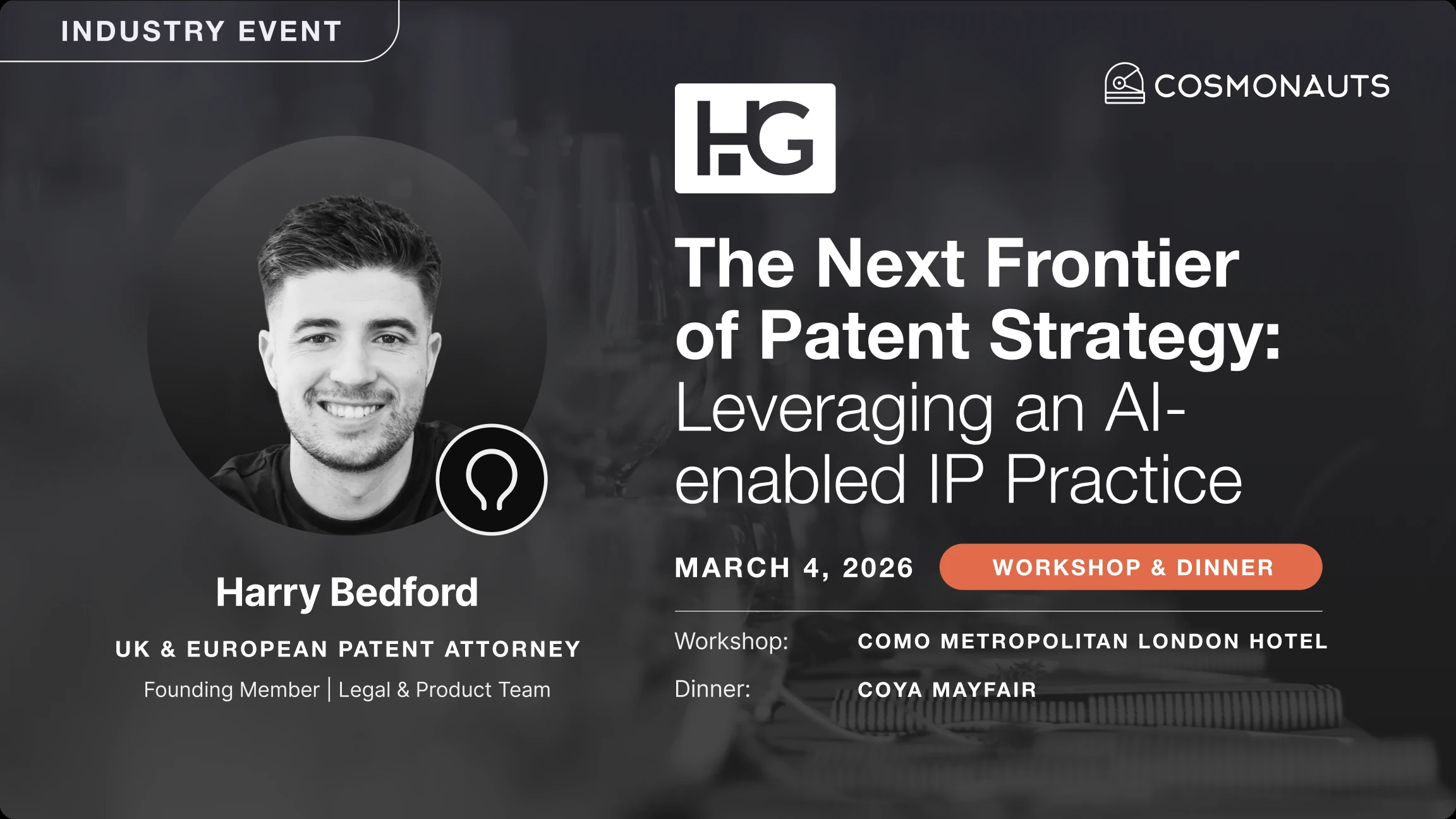
Level Up Your IP Strategy - Senior IP & Patent Leaders, see AI in action.Solve Intelligence will be presenting a live product demo at the upcoming private workshop hosted by HG Law and organised by Cosmonauts . 📅 Wednesday, 4 March 2026: Workshop: 2:30 PM - 6:00 PM | COMO Metropolitan London Hotel, London, UK Dinner: 6:00 PM - 9:00 PM | COYA Mayfair, London, UK This session is designed for Heads of IP, Patent Directors, and innovation leaders who want to level up their IP strategy by seeing AI applied in patent drafting, preparation, and prosecution . Register Here .
How to Talk to Clients About Using AI in Patent DraftingArtificial intelligence is no longer a theoretical issue in patent drafting, and many firms are already using AI-assisted workflows in some form. The harder question now isn’t whether to use AI, but how to talk to clients about using it. Key insights Focus on better drafting quality, enforceability, and fewer avoidable downstream problems. Walk through data handling so confidentiality and retention protections are easy to trust. Explain inventorship stays human and the attorney remains responsible for every word. Keep the process clear and documented so expectations stay aligned from day one. For some clients, AI usage signals efficiency and modernisation. For others, it raises immediate concerns about confidentiality, inventorship, and quality control. Those concerns are legitimate, so the key is to approach conversations about AI in a way that is structured, transparent, and grounded in professional responsibility. In practice, the most effective discussions with clients will focus on outcomes rather than technology. This article provides a structured framework to use when talking to clients about using AI, such as Solve Intelligence’s Patent Drafting Copilot TM , in patent drafting.
How to use AI in patent practice: USPTO guidance and compliance tipsAs Artificial Intelligence (AI) and large language models (LLMs) increasingly integrate into legal practices, the U.S. Patent and Trademark Office (USPTO) issued guidance to assist patent attorneys with adopting AI tools in patent drafting, prosecution, and other areas of patent law. In this article, we summarize the key compliance requirements from the USPTO's guidance and explain how Patent Copilot™ helps practitioners meet these obligations while leveraging AI's benefits.
UK Supreme Court aligns UK software patentability with EPO approachThe UK Supreme Court’s Emotional Perception decision moves UK practice closer to the EPO for computer implemented inventions, including AI. Claims with ordinary hardware will usually avoid the “computer program as such” exclusion, but only technical features can support inventive step. In practice, applicants should focus arguments and evidence on technical contribution and inventive step. Key takeaways UK moves closer to EPO, inventive step becomes the main battleground. Ordinary hardware avoids exclusion, but may not support inventiveness. Only technical features count at inventive step, not business aims. Neural networks are treated as software, no special treatment either way. Draft around technical contribution, measurable effects, and system level impact.
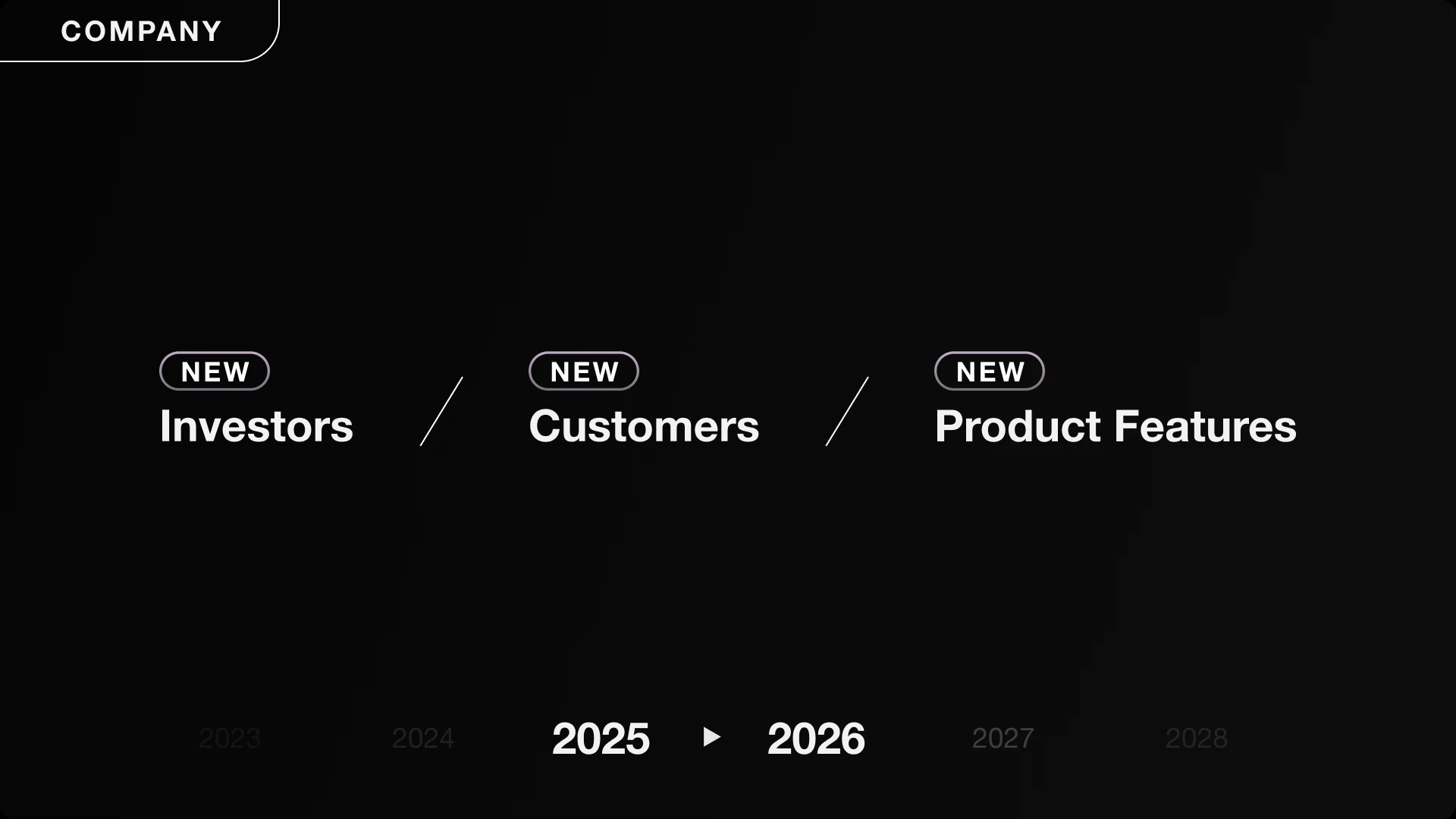
Kicking Off 2026: New Investors, New Customers, New Product FeaturesA lot has happened in the last two months. We wanted to take a moment to share what we've been building, who's joined us, and where we're headed next. Since we started Solve, the goal has been simple: help IP teams do their best work by combining real-world patent expertise with deep AI research, intuitive UX, and state-of-the-art security. The momentum we're seeing across the business tells us the market agrees as 400+ IP teams across 6 continents now use Solve . Here's what's new.
Reflections from AUTM: What Tech Transfer Offices Really Need in 2026Last week, my colleagues and I attended the annual meeting of AUTM, the global association for technology transfer professionals. For anyone building in the intellectual property (IP) space, it’s one of the most important rooms you can be in. The three-day conference brings together higher education decision-makers from around the world who are shaping how intellectual property is evaluated, protected, and commercialized. This year’s conversations revealed something important: the question is no longer if AI will influence tech transfer, but instead about how institutions will integrate it.
PTAB Case Studies of AI Disclosure Requirements: Part IArtificial intelligence (AI) is a fast-evolving field with new technical methods, systems, and products constantly being developed. This growth has also been reflected in the dramatic increase in patent filings for AI-related inventions. According to Patents and Artificial Intelligence: A Primer from the Center for Security and Emerging Technology, more than ten times as many AI-related patent applications were published worldwide in 2019 than in 2013, and the increasing trend has only continued since. Although AI-related patent applications have been on the rise, explicit guidance on patentability requirements have only recently begun to be published by patent offices around the world. Indeed, as a burgeoning field of technology, AI inventions have unique features, such as the importance of training data and the lack of explainability and predictability of trained AI models, that differentiate such innovations from traditional types of computer-implemented inventions (CII). These features raise questions about the interpretation of disclosure requirements, among other patentability requirements, for AI-related inventions. For example, how much information, such as source code, training data sets, or machine learning model architectures, should be provided to satisfy the written description and enablement requirements of Title 35 of the U.S. Code § 112(a) or analogs in other patent jurisdictions? As we await further official guidance from the U.S. Patent & Trademark Office (USPTO) on disclosure requirements for AI-related inventions, we can gather initial indications from recent patent prosecution decisions from the Patent Trial & Appeal Board (PTAB) on such issues. In this article, we study a selection of PTAB appeals decisions for applications for AI-related inventions rejected under § 112. To set the background, we first review a classification of AI inventions and USPTO guidelines on disclosure requirements for computer-implemented inventions. After analyzing three case studies, we conclude with general takeaways and best practices, which emphasize that applicants must disclose specific algorithms and implementation details, not just desired outcomes, to satisfy written description requirements.
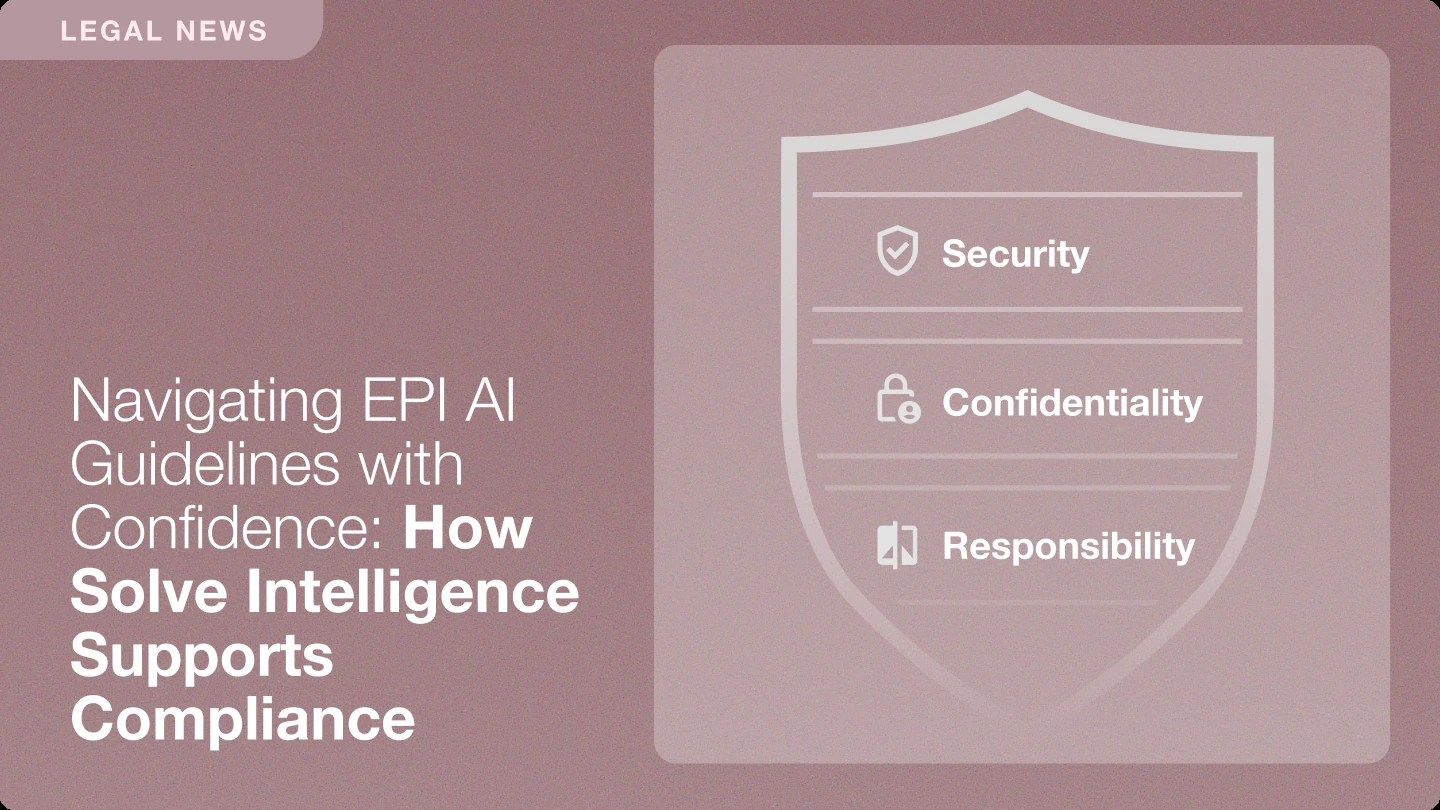
Navigating epi AI Guidelines with Confidence: How Solve Intelligence Supports ComplianceIn 2024, the Institute of Professional Representatives before the European Patent Office (epi) published its Guidelines on the Use of Generative AI in the Work of Patent Attorneys . These Guidelines provide practical guardrails for the responsible use of generative AI in patent practice, reaffirming that professional responsibility, confidentiality, and transparency remain central when AI tools are used. In our earlier blog post , we outlined the key principles set out in the epi Guidelines. Since then, the Guidelines themselves have not changed. However, the use of AI in patent workflows has continued to mature, and so has Solve Intelligence. This update highlights how Solve Intelligence supports compliance with the epi Guidelines in day-to-day practice, focusing on concrete product capabilities and supporting processes.
Patent Attorneys' Guide to Adopting AI: The First 30 DaysArtificial intelligence is already reshaping patent practice, but adopting it swiftly, efficiently and securely is where most firms get stuck. Patent professionals know the productivity upside to using gen AI tools, yet often get derailed when informal experiments run into real-world problems: client confidentiality concerns, inferior work-product quality, delayed internal approvals, and decision-fatigue. This guide lays out a practical, 30-day plan for adopting AI in patent work, moving from ad hoc trials to a controlled, firm-ready strategy. It shows how you can run a focused pilot, set clear guardrails, train attorneys, and document decisions in a way that satisfies partners, clients, and internal stakeholders.
EPO Guidelines 2026: Key Changes Including G 1/24, G 1/23, and AIThe European Patent Office has published a preview of its Guidelines for Examination, effective April 2026. This update incorporates the landmark Enlarged Board decisions G 1/24 (claim interpretation) and G 1/23 (products on the market), alongside a significant change of practice for selection inventions, new rules on colour drawings, and the EPO's first formal guidance on artificial intelligence.
Hauptman Ham Integrates Solve Intelligence into Patent PracticeHauptman Ham is redefining patent prosecution with Solve Intelligence. By integrating AI-driven workflows into their patent practice, Hauptman Ham attorneys and agents are delivering office action responses that set a new standard—precise, insightful, and creatively crafted. Their clients are gaining a strategic edge with more innovative outcomes that stand out in a competitive landscape. Firm leader Ron Embry describes the value of Solve Intelligence in Hauptman Ham’s patent practice. “The Patent Copilot system allows practitioners at Hauptman Ham to use more creative strategies in pursuit of broad, defensible patent claims for our clients. We use the advanced functionality of the Solve Intelligence system to explore multiple potential avenues in responding to rejections and prosecuting families of patent applications. We find the tool to be quite useful in integrating different legal strategies into one unified, comprehensive, and nuanced approach to obtaining patent protection for our clients.”
Drafting for the EPO: How AI Can Make the New EPO–IP Australia PCT Pilot a SuccessThe EPO and IP Australia are launching a new PCT pilot programme on 1 March 2026 which will allow Australian applicants to designate the EPO as their International Searching and Preliminary Examining Authorities (ISA and IPEA). Given the EPO’s rigorous approach to clarity and support requirements, for this pilot programme to succeed, Australian applicants and patent practitioners will have to adapt to draft international applications with EPO-specific requirements in mind. The launch of this pilot programme will add a new layer of complexity — (and opportunity) for patent practitioners. In a landscape where jurisdictional nuance can shape international search and examination outcomes, AI‑augmented tools such as Solve Intelligence's Patent Copilot TM are becoming increasingly valuable.
Joshua Davenport to join Solve’s Customer Advisory BoardWe are excited to welcome Joshua Davenport, Shareholder at Banner Witcoff, to Solve Intelligence’s Customer Advisory Board.
AI Assistance vs. Inventorship: Ethical Guidelines for Patent AttorneysAI is now a daily tool for many patent attorneys; from drafting assistance to prior art searches. But questions about inventorship and ethics persist. Courts and patent offices worldwide continue to grapple with whether AI can be considered an inventor, and the recent November 2025 USPTO guidance has brought fresh clarity to this evolving area. This article explores where the line is drawn between AI as a tool and AI as an inventor, and how attorneys can use AI responsibly while meeting their professional obligations.
Webinar: Masterclass – AI Prompt Engineering for Patent WorkflowsAs AI adoption in patent practice continues to accelerate, a critically important question emerges—How do you get AI to deliver the work product you need and the quality you want? Please join Solve Intelligence and IPWatchdog on Thursday, February 5, at 12 PM ET for a detailed examination of the practical application of AI prompting for patent practice. This webinar is designed for patent attorneys and in-house counsel who want to move beyond experimentation and understand how prompt engineering can be used as a repeatable skill, enabling more efficient, higher-quality patent work across AI-enabled workflows. Register here .
Khurana & Khurana Adopts Solve Intelligence to Scale Patent PracticeWe are delighted to announce that Khurana & Khurana (K&K) is deploying Solve Intelligence across their extensive global practice. Professionals at K&K leverage Solve Intelligence to analyze prior art, formulate response strategies, and draft patent applications more efficiently. The platform is designed to keep legal professionals firmly in control throughout the entire process, allowing them to use AI as an extension of their legal expertise.
How to Generate SEP Claim Charts: An Essentiality Analysis GuideSEP claim charting can be a bottleneck in patent licensing and portfolio management: too time-consuming and expensive to perform rigorously at scale, yet too important to skip. Solve Intelligence is changing this equation, allowing practitioners to generate high-quality claim charts in minutes rather than hours, while surfacing insights that might otherwise be missed.
How to Run a Due Diligence Checklist on AI tools for Patent Practice for Law FirmsThis article provides a practical, structured due diligence checklist your firm can use to help move from abstract concerns about AI risk to a clear, repeatable evaluation, which reduces risk, aligns stakeholders, and speeds up internal approval.
Laura Brutman to join Solve’s Customer Advisory BoardWe are excited to welcome Laura C.Brutman, Shareholder at Banner Witcoff, to Solve Intelligence’s CustomerAdvisory Board.
Engineering Excellence: How Haynes Boone is Evaluating Enhancements to Patent Practice with Solve IntelligenceWe are proud to announce that HaynesBoone is working closely with Solve Intelligence following a rigorous evaluation process.
Customers report 50%+ efficiency and quality improvements.
Cookie settingsBy clicking “Accept all”, you agree to the storing of cookies on your device to enhance site navigation, analyze site usage, and assist in our marketing efforts. For further details see ourManage cookie preferencesChoose which cookies we may store on your device. Essentials keep the site working and cannot be turned off.EssentialsNecessary for the site to function. Always on.Always activeAnalyticsMeasures usage and improves your experience.MarketingUsed for targeted advertising.Cookie preferences