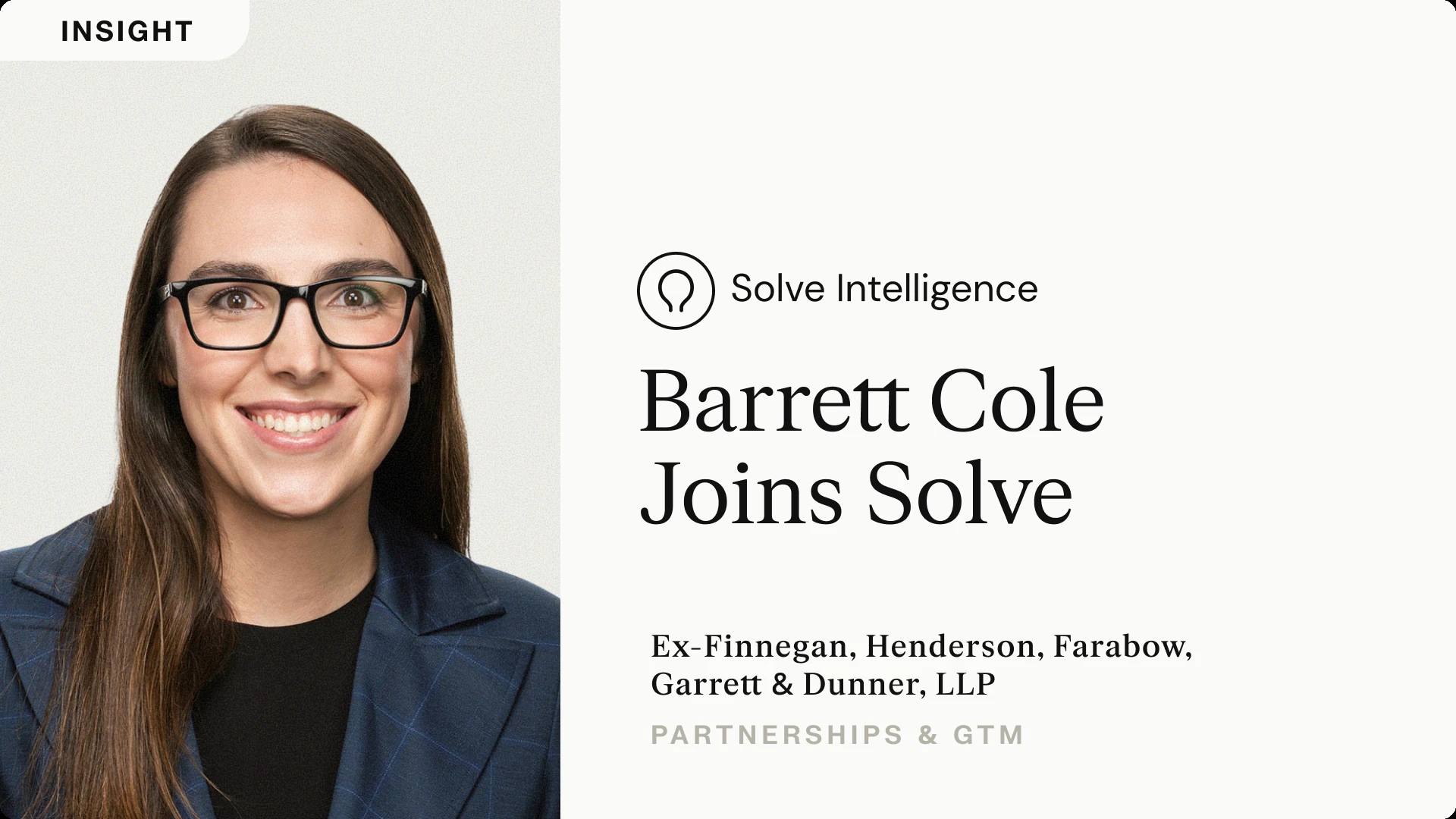
Barrett Cole Joins Solve

We're excited to announce that Barrett Cole is joining Solve Intelligence!

Barrett Cole Joins Solve

Barrett Cole has joined Solve Intelligence's Partnerships and Go-To-Market team, bringing a strong background in intellectual property, international law, and emerging technologies.

Barrett earned a J.D. from the University of Notre Dame Law School, where she served as Editor-in-Chief of the Journal of International and Comparative Law. She also holds a master’s degree in Advanced Data Analytics, combining legal expertise with technical fluency.

Her experience at Finnegan, Henderson, Farabow, Garrett & Dunner LLP spans patent drafting, freedom-to-operate, and invalidity analyses, with a particular focus on AI, autonomous systems, business methods, and software technologies. Her cross-border IP strategy experience includes portfolio acquisitions, trade marks, and contentious patent disputes.

At Solve Intelligence, Barrett will help drive partnerships and go-to-market initiatives, supporting the company’s growth and expanding its global reach.

AI for patents.

Be 50%+ more productive. Join thousands of legal professionals around the World using Solve’s Patent Copilot™ for drafting, prosecution, invention harvesting, and more.

Related articles

Validating AI Output in Patent Practice: Solve Intelligence at ABA-IPL 2026

The American Bar Association’s Intellectual Property Law Section Spring Conference (ABA-IPL) remains one of the premier annual gatherings for IP professionals, bringing together practitioners, in-house counsel, academics, and policymakers to explore the latest developments shaping the field. 

Solve Intelligence was invited not only to attend, but to share their expertise on the concluding panel as leaders in AI.

Sughrue Mion Integrates Solve Intelligence into Patent Practice

Sughrue Mion has always set the standard for what patent prosecution looks like. Founded in 1957, the firm has obtained more U.S. patents than any other law firm in the world. That record is built on deep technical expertise, disciplined prosecution strategy, and a culture that takes the quality of every work product seriously.

When Sughrue decided to integrate AI into patent workflows for select clients, their approach reflected that culture. Sughrue thoughtfully structured its implementation, and demonstrated a clear vision of where technology and AI adds value and where attorney judgment remains irreplaceable.

Key Insights

  • Sughrue adopted Solve Intelligence's platform for certain clients across Drafting, Prosecution, and Charts following firm-wide testing, culminating in an enterprise partnership.
  • The rollout was driven by Firm leadership prioritising practitioner education and a structured implementation framework from day one.
  • Solve Intelligence is now integrated into numerous preparation and prosecution workflows, helping Sughrue's attorneys work faster, think more expansively, and deliver higher-quality outcomes for a global client base.

Solve Intelligence, Powered by Claude

At Solve Intelligence, we believe the future of intellectual property belongs to professionals who can combine deep legal expertise with the most capable AI available. That's why our platform is powered by Claude, and why we're expanding what's possible for patent professionals and inventors worldwide.

The Speed-Quality Trade-Off in UPC Provisional Measures

Preliminary injunctions, or “provisional measures” in Unified Patent Court (UPC) terminology, have become the most consequential procedural tool in European patent litigation. In under three years, the UPC has issued 63 decisions across 88 cases, with filings accelerating year on year. The analytical rigour courts demand has increased at precisely the moment timelines have compressed.

For patent teams on both sides, the procedural reality is stark: court-ready claim analysis that once took months must now be produced in days, at a depth that no longer rewards manual workflows.

Tools like Solve Intelligence’s Charts are emerging as a response to that structural pressure, compressing the mechanical phases of claim charting while preserving the practitioner-led judgment that courts expect.