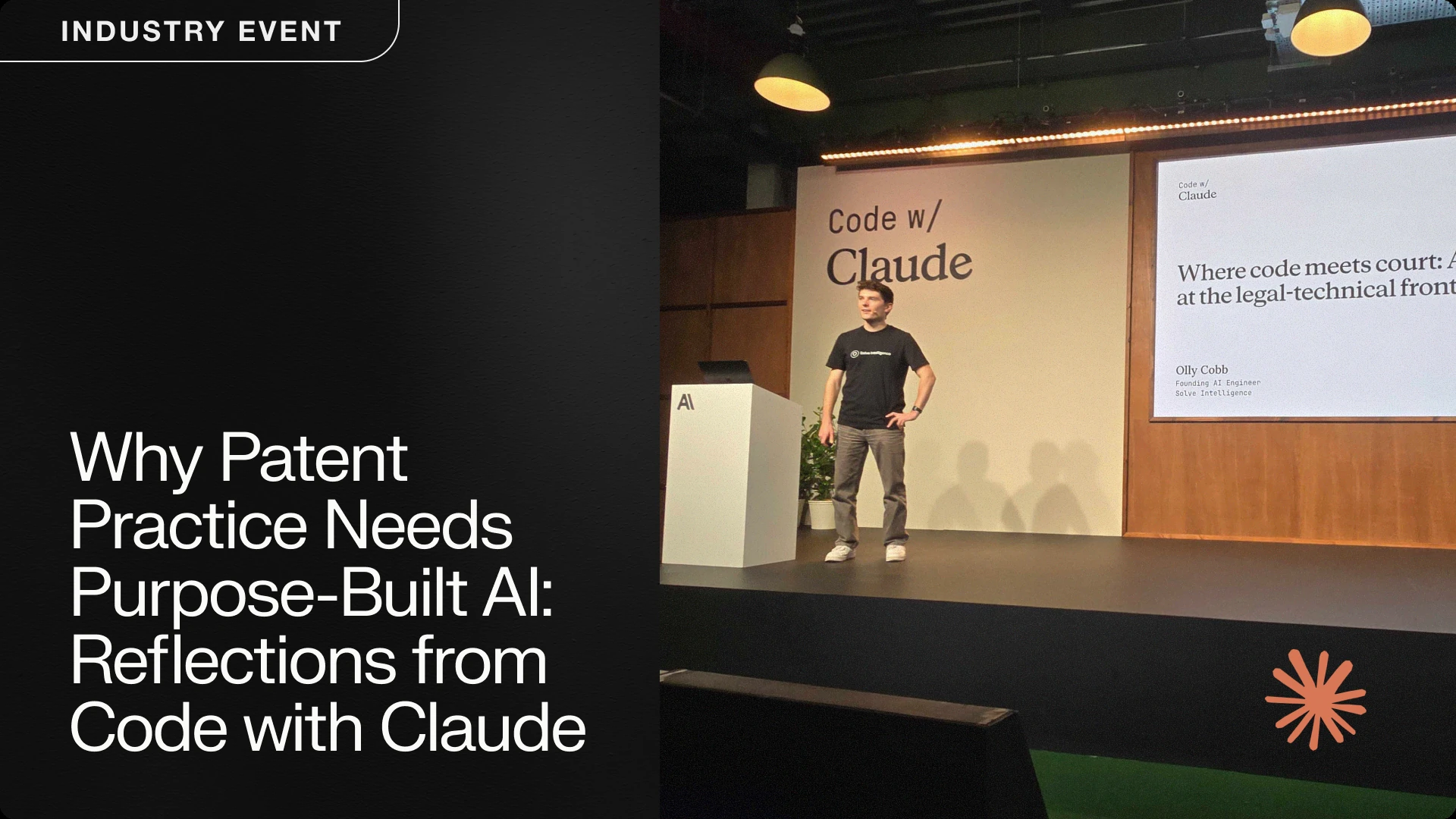
The talk opened on the point that patent work sits at the intersection of two capabilities modern AI handles well: technical reasoning over complex subject matter, and identification of relevant material across large document sets.
Software development tends to draw mainly on the first. Much of legal practice draws mainly on the second. Patent work draws on both at once. Drafting a claim requires reasoning about what is technically novel in an invention while keeping the constraining prior art in view. Responding to an office action requires engaging carefully with the examiner's technical reasoning while working through the cited references to find the strongest counterargument.
In each case depth and breadth have to be brought to bear on the same problem at the same time, and the fact that models have become capable of both is much of what allows AI to be so valuable for patent work
A second theme was that the value of an AI application does not come from the model alone. It comes from how the application is designed around the model: the interfaces, the workflows, the way information is sourced, structured, and cited.
For patent work specifically, this means tooling that respects how attorneys actually work. The way prior art is surfaced when an attorney is reasoning about claim scope is one example. The way citations are handled, so that an attorney can verify each part of an output against the underlying source, is another. So is how non-textual material, figures, chemical structures, biological sequences, is represented to the model and to the user. These are the kinds of details that purpose-built software gets right and general tools do not.
Solve Intelligence has been powered by Claude since the platform's earliest days, and our partnership with Anthropic has continued to expand, most recently through the launch of our MCP server inside Claude. This MCP connection means that users who have both a Solve Intelligence subscription and a Claude subscription can use some basic Solve features directly within Claude, so long as the connection is enabled. Speaking at Code with Claude reflects the depth of that collaboration, and the shared view that the future of applied AI in regulated fields will be defined by the application layer as much as the model.
For practitioners weighing where AI fits in their workflow, the takeaway from Code with Claude is a practical one. The model under the hood is converging across serious applications, which means the differences that matter in daily use are coming from elsewhere, from how the software handles citations, how it surfaces prior art, how it represents figures and structures, and how it keeps the attorney in control of consequential decisions. These are the kinds of details that purpose-built tools get right and that AI features added to general-purpose software tend to miss. The shape of the tool matters as much as the model behind it.
Why was Solve Intelligence invited to speak at Code with Claude?
Solve Intelligence is a long-standing Anthropic partner and one of the more established applied-AI companies building on Claude in the legal space. The invitation reflects both that working relationship and the broader interest in how AI is being deployed in technically demanding professional domains like patent practice.
How does AI keep the attorney in control of patent work?
By keeping the attorney's judgement at the centre of the workflow rather than at the end of it. Patent decisions tend to be entangled: claim scope, claim terminology, the spec, and the figures all depend on one another, and a poor judgement call early on can be expensive to unwind later. The most useful AI tools surface those decisions at the points they need to be made, and handle the mechanical work around them. The aim is to compress the work without removing the judgement that defines good patent practice.
How is Solve Intelligence different from AI features built into existing legal tools?
Solve Intelligence is purpose-built for patent practice, rather than being an AI feature added to software designed for general document editing or legal research. That difference shows up in how the platform handles citations, prior art, figures, chemical structures, and the points at which the attorney is brought in to make decisions.
What is the Solve Intelligence MCP server inside Claude?
The Solve Intelligence MCP server makes a selection of Solve's capabilities available directly within Claude for users who hold both a Solve subscription and a Claude subscription. It gives Claude access to global patent literature, non-patent literature, legal texts and case law across major jurisdictions, and SEP technical standard documentation.