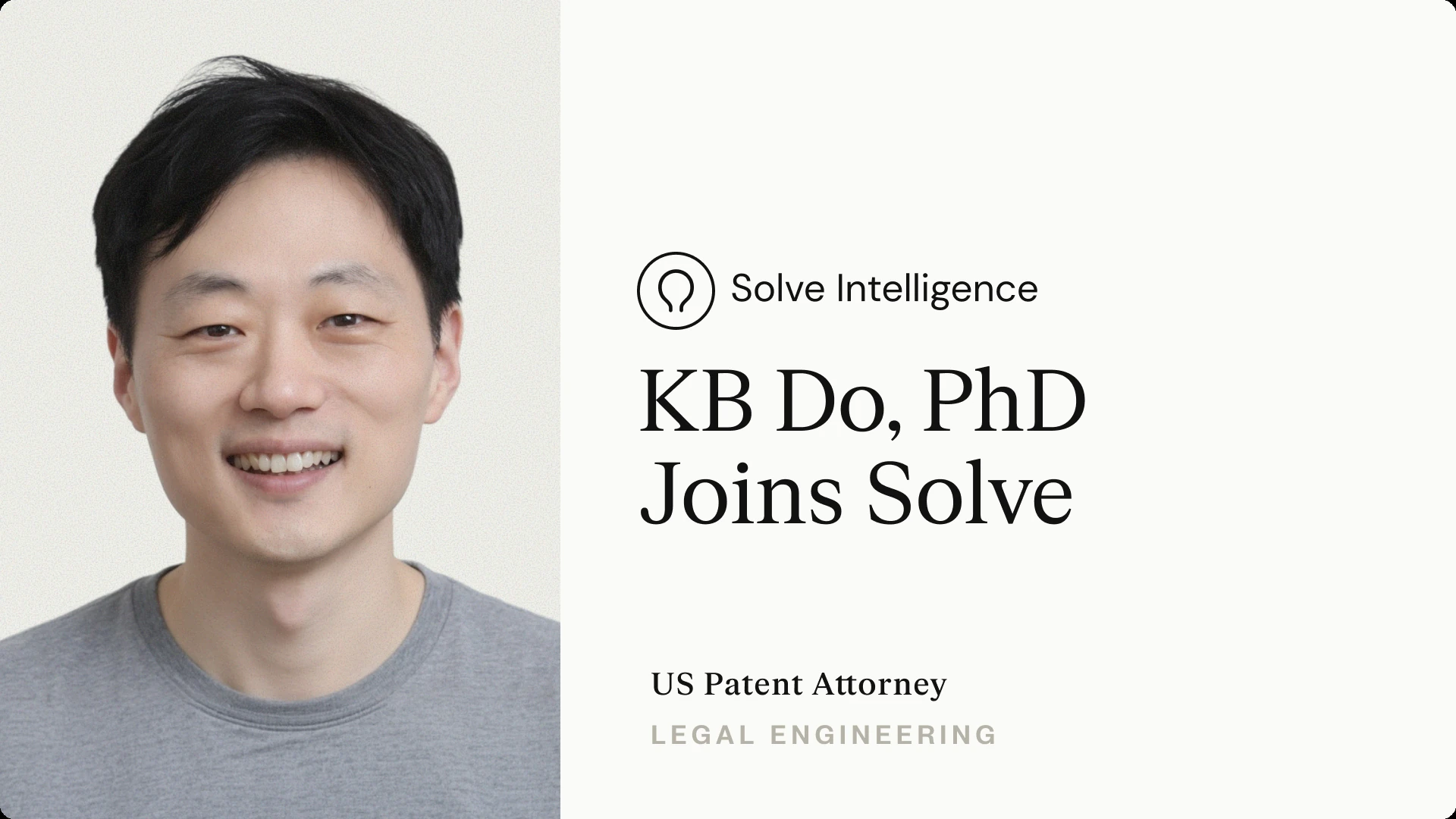
Keunbong (KB) Do Joins Solve

We're delighted to welcome Keunbong (KB) Do to Solve Intelligence as our newest Legal and Product Engineer.

Keunbong (KB) Do Joins Solve

KB joins us from Morrison & Foerster, where he spent over six years as a patent attorney based in Boston. His practice focused on patent prosecution strategy and portfolio management in the U.S. and internationally, alongside IP due diligence work including validity and freedom-to-operate assessments. 

KB earned his J.D. from Harvard Law School, where he received the Irving Oberman Memorial Prize. Before law school, he completed his Ph.D. in biophysical chemistry at Stanford University as a John Stauffer Stanford Graduate Fellow and a Korea Foundation for Advanced Studies Fellow, and worked at Samsung SDI as a Senior Research Engineer. He holds a B.S. summa cum laude in chemistry from Seoul National University. KB is registered to practice before the U.S. Patent and Trademark Office, and is admitted to practice in California, New York, and Massachusetts. He is a native Korean speaker, adding to Solve's international reach.

At Solve, KB will help us continue building the most capable AI tool for every stage of the patent process.

Please join us in welcoming KB to the team!

AI for patents.

Be 50%+ more productive. Join thousands of legal professionals around the World using Solve’s Patent Copilot™ for drafting, prosecution, invention harvesting, and more.

Related articles

Dan Rudoy to join Solve’s Customer Advisory Board

We are excited to welcome Dan Rudoy, Shareholder at Wolf Greenfield, to Solve Intelligence’s Customer Advisory Board.

EPO G 1/26: How the Coated Steel Strips Case Tests Article 123(2)

At Solve Intelligence, we build AI tools purpose-built for patent prosecution and opposition workflows. European teams, including cross-Atlantic firms like HG, use Solve Intelligence to stay ahead of EPO doctrine shifts as they happen. In this article, we cover the three referred questions in G 1/26, the practical implications for prosecution and opposition teams, and what to do before the decision lands.

Key takeaways

  • G 1/26 asks whether G 1/24's rule to consult the description extends from patentability assessment to Article 123(2) added matter.
  • The underlying case (T 873/24) turns on whether "ratio of titanium to nitrogen in excess of 3.42" means a weight ratio or a molar ratio.
  • The referral poses three sets of questions: admissibility under Article 112(1), the reach of the description in claim interpretation, and the consequences for Article 123(2).
  • If the Enlarged Board extends G 1/24 to Article 123(2), description-based narrowing applies to added-matter assessment across all European proceedings.

Built for IP: How Banner Witcoff Is Raising the Bar on Patent Work with Solve Intelligence

"We viewed our choice of AI platform as significant to the future of our patent practice. After extensively evaluating many products, we concluded that Solve Intelligence best met the needs of our attorneys and our clients." Laura Brutman, Shareholder, Banner Witcoff

Patents and Standards 2026: When SEP portfolios outgrow human review

The 8th UCL Patents and Standards conference brought together all the key standard essential patent (SEP) players on both the holder and implementer sides. 

By the end of day two, one technical question kept resurfacing across panels that were nominally discussing other topics. How does anyone actually assess essentiality and validity at the scale modern declared portfolios now reach? At Solve Intelligence, this is the question we have built our platform to answer.

Key takeaways

  • At today's portfolio scales, AI is a precondition for SEP essentiality and validity assessment, not an enhancement of human review.
  • Streaming standards are fully in SEP territory, bringing implementers with no licensing history into the same mapping problems as in cellular standards.
  • SEP disputes default to parallel multi-jurisdiction proceedings, requiring position alignment across every forum before the first filing.