The thread running under almost every panel was the same. Declared SEP portfolios are measured in tens of thousands of patents per major contributor. The analytical work, including essentiality reads, validity assessments, and mapping to specific sections of a standard, ideally would be done at that same scale. Currently it isn’t really done in the scope required to make assessments on an entire portfolio.
From the implementers' point of view, an SEP owner’s declaration is not the same as an independent assessment. However, you cannot manually assess a 10,000-patent portfolio one chart at a time.
Conversely, for SEP owners, sifting through their entire portfolio to identify all patents with strong essentiality reads is equally impractical, and many valuable patents are left unidentified and underutilised. That leaves the underlying R&D spend unrewarded, not because the technology is weak, but because it was not possible to get the analysis done.
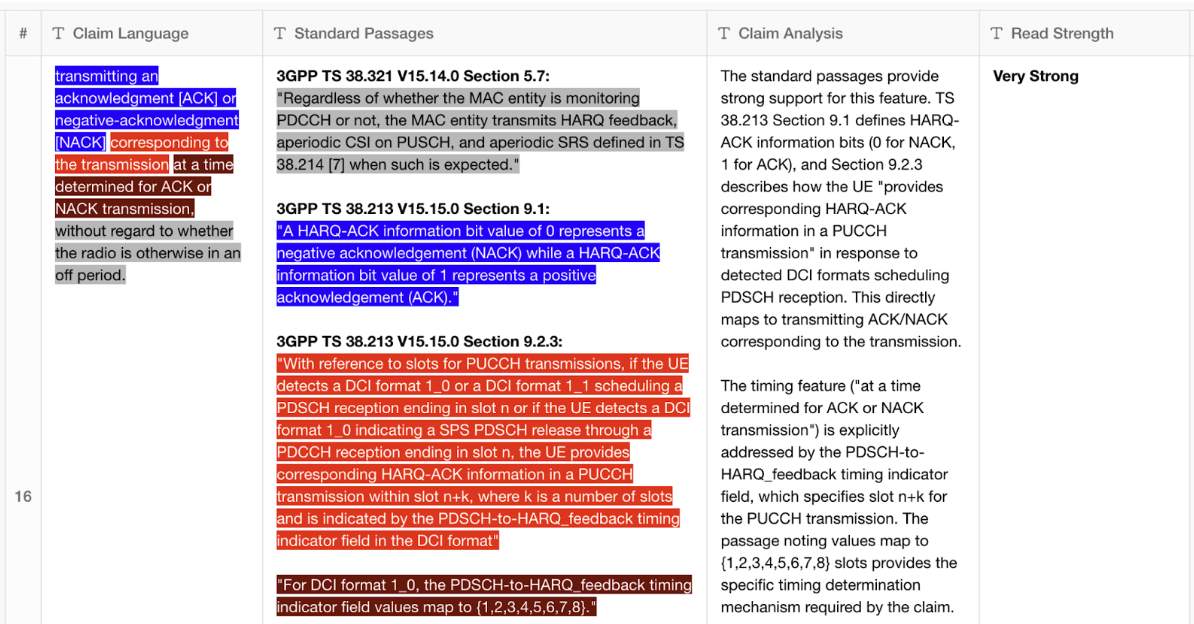
This is the gap AI is filling, and it is where we have built Solve Intelligence. The Solve Intelligence Charts product handles patent-to-standard mapping as a first-class workflow. Upload or pull a patent portfolio, map each patent against Solve Intelligence’s integrated standards corpus, and get read strength assessments across the whole set on a timeline that matches how licensing and litigation actually move. Validity is the other half of the same scale problem.
Every SEP that survives an essentiality read still has to hold up under prior art. Solve Intelligence’s Charts product can also run agentic prior art searches and invalidity assessments across the portfolio with the same rigour. Together this lets a team move from “we have a declared portfolio” to “we have an assessed portfolio” without burning a year of outside counsel time. In this way, Solve Intelligence helps provide both SEP holders and implementers with a more complete view of the to-be-licensed portfolio, streamlining rate negotiations.
See how to generate SEP claim charts with Solve Intelligence.
The panel on streaming standards put a problem on the table that doesn't have a tidy precedent in cellular SEP licensing. Video codecs and the surrounding streaming standards bring in implementers (e.g., content platforms) who have never sat at a SEP licensing table, and SEP holders negotiating against a counterparty population they have not faced at scale before.
Warner Bros made the point that content companies are deeply IP-focused businesses, but they traditionally operated in copyright rather than patents. That doesn't change the analytical substance. Both sides, new implementers learning SEP licensing for the first time, and rights holders working through what a streaming licence to a content platform should actually look like, are arriving at the same technical questions in parallel.
The underlying analytical work is the same as in cellular: claim limitations mapped against specific sections of the standard, supporting language structure, and read strength assessed. But the population of patents and the population of implementers are both new, and both growing. H.266 alone has thousands of declared patents across multiple pools, and AV1 sits in its own structurally different ecosystem.
What moves the negotiation forward, on either side of the table, is rigorous mapping. Both sides knowing which claims read cleanly onto the standard and which do not. That is a shared interest. Implementers want to license what is genuinely essential, and rights holders are in the strongest commercial and legal position when they can stand on their cleanest reads.
Solve Intelligence’s Charts product is integrated with standard datasets across both cellular and streaming, including standards documents, declarations, and technical contributions. It treats H.266, HEVC, AV1, and the rest of the streaming codecs the same way it treats LTE and 5G: standards a practitioner should be able to map a patent against in minutes rather than weeks.
For teams entering streaming SEP work for the first time, on either side, that compresses what would otherwise be a long learning curve into something that can keep pace with how negotiations now move.
Similar issues are being faced by the automotive industry, which has recently found itself at the forefront of SEP debates. See Reflections from Auto IP USA: Standards, Software, and the Shape of Modern Automotive IP.
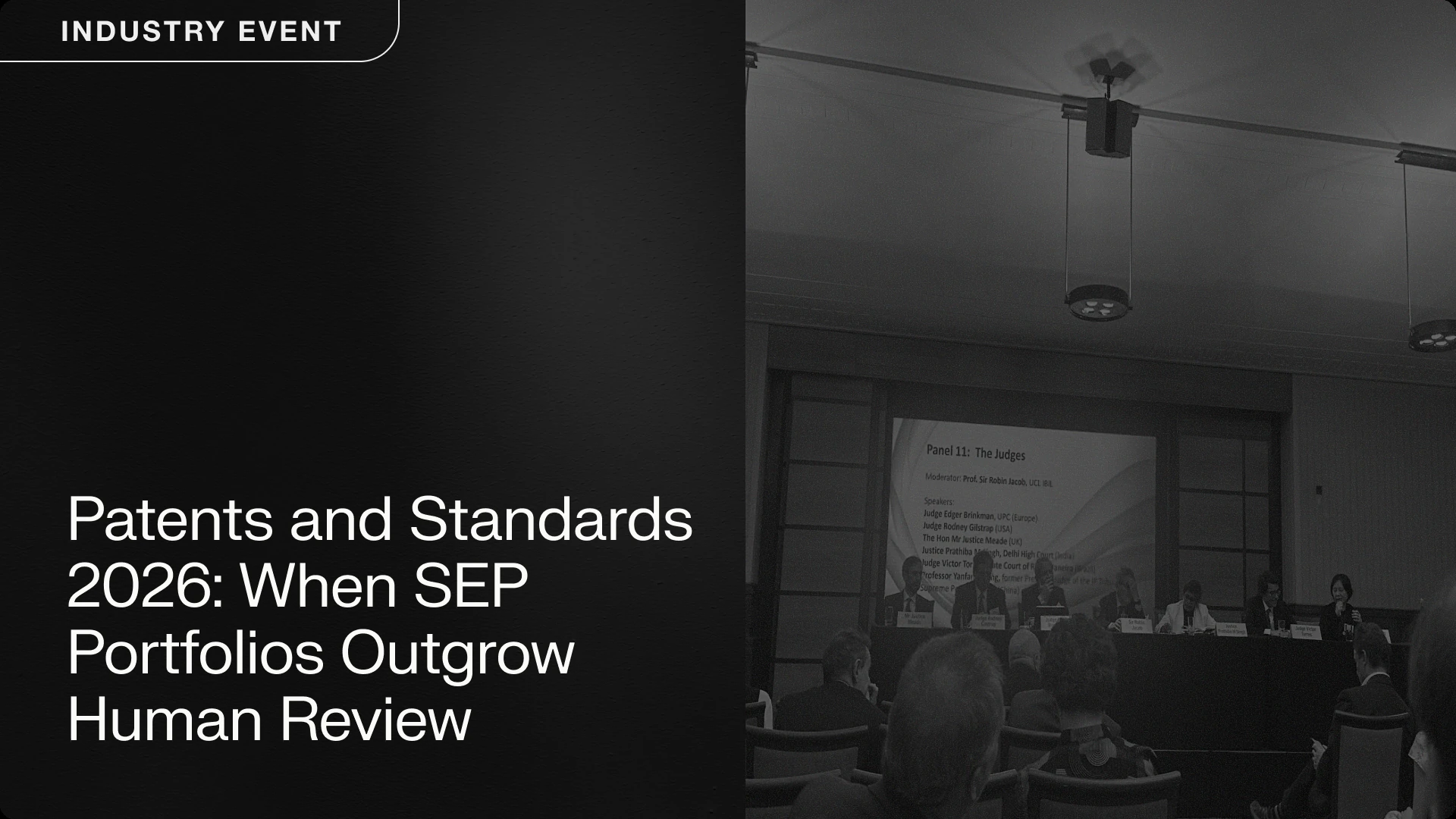
The judge panels, which included input from judges from the UK, US, China, India, Brazil, and the UPC, brought out a contrast that doesn’t get discussed as cleanly as it should. The common law benches such as the UK (a popular venue for FRAND disputes) tend toward pragmatic resolution. Set a global rate if that is what unblocks the dispute, find a workable answer even if the doctrinal route is novel.
A clear example of this was given by Lord Justice Arnold from the UK. He recently took the approach of setting an interim licence rate at the midpoint between the two parties’ latest offers (see Panasonic Holdings Corporation v Xiaomi Technology UK Ltd & Ors [2024] EWCA Civ 1143). The civil law benches such as Germany tend more toward rule-bound application. Stay within the four corners of the statute, give the remedy the code provides, no more.
Both traditions work in isolation. The complication is that global FRAND terms can now be set by a national court in either of them. A pragmatic UK rate-setting and, where the Huawei v ZTE conditions are met, a German injunction can apply to the same parties and the same portfolio at the same time, with the practical commercial outcome shaped by whichever court moves first.
Parallel proceedings are now the default rather than the exception, so positions in every relevant forum have to be locked down before the first filing, not developed reactively after it.
This is where AI is changing what is feasible. For SEP counsel, primary case law from each of the major jurisdictions has to be a routine input rather than something pulled together once per dispute, and the cost of doing that the old way is no longer competitive.
The Solve Intelligence platform has integrated case law across the US, Europe, Japan, and other major jurisdictions, with legal research tools built to run comparative analyses across them in the same workflow. Research rate-setting practices across jurisdictions, and get grounded answers with citations to the cases that matter, all in minutes rather than days.
Solve Intelligence has further expanded its support for litigation workflows by the recent acquisition of Palito.ai.
Patents and Standards 2026 reinforced a shift that has been building for several years and is now visible across the agenda. SEP work has moved from a doctrinal debate to an analytical infrastructure problem.
The teams winning at FRAND disputes in 2026 are not the ones with the largest outside counsel rosters. They are the ones who can run portfolio-scale essentiality, validity, and standards mapping as routine operations, and who can do that work with the rigour a tribunal will accept.
That is what Solve Intelligence is built for, and the conversations at UCL made the case more cleanly than we could ourselves. If you lead SEP licensing, portfolio strategy, or FRAND litigation at an operating company, a pool, or a firm, and any of this sounds familiar, we would be glad to compare notes.
You can request a demo or reach out at partnerships@solveintelligence.com to set up a conversation.
What is the difference between a declared SEP and an actually essential patent?
A declared SEP is one the holder has notified to a standards body as potentially essential. That declaration is not an assessment. Whether each declared patent actually reads onto the standard has to be worked out separately, claim by claim against specific sections. With major contributors declaring portfolios in the tens of thousands, that work has outgrown human review.
What is a patent pool, and how does it fit into SEP licensing?
A patent pool aggregates SEPs from multiple holders into a single licence offered to implementers. Avanci, Sisvel, and MPEG LA are the best-known examples, across cellular, video codecs, and other standards. Pools cut transaction costs by collapsing many bilateral negotiations into one and routing administration through a single entity. They sit alongside bilateral licensing rather than replacing it, and pool, direct, or both is now a routine portfolio question.
What is an anti-suit injunction in SEP litigation?
An anti-suit injunction is a court order barring a party from pursuing related litigation in another jurisdiction. In SEP disputes they typically issue from a court already determining a global FRAND rate, to preserve the integrity of those proceedings against parallel actions elsewhere (most often injunction proceedings in another jurisdiction) that could pre-empt or undermine the rate-setting court's ruling. UK, US, Chinese, and German courts have each taken different views on when one is appropriate, making anti-suit risk a planning variable for both licensors and implementers from the moment a dispute escalates.
Is AI safe to use on confidential SEP and FRAND work?
It can be, but the vendor has to be built for it. SEP material (portfolios under analysis, draft licensing positions, negotiation strategy) is some of the most sensitive content a company produces, so the questions that matter are operational. Where is the data stored, who has access, how is pre-negotiation confidentiality protected, and how do outputs hold up over time. Solve Intelligence was built around these questions from day one, with a security-first architecture and a published Trust Center. We are glad to walk teams through the details.
See our AI tool due diligence checklist for key factors to assess when evaluating AI tools for SEP and FRAND work.

.webp)