Solve Intelligence MCP server now available in Claude

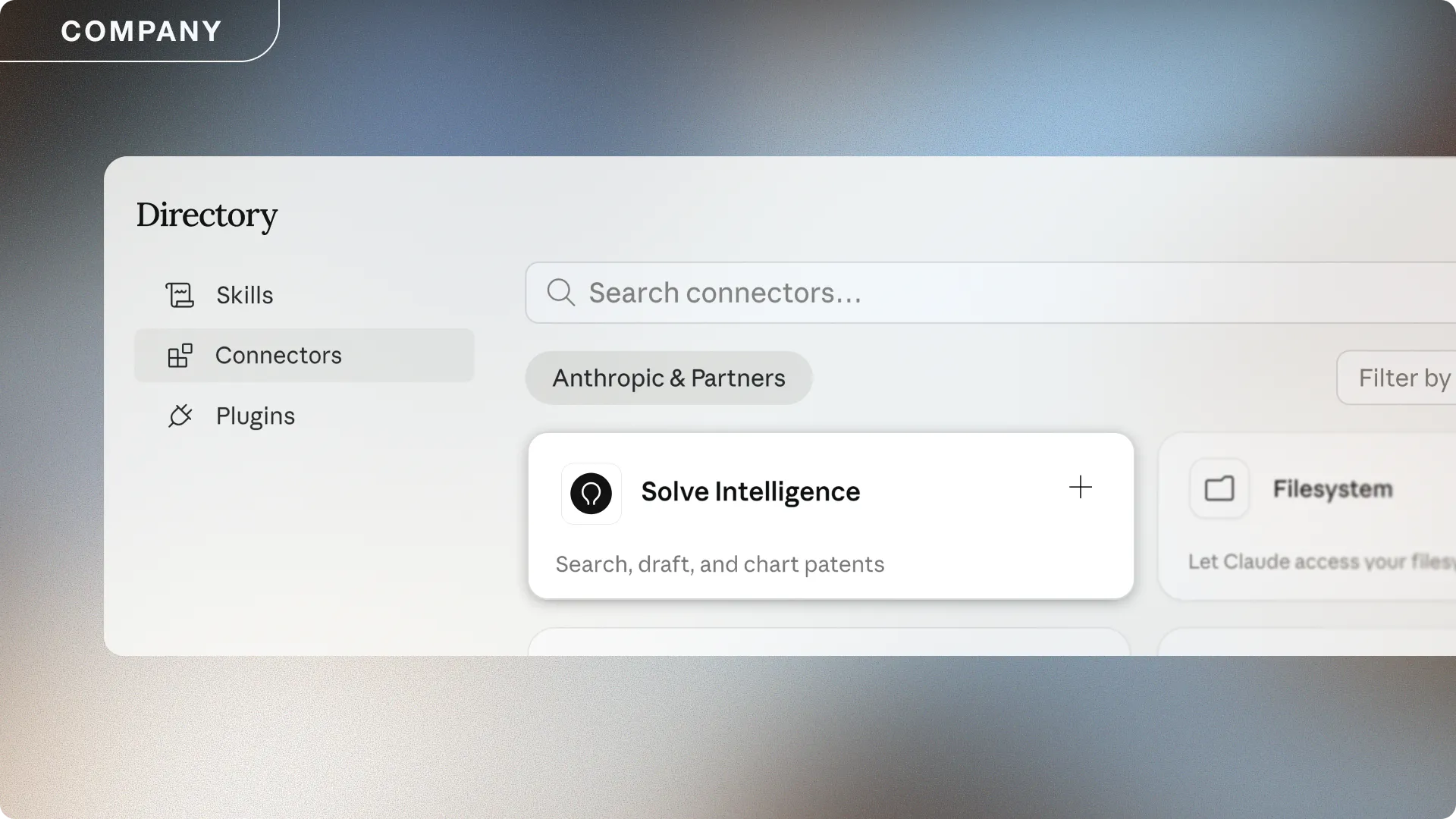
Last week, we shared how Solve Intelligence is powered by Claude across our platform, from patent application drafting to office action responses and claim chart generation. We’re now taking the next step: making a selection of Solve Intelligence’s capabilities accessible inside Claude through our new MCP server, available from today.

This MCP connection means that users who have both a Solve Intelligence subscription and a Claude subscription can use some basic Solve features directly within Claude, so long as the connection is enabled. Claude gains access to global patent literature across every major jurisdiction; non-patent literature including scientific papers, books, theses, datasets, and journals; patent legal texts and case law across key jurisdictions including the US, Europe, Japan, and Australia; and SEP technical standard documentation. A Solve subscription is still required to use this integration.

Solve Intelligence MCP server now available in Claude

A Patent Solution Built for Real IP Work

General-purpose AI assistants are powerful, but they aren’t built for patent work. They lack access to the specialised corpora, legal texts, technical standards, and analytical tools that IP professionals rely on every day. Ask a generic assistant to perform an invalidity search, map a claim onto H.266, or conduct an FTO search in China, and you’ll quickly hit the limits of what it can do.

Solve Intelligence's MCP server changes that. Connect once, and Claude gains access to:

  • Global patent literature across every major jurisdiction
  • Non-patent literature including scientific papers, books, theses, datasets, and journals
  • Patent legal texts and case law across key jurisdictions including the US, Europe, Japan, and Australia 
  • SEP technical standard documentation 

This is a subset of the patent intelligence stack our customers already trust, now accessible through Claude. The MCP connection covers a useful range of Solve’s capabilities, though for more complex workflows the full Solve platform offers additional tools and deeper integrations.

What You Can Do With Solve in Claude

The Solve Intelligence MCP server supports a number of the workflows patent professionals run every day. For example:

Infringement Detection
  • “Search for products that infringe US10445884B2.” Claude combines patent claim analysis with open web research to identify candidate products and articulate the infringement read.
Legal Research
  • Ask Claude: “What is the approach to patentability of simulation inventions in the US, Europe, and Japan?” Claude will search across primary legal texts and case law in each jurisdiction and synthesise a grounded comparative analysis.
Freedom-to-Operate Searching
  • “Conduct a FTO search in China for the attached product.” Claude analyses the product, generates targeted search strategies, and identifies potentially blocking patents in the relevant jurisdiction.
Invalidity Searching
  • “Perform an invalidity search for US12345678B1.” Claude retrieves the patent’s claims, searches global patent and non-patent literature for relevant prior art, and surfaces the strongest references with citations.
SEP Mapping
  • “Does my claim 1 still read onto the H.266 technical standard?” Claude pulls the relevant sections of the standard and maps each claim element against the technical specification.
Patent Document Analysis & Drafting
  • “Analyse US12345678B1 and suggest potential 101 and 112 invalidity attacks.” Claude retrieves the patent, evaluates the claims and specification, and proposes substantive grounds for challenge.

These are the same basic workflows that 600+ IP teams already run on Solve Intelligence, now accessible through a conversational interface backed by frontier-grade reasoning.

Users looking for Solve’s full suite of drafting, prosecution, and claim charting tools will find those inside the Solve platform.

Why MCP, and Why Now

The Model Context Protocol (MCP) gives users a standardised way to connect specialised tools and data sources to Claude. For patent professionals, this matters because IP work is inherently multi-source, a single FTO opinion may require pulling from patent databases, technical standards, case law, and product information on the web.

By exposing a selection of Solve Intelligence’s research and analysis capabilities through the MCP, we’re offering an additional access point for patent professionals who already use Claude.

A Note on Security and Data Handling

Patent work involves some of the most sensitive material in any legal practice, such as invention disclosures, privileged communications, and unpublished applications. Solve Intelligence is SOC 2 certified and adheres to ISO 42001, ISO 27001, GDPR, and CCPA requirements. No data uploaded to or generated by our platform is ever used to train any AI model. All data is encrypted with AES-256 and TLS 1.3, and customers choose where their data is stored and processed.

When using Solve through Claude, the security and data locality provisions will depend on the user’s own Claude subscription and Anthropic’s policies, rather than Solve’s infrastructure alone. For this reason, only Solve organization administrators can enable this integration for their users, and we recommend obtaining IT approval before connecting.

Getting Started

The Solve Intelligence MCP server is available in Claude from today.

To connect Solve Intelligence to Claude, visit claude.com/connectors/solve-intelligence. To learn more about our platform, visit solveintelligence.com or request a demo.

AI for patents.

Be 50%+ more productive. Join thousands of legal professionals around the World using Solve’s Patent Copilot™ for drafting, prosecution, invention harvesting, and more.

Related articles

Dan Rudoy to join Solve’s Customer Advisory Board

We are excited to welcome Dan Rudoy, Shareholder at Wolf Greenfield, to Solve Intelligence’s Customer Advisory Board.

EPO G 1/26: How the Coated Steel Strips Case Tests Article 123(2)

At Solve Intelligence, we build AI tools purpose-built for patent prosecution and opposition workflows. European teams, including cross-Atlantic firms like HG, use Solve Intelligence to stay ahead of EPO doctrine shifts as they happen. In this article, we cover the three referred questions in G 1/26, the practical implications for prosecution and opposition teams, and what to do before the decision lands.

Key takeaways

  • G 1/26 asks whether G 1/24's rule to consult the description extends from patentability assessment to Article 123(2) added matter.
  • The underlying case (T 873/24) turns on whether "ratio of titanium to nitrogen in excess of 3.42" means a weight ratio or a molar ratio.
  • The referral poses three sets of questions: admissibility under Article 112(1), the reach of the description in claim interpretation, and the consequences for Article 123(2).
  • If the Enlarged Board extends G 1/24 to Article 123(2), description-based narrowing applies to added-matter assessment across all European proceedings.

Built for IP: How Banner Witcoff Is Raising the Bar on Patent Work with Solve Intelligence

"We viewed our choice of AI platform as significant to the future of our patent practice. After extensively evaluating many products, we concluded that Solve Intelligence best met the needs of our attorneys and our clients." Laura Brutman, Shareholder, Banner Witcoff

Patents and Standards 2026: When SEP portfolios outgrow human review

The 8th UCL Patents and Standards conference brought together all the key standard essential patent (SEP) players on both the holder and implementer sides. 

By the end of day two, one technical question kept resurfacing across panels that were nominally discussing other topics. How does anyone actually assess essentiality and validity at the scale modern declared portfolios now reach? At Solve Intelligence, this is the question we have built our platform to answer.

Key takeaways

  • At today's portfolio scales, AI is a precondition for SEP essentiality and validity assessment, not an enhancement of human review.
  • Streaming standards are fully in SEP territory, bringing implementers with no licensing history into the same mapping problems as in cellular standards.
  • SEP disputes default to parallel multi-jurisdiction proceedings, requiring position alignment across every forum before the first filing.