FEATUREDAugust 24, 2026Thomson Reuters and Solve Intelligence Partner to Deepen AI Adoption Across Leading Patent PracticesSolve Intelligence’s partnership with Thomson Reuters brings together Solve’s patent and IP platform and practitioner-led support with Thomson Reuters’ longstanding experience helping global law firms adopt professional technology.
Solve Intelligence brings patent-specific AI capabilities to Google Cloud's Gemini Enterprise for LegalSolve Intelligence is pleased to announce that it is a launch partner for Google Cloud’s Gemini Enterprise for Legal.
Page White Farrer Adopts Solve Intelligence for AI-Assisted Patent DraftingPage White Farrer Adopts Solve Intelligence and Solve's AI Templates Page White Farrer ("PWF"), a specialist intellectual property firm with a longstanding focus on technology-driven innovation, has selected Solve Intelligence to support patent application drafting following an extensive evaluation of available AI tools. The firm has initially deployed the platform within its technology-focused patent teams, supporting work across sectors such as AI, software, telecommunications, electronics, semiconductors and engineering. The firm's objective was not to automate legal judgement or replace attorney expertise, but to accelerate the preparation of high-quality first drafts of patent applications. By combining AI-assisted drafting with custom templates tailored to the firm's preferred drafting approaches, Solve Intelligence helps attorneys move from an initial claim set to a reviewable first draft more efficiently while maintaining consistency and technical accuracy. For this partnership, PWF's primary focus was on configuring the platform around the firm's own drafting conventions, client preferences and established best practices, ensuring that the technology supports the way its attorneys already work.
Maiwald Chooses Solve Intelligence for Selected AI-Supported IP WorkflowsSolve Intelligence is proud to share that Maiwald, one of Germany’s largest and most progressive intellectual property firms, works with Solve Intelligence on selected AI-supported workflows in its patent and legal practice groups. Following an evaluation period during which selected functionalities were assessed for approved internal use cases, Maiwald and Solve have formed an enterprise partnership for 2026. The rollout reflects the same careful approach Maiwald brings to its client work. Solve enables customers in Europe to process data on servers located within Europe and holds recognized information-security certifications. In addition, Solve offers contractual commitments designed to protect confidential professional information in line with applicable statutory confidentiality obligations and professional conduct requirements. Against that background, any use of AI-supported tools took place only within approved governance structures and under applicable professional, contractual, confidentiality and data-protection requirements. That balance of innovation and professional judgment is characteristic of Maiwald. The firm has spent decades setting a standard for IP work in Europe: rigorous prosecution, a formidable contentious practice, and interdisciplinary teams of patent attorneys and attorneys-at-law working side by side. The firm approached AI the same way, methodically, with a clear sense of where it adds leverage and where an experienced attorney’s judgment remains irreplaceable.
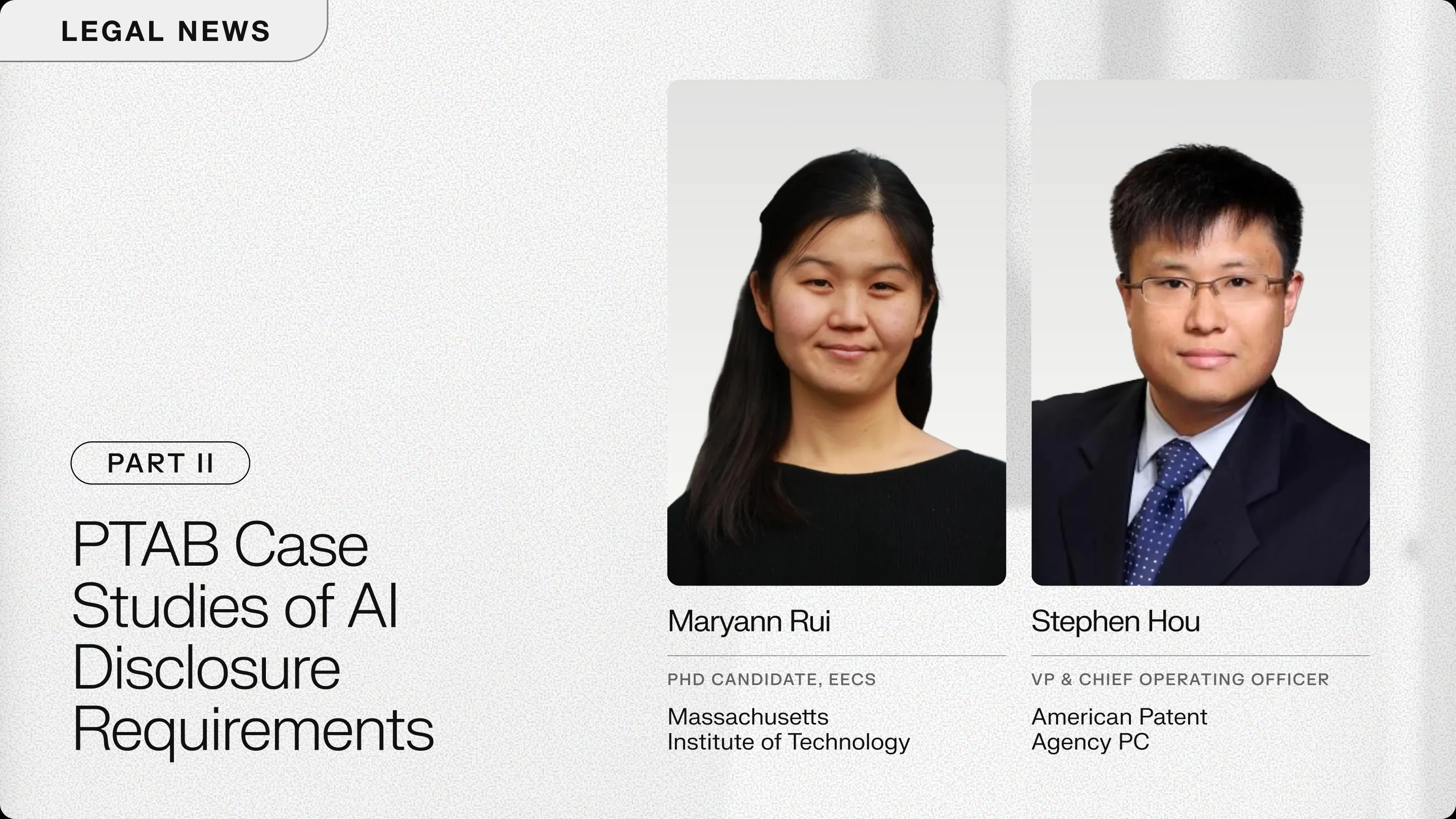
PTAB Case Studies of AI Disclosure Requirements: Part IIThis article is the second of a series of Patent Trial & Appeal Board (PTAB) case studies (see Part I ), which aims to inform applicants’ approach to satisfying the written description and enablement requirements for patenting artificial intelligence (AI) and machine learning technologies.
How Successful Patent Practitioners Are Putting AI to WorkThe most effective patent practitioners are already using AI patent drafting to draft faster, catch claim inconsistencies earlier, and free up hours for the strategic work that actually wins allowances. Key takeaways AI patent drafting tools can reduce application drafting time by up to 80 percent, with Solve Intelligence customers consistently reporting 50 percent or greater efficiency gains across drafting and prosecution Roughly 9 out of 10 utility patent applications receive at least one office action rejection, so prosecution efficiency matters as much as drafting speed Solo attorneys use AI to match larger law firms on turnaround speed and client capacity The strongest reported results come from iterative AI–attorney collaboration, with practitioners directing the process and owning the final work product
Adopting AI in Patent Work: A Practical Playbook for IP TeamsSolve Intelligence works with over 700+ patent teams as they bring AI into daily practice, and the same pattern shows up again and again: recognising that AI helps is easy, but building consistent, team-wide use is not. Adoption tends to stall for a handful of reasons, from informal early experiments to unclear decision making, and a promising trial can fade out without anyone establishing whether the tool or the rollout was at fault. This playbook lays out the process that gets a team from first experiment to settled habit, with the attorney's judgment in control at every step.
How AI Brings Patent Intelligence Into Every DecisionAI makes it practical to rerun patent intelligence as products and patent rights develop. For example, at concept stage, broad freedom-to-operate screening identifies the rights that merit attention. As the design matures, selected patents are escalated for feature-by-feature claim charts, while scheduled monitoring refreshes the analysis when claims are amended or an application proceeds to grant. This contrasts with the traditional approach, in which landscapes, FTO reviews, and portfolio analyses were commissioned as separate projects at fixed stages. Each took substantial time to complete and was rarely repeated.
Automated Patent Proofreading: QA Framework for §112The final review before a U.S. patent filing should not be another linear read-through. Rather, it should be a controlled quality-assurance step: a systematic check of the relationships among the claims, specification, and drawings while the full range of corrective options is still available. Done well, pre-filing QA catches errors that are inexpensive to fix at the drafting desk but costly after filing. Done poorly, it can leave the applicant facing an avoidable rejection, a narrowing amendment, a priority problem, or a validity challenge years later. Key Takeaways: Pre-filing is the best time to correct disclosure, claim, and drawing defects without creating new-matter or priority complications. Antecedent basis gaps, contradictory claim dependencies, and terminology drift are the most common pre-filing defects, and all are correctable before filing. Section 112(a) review is substantive, not clerical: a broad range or functional limitation may warrant scrutiny even when the claim reads cleanly. Automated patent proofreading identifies candidate defects for attorney review but does not substitute for legal judgment on claim scope, support, or strategy.
Solve Intelligence × iManage: Solve’s Patent Workflows and AI agents seamlessly integrated with your Firm’s IntelligencePatent attorneys can now directly connect with iManage into Solve Intelligence’s platform, further streamlining your patent workflows. The best patent applications are built from deep context. Claim sets that hold up, specifications that anticipate rejections and objections, arguments that resonate with examiners and legal and IP decisions that align with business and client needs. All of this depends on the attorney having the right materials at the right time. That's why we integrated Solve Intelligence directly with iManage. iManage is where IP practices and firm intelligence lives. It's the document management platform trusted by thousands of legal organizations globally, where client disclosures land, where prosecution histories are stored, where the institutional knowledge of a firm accumulates over years. Now, that knowledge is directly accessible inside Solve.
Solve Intelligence and HGF Partner to Deliver Custom AI Patent Drafting WorkflowsSolve Intelligence is pleased to announce a strategic partnership with HGF , one of Europe’s leading intellectual property firms. The collaboration is focused on a clear objective: customising AI-driven drafting workflows to meet the specific needs of HGF and some of its clients. Rather than adopting a one-size-fits-all approach, HGF is working closely with Solve Intelligence to shape how the drafting platform behaves across different technologies, client preferences, and drafting styles. The built-in, customisable features available in Solve’s platform are what makes this possible. "We evaluated the field carefully before committing. Solve Intelligence delivered the drafting quality our attorneys demand and integrated seamlessly into how they already work. We are investing in the foundation for HGF's future practice." Richard Hodkinson, Chief Technology Officer at HGF
How Much of Your Patent Practice Should You Codify?Put your time into more strategic codification and judgment that sets your work apart, and lets a specialist carry and maintain the shared foundation for your patent work. AI is changing how in-house teams and outside counsel approach patent work. One reason is that it has raised the payoff for turning a practice into AI templates, instructions, and review criteria that run at scale. Let’s call that codification. A purpose-built platform already encodes a great deal of best practice out of the box, and a team can layer its own on top with custom AI templates and instructions. So the real question is not whether to codify, but how much to do yourself and how much to leave to a platform built for the work. There is no fixed formula, only a sensible division of labor. Key Takeaways: • AI has raised the payoff for codifying patent practice: a written standard now guides AI-assisted drafting and review directly, not just junior training. • A purpose-built patent platform encodes a large body of best practice out of the box, so a team can run on that foundation without writing its own. • Solve Intelligence maintains its shared foundation across more than 700 IP teams, keeping it current far more efficiently than any single team could alone. • The strategic choice is how much of your own practice to codify on top; scarce expert time belongs on the standards and judgment that differentiate your work. • A named professional still signs off on every filing regardless of the tools used, so accountability for the result never moves to the AI.
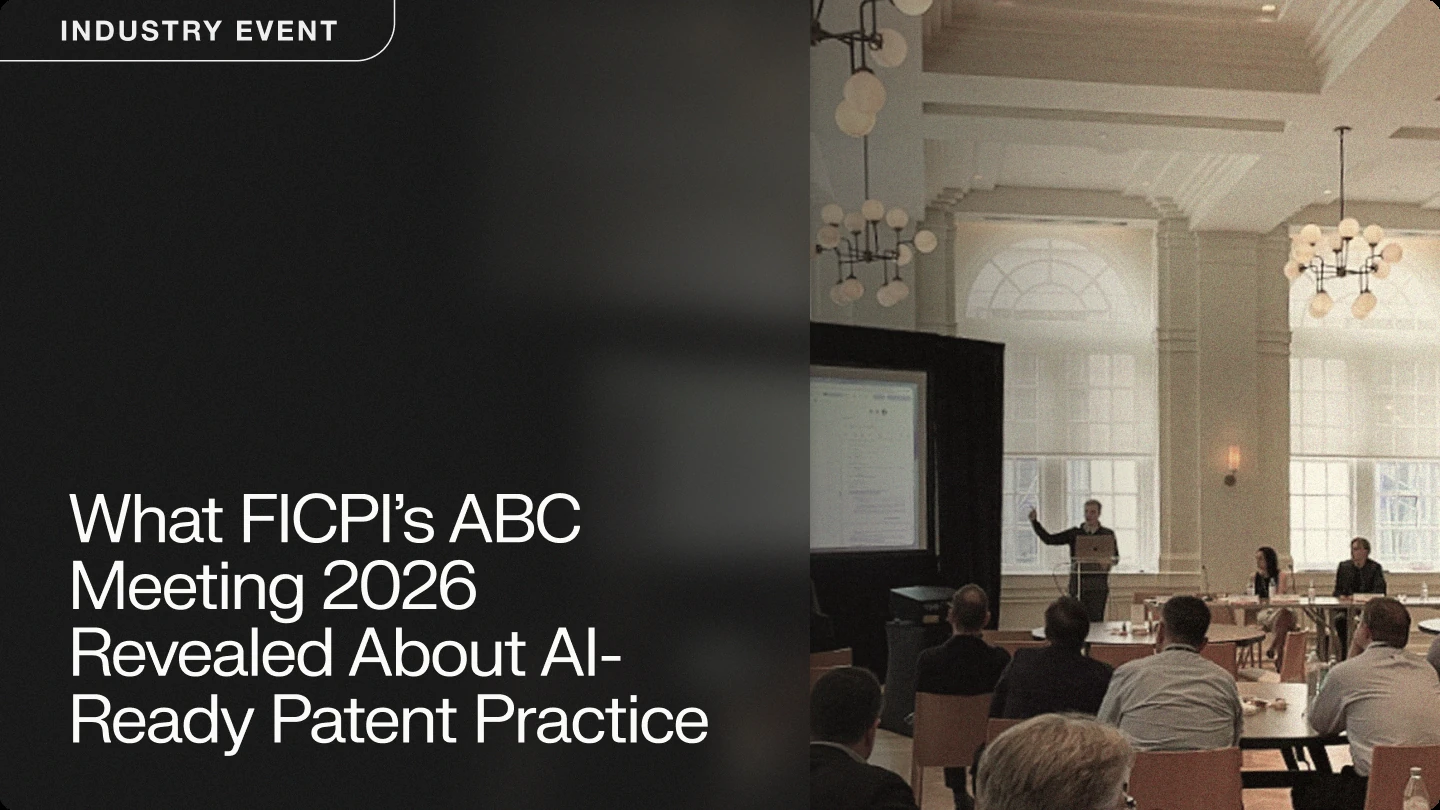
What FICPI's ABC Meeting 2026 Revealed About AI-Ready Patent PracticeSolve Intelligence participated as a sponsor of FICPI’s ABC Meeting 2026 in Nashville, with CEO and Co-founder Chris Parsonson , demonstrating the practical application of a purpose-built patent AI platform. Patent attorneys and litigators convened for a key session addressing a central question: what is required for AI to be ready for patent practice? Key Takeaways: Solve Intelligence supports the full patent lifecycle across 700+ IP firms, from invention disclosure through litigation. One firm that adopted Solve Intelligence mid-fiscal year exceeded its billing targets by $1 million by reallocating AI-saved time to higher-value work. In-house teams now require outside counsel to use AI tools, making AI fluency a firm selection criterion rather than a differentiator. Attorneys report that ROI is not simply about increasing speed, but about reallocating the time saved to higher-value strategies, cross-sell analysis, and client insights.
How Solve Intelligence Expands the Offerings of Small Patent FirmsSolve Intelligence cuts the time attorneys spend on patent work by half . This lets a solo practitioner or small patent firm widen their offering without widening headcount. Work that a small practice once had to outsource can now be brought in-house, including creating patent drawings and prior art searching. The results are faster turnaround and higher margins for small firms. These time savings also free up capacity to offer ancillary services like landscaping, freedom-to-operate analysis, and infringement detection, work that was historically hard to do for small firms because of the manual effort involved. Key Takeaways: AI lets small firms bring outsourced work back in-house, including patent drawings and prior art search, improving margins and shortening turnaround. AI makes patent attorneys more productive , freeing capacity for landscaping, FTO, and infringement detection work. Patent work is structurally complex, so purpose-built patent AI, not a general chatbot, is what delivers reliable output.
Hansson Thyresson Integrates Solve Intelligence into Patent PracticeFounded in Malmö over three decades ago, Hansson Thyresson has built its reputation on close client relationships paired with deep technical and legal expertise. When the firm decided to integrate AI into its practice, it looked for a platform that could deliver enterprise-grade capability. They chose Solve Intelligence. Key Takeaways: Hansson Thyresson has adopted Solve Intelligence for patent application drafting, bringing enterprise-grade AI into the firm's workflows. The firm pairs Solve Intelligence with its hands-on, attorney-led service model, keeping practitioners in control of every output. For Hansson Thyresson, Solve Intelligence amplifies attorney expertise, improving work quality and focus on strategic work that matters most to clients.
Bringing LexisNexis® Global Patent Litigation Data into Solve Intelligence Workflows Solve Intelligence has teamed up with LexisNexis ® Intellectual Property Solutions to bring global patent litigation insights into Solve Intelligence workflows for patent drafting, prosecution, claim charting, freedom-to-operate assessments, invalidity analysis, and related IP work.
Patent Landscape Analysis: How R&D Teams Identify WhitespaceR&D teams use patent landscape analysis to locate uncharted areas of a technology field, assess freedom-to-operate (FTO), and focus development resources on the areas of highest commercial value and broadest potential claim coverage. Key Takeaways: A patent landscape search locates whitespace; a novelty search locates prior art blockers. Patent landscape outputs require contextual analysis; volume alone does not determine opportunity or density. Solve’s Charts tool scans millions of patents from a single file upload and leverages agentic searching, replacing manual iterative keyword & semantic search.
What IPBC Global 2026 in San Diego Revealed about the Future of IPAt IPBC Global 2026, Solve Intelligence was proud to be a sponsor of the conversations shaping the future of intellectual property. At the conference, we demonstrated how our platform amplifies end-to-end patent workflows, including licensing, litigation, and IP-backed finance. Key Takeaways: Generic LLMs cannot perform the structured legal reasoning and claim analysis that patent licensing and litigation require. AI lowers the cost of analysing portfolios, from claim-to-product mappings to validity analyses, accelerating both sides of licensing negotiations. IP-backed finance, insurance, and M&A due diligence are growing in sophistication and volume. The profession faces a capacity gap that generic AI tools are not designed to close.
What Is a Freedom to Operate Analysis, and How Does AI Speed It Up?A freedom to operate (FTO) analysis is a claim-by-claim assessment of whether a commercial activity would infringe any third-party patents in the markets where it will take place. AI speeds it up by handling the parts that scale badly by hand: surfacing relevant patents, mapping product features against claims element by element, pulling legal status by jurisdiction, and producing a cited, structured draft for the attorney to review and refine. Key takeaways • FTO analysis determines whether a product infringes third-party patents. • A valid patent on your own invention doesn’t guarantee freedom to operate. • AI compresses the slowest stages of FTO, including search, triage, and element-by-element claim mapping, while the attorney retains the legal judgment and owns the opinion. • Generalist AI and purpose-built patent tools share a surface format; but FTO reliability depends on integration, not interface.
How to Build an Invalidity Claim Chart: A Practical GuideAn invalidity claim chart is a structured document that maps, for example, each limitation of a patent claim against prior art to show the patent should never have been granted. If you’re defending against infringement allegations, preparing an IPR petition, opposing a European patent, or advising a client on patent risk, knowing how to build one correctly is non-negotiable. Key Takeaways: • A well-built invalidity chart maps every claim limitation to prior art, element by element, with pinpoint citations to the exact column, line, page, or figure. • When IPRs reach a final written decision, the PTAB now finds every challenged claim unpatentable around 70% of the time; and the chart is a key component of getting a petition instituted in the first place. • Solve Intelligence’s Charts generates fully cited, limitation-by-limitation invalidity charts in minutes rather than days, flags weak limitation coverage candidly, and lets attorneys inspect the reasoning behind every mapping.
LAC 2026: What Generic and Biosimilar IP Teams Think About AIGeneric and biosimilar IP teams are already using AI for prosecution history and FTO work. The live debate is not about adoption, but internal framing of quality and coverage extension without reducing headcount. The teams furthest along chose the former. Key Takeaways: Generic and biosimilar IP teams use AI primarily for prosecution history summaries, invalidity analysis and FTO claim charting. Viewing AI as a quality and coverage extension drives durable internal adoption. General-purpose AI cannot reliably interpret claim scope from prosecution history; patent-specific tools are required.
Dan Rudoy to join Solve’s Customer Advisory BoardWe are excited to welcome Dan Rudoy, Shareholder at Wolf Greenfield, to Solve Intelligence’s Customer Advisory Board.
EPO G 1/26: How the Coated Steel Strips Case Tests Article 123(2)At Solve Intelligence , we build AI tools purpose-built for patent prosecution and opposition workflows. European teams, including cross-Atlantic firms like HG , use Solve Intelligence to stay ahead of EPO doctrine shifts as they happen. In this article, we cover the three referred questions in G 1/26, the practical implications for prosecution and opposition teams, and what to do before the decision lands. Key takeaways G 1/26 asks whether G 1/24's rule to consult the description extends from patentability assessment to Article 123(2) added matter. The underlying case (T 873/24) turns on whether "ratio of titanium to nitrogen in excess of 3.42" means a weight ratio or a molar ratio. The referral poses three sets of questions: admissibility under Article 112(1), the reach of the description in claim interpretation, and the consequences for Article 123(2). If the Enlarged Board extends G 1/24 to Article 123(2), description-based narrowing applies to added-matter assessment across all European proceedings.
Built for IP: How Banner Witcoff Is Raising the Bar on Patent Work with Solve Intelligence"We viewed our choice of AI platform as significant to the future of our patent practice. After extensively evaluating many products, we concluded that Solve Intelligence best met the needs of our attorneys and our clients." Laura Brutman, Shareholder, Banner Witcoff
Patents and Standards 2026: When SEP portfolios outgrow human reviewThe 8th UCL Patents and Standards conference brought together all the key standard essential patent (SEP) players on both the holder and implementer sides. By the end of day two, one technical question kept resurfacing across panels that were nominally discussing other topics. How does anyone actually assess essentiality and validity at the scale modern declared portfolios now reach? At Solve Intelligence , this is the question we have built our platform to answer. Key takeaways At today's portfolio scales, AI is a precondition for SEP essentiality and validity assessment, not an enhancement of human review. Streaming standards are fully in SEP territory, bringing implementers with no licensing history into the same mapping problems as in cellular standards. SEP disputes default to parallel multi-jurisdiction proceedings, requiring position alignment across every forum before the first filing.
Why Patent Practice Needs Purpose-Built AI: Reflections from Code with ClaudeAnthropic's Code with Claude convened the global community of developers, founders, and researchers building applied AI on Claude. Solve Intelligence was invited to speak from the stage on what we have learned building AI for patent professionals, and the conference was a useful reminder of why domain-specific software matters in high-stakes legal work.
UPC Long-Arm Jurisdiction Is Reshaping European Patent LitigationThree years in, the Unified Patent Court is no longer just a faster route through European patent litigation. It is becoming a single venue capable of resolving infringement across the UK, Switzerland, Turkey and Spain in one action. That shift has one source: the CJEU's BSH v Electrolux ruling, and what UPC divisions have done with it since February 2025. The court has issued more than 1,800 decisions, with around 700 new actions a year and 31 already citing BSH. For teams navigating that volume across multiple jurisdictions, AI-assisted research platforms like Solve Intelligence exist for exactly this kind of work.
AI X IP Thought Leader Exchange with Solve Intelligence, Haynes Boone, and 100+ Leading Voices in IPSolve Intelligence partnered with AmLaw 100 firm Haynes Boone to bring together 100+ senior IP leaders in Silicon Valley for a candid discussion on how AI is being used in patent practice today, and how that's shifting over the next 12 months. The evening was led by Leah Poynter Waterland (Sr. Director, Cisco), Jeff Draeger (Chief Patent Counsel, Intel), David McCombs (Partner and Board Member, Haynes Boone), Tony Capecci (Director of Practice Innovation, Haynes Boone), and Mallun Yen (Founder, Operator Collective; IP leader and Ex-Cisco). The room was 70% in-house, drawing Heads of IP and senior IP leaders from across enterprise software and cloud (Microsoft, IBM, Snowflake), semiconductors (Intel, Applied Materials), life sciences (Johnson & Johnson, Pfizer, Gilead), mobility and autonomy (Tesla, Waymo), connected devices and networks (Cisco, Samsung Research America), and AI labs (Mistral AI). The remaining 30% were outside counsel from firms including BCLP, Finnegan, Perkins Coie, Procopio, and Skadden. Key Insights Today, Solve supports global IP teams deploying AI agents for large-scale tasks including search across millions of patent and non-patent literature, portfolio analysis on thousands of assets, and claim charting, focussed on transparent source-backed and auditable outputs. Every IP leader in the room had either rolled out an AI patent platform or was in active procurement. Successful AI implementation requires collaboration and trusted long-term partnerships between IP teams, vendors, and outside counsel. Solve CEO Chris Parsonson expects per-user token usage to grow more than 1000x over the next 12 months.
Cookie settingsBy clicking “Accept all”, you agree to the storing of cookies on your device to enhance site navigation, analyze site usage, and assist in our marketing efforts. For further details see ourManage cookie preferencesChoose which cookies we may store on your device. Essentials keep the site working and cannot be turned off.EssentialsNecessary for the site to function. Always on.Always activeAnalyticsMeasures usage and improves your experience.MarketingUsed for targeted advertising.Cookie preferences