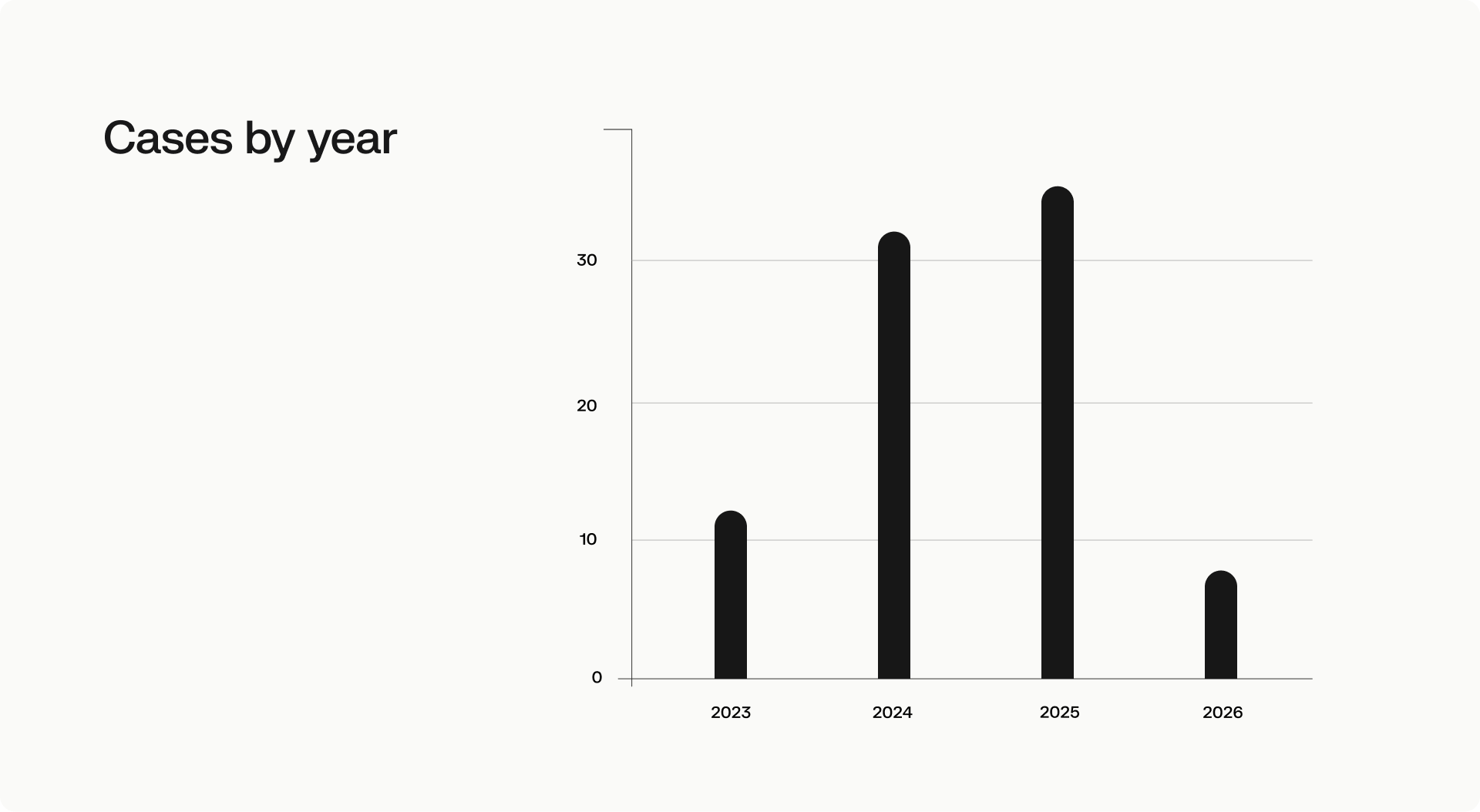
The numbers tell a clear story. In its first partial year (June–December 2023), the UPC produced 18 provisional measures decisions across cases including myStromer v Revolt Zycling, Edwards Lifesciences v Meril, and 10x Genomics v NanoString. By 2024, that figure doubled to 36. Early 2026 filings, including Align Technology v Angelalign and Ottobock v BrainPortfolio, suggest no deceleration.
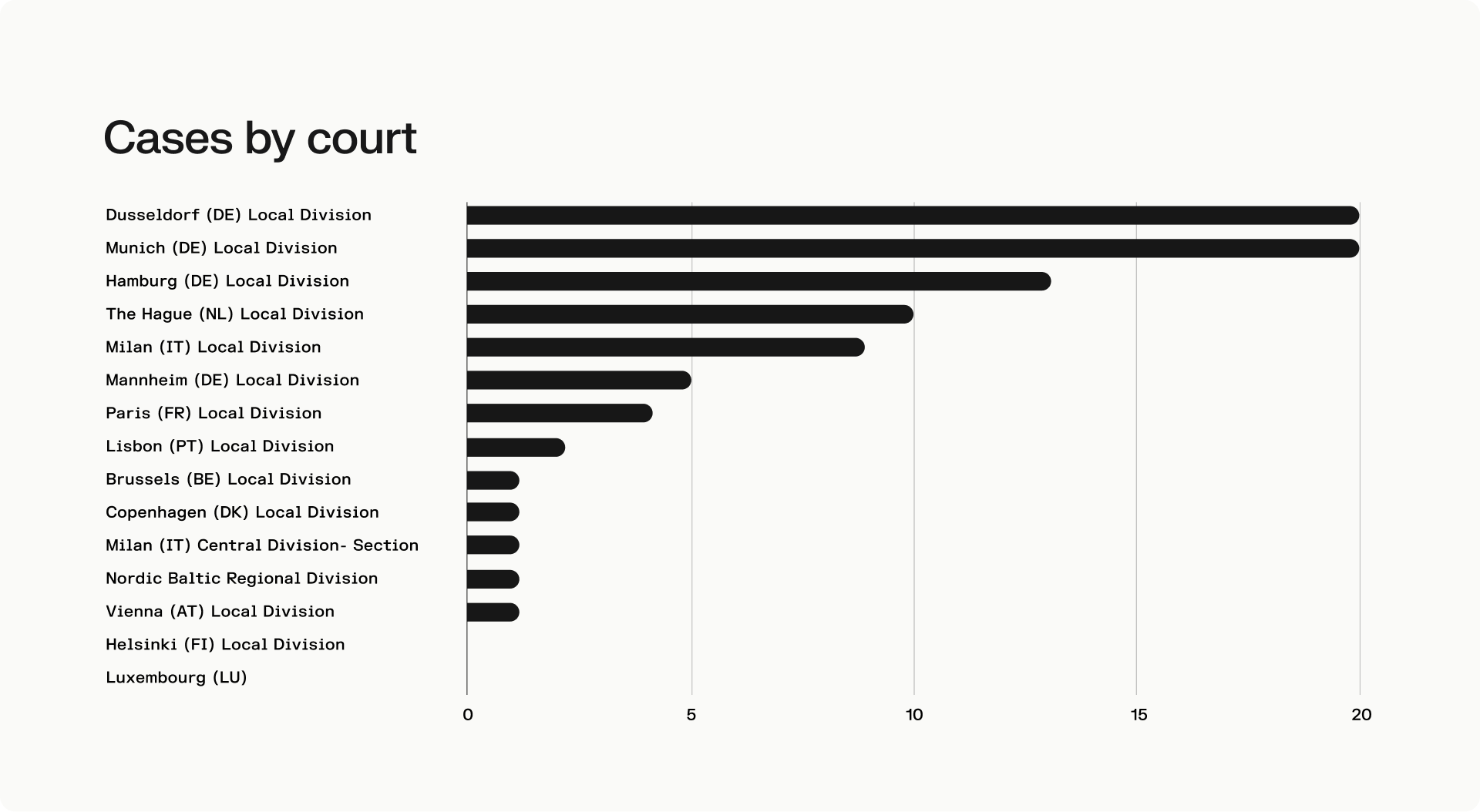
The geographic concentration is striking. Düsseldorf (20 cases), Munich (20), and Hamburg (13) together account for 60% of all activity, reflecting Germany’s established preliminary injunction culture. But filings in The Hague (10), Milan (9), Paris (4), and Lisbon (2) signal this is becoming a pan-European strategic tool.
Equally notable is the pattern of coordinated enforcement campaigns. 10x Genomics v Curio Bioscience generated nine separate decisions in early 2024. Insulet Corporation filed parallel measures in Milan against both Menarini Diagnostics and EOFLOW. These aren’t isolated applications, they multiply the analytical burden on both sides. Absorbing this volume without sacrificing depth will require making use of intelligent tools like Solve’s AI-assisted claim charting, not only late nights.
Art. 62(4) UPCA requires the court to be satisfied “to a sufficient degree of certainty” that the patent is valid and infringed. 10x Genomics v NanoString (Munich, September 2023) interpreted this as a “preponderance of probability,” a standard the Court of Appeal has since framed as requiring the court to be convinced it is “more likely than not.”
This isn’t a prima facie test. Courts engage in full claim construction under Art. 69 EPC before assessing infringement, treating the patent claim as “not only the starting point but the decisive basis for determining the scope of protection” (Dyson v SharkNinja, Munich LD, May 2024).
Two dismissed applications illustrate the depth of analysis panels undertake.
In SES-imagotag v Hanshow (Munich, December 2023), the court’s independent claim construction yielded a different reading of the technical features than the applicant’s mapping assumed. The claim chart wasn’t incomplete, but it didn’t anticipate the court’s construction. In CUP&CINO v Alpina (Vienna, September 2023), the court used numerical values from the description to constrain claim scope, finding the accused device fell outside the patent’s teaching.
The lesson: claim charts must anticipate how the court will construe claims, drawing on the description, prosecution history, and technical purpose. Courts conduct their own analysis. Mappings that don’t withstand that scrutiny fail, and an applicant who misreads the court’s construction pays the costs of a dismissed application.
This is precisely the kind of multi-source, element-by-element analysis where AI-powered claim charting can accelerate the mechanical work, freeing practitioners to focus on the interpretive and strategic layers.
SES-imagotag v Hanshow established that original claim wording “can be used as an aid to interpretation in connection with amendments made during prosecution.” Any narrowing amendments during examination or opposition are fair game. A claim chart built solely on granted claims, without reference to what was surrendered during prosecution, leaves the applicant exposed.
10x Genomics v NanoString set the foundational standard: a “preponderance of probability” that the patent will be upheld. Granted patents benefit from a presumption of validity under Art. 54 UPCA, which the defendant must rebut.
But defendants are meeting that burden. In Alexion v Samsung Bioepis and Alexion v Amgen (both Hamburg, June 2024), the court dismissed both applications despite finding infringement, because it couldn’t be sufficiently certain of validity. The Hamburg panel introduced a critical factor: courts must consider “the likelihood that the opposition division of the EPO will revoke the patent.” Pending EPO opposition creates uncertainty that provisional measures panels can’t ignore.
An applicant whose patent faces active opposition must now assess the trajectory of those proceedings in its filing. Ignoring the opposition file isn’t an option.
Dyson v SharkNinja (Munich LD, May 2024) established that validity arguments should “typically be limited to the defendant’s best three.” This cuts both ways: defendants must prioritise, but applicants who have identified and prepared responses to the three strongest attacks are in a significantly stronger position. The Court of Appeal set aside the injunction in December 2024 on infringement grounds but did not revisit this first-instance approach to validity.
Where no opposition exists, the path is easier. myStromer v Revolt Zycling (Düsseldorf, June 2023), the first-ever UPC ex parte order, treated validity as sufficiently secured by the patent’s clean history since grant in 2015. Systematic validity stress-testing, whether manual or supported by tools like Solve Intelligence’s prior art analysis, has become a prerequisite for provisional measures strategy.
Dyson v SharkNinja (Munich LD, May 2024) held that filing within two months of detecting infringement is “generally not unreasonably delayed.” Trade fairs have emerged as urgency triggers, myStromer v Revolt was filed during Eurobike 2023, where the defendant’s ability to build market presence constituted sufficient urgency for ex parte relief.
On proportionality, courts apply a sliding scale: the stronger the conviction on infringement and validity, the more justified the injunction. Where uncertainties exist, courts consider milder measures or dismissal. Ex parte orders require showing irreparable harm and carry procedural safeguards, security deposits (EUR 500,000 in myStromer), penalty provisions up to EUR 250,000 per violation, and a 31-day deadline to file main proceedings.
UPC provisional measures can cover up to 18 member states in a single order. Under Article 34 UPCA, the court applies uniform claim construction across the entire territory, so a single claim chart and validity assessment can, in principle, support pan-European relief. But that uniformity has limits.
Where the national part of a European patent has been limited or partially revoked in one member state, the claim scope in that state diverges from the granted B1 claims that apply elsewhere. A patentee may have voluntarily narrowed claims in Germany to settle national litigation or avoid a validity finding, while the full B1 claims remain in force across the other 17 states. Equally, pre-UPC national validity outcomes carry over: a Dutch court may have upheld all claims while a German court narrowed them during the transitional period. These asymmetries persist under the UPC.
For provisional measures, this means the applicant may need separate claim charts for the same patent: one based on the full B1 claims for the majority of states, another based on the limited claims for the state where scope was narrowed, with a corresponding validity assessment for each version.
Multiply this across coordinated enforcement campaigns involving several patents and defendants, as in the Ericsson v ASUS proceedings (Lisbon, October 2024), Dolby v Roku (Munich, May 2025), and the Pirelli parallel filings (Milan, November 2024), and the analytical workload compounds rapidly.
For teams managing this volume, the ability to run multiple claim charts in parallel through tools like Solve Intelligence Charts becomes a practical necessity rather than a convenience. Teams still doing this work by hand are making tacit concessions, filing narrower relief than the case justifies, or taking on risk their opponents have already eliminated.
The requirements above - independent claim construction, element-by-element product mapping, proactive validity assessment, consideration of parallel EPO proceedings, and jurisdiction-specific claim scope analysis where national limitations exist - must all be satisfied simultaneously, at the quality level the caselaw demands, within timelines measured in days or weeks.
Ex parte orders can issue within days of filing. Even inter partes proceedings move on compressed schedules. The two-month window from detection to filing must accommodate claim construction, product teardown, prior art searching, validity stress-testing, and preparation of court-ready claim charts that survive independent judicial scrutiny.
The constraint isn’t expertise, it’s capacity. Patent litigation teams have the skills. They lack the time to do it all manually at the depth courts now require. The firms winning these applications aren’t trying to.
This is the structural problem that purpose-built AI tools address, not by replacing practitioner judgment, but by compressing the analytical phases that consume the most time. The gap between teams using them and teams not using them widens with every filing window.
Solve Intelligence’s Charts generates element-by-element claim analyses across multiple patents and products simultaneously, with multi-source citations and transparent reasoning in each cell. When a provisional measures application requires mapping three patent claims against two product variants across four jurisdictions, the difference between manual and AI-assisted charting is the difference between meeting and missing the filing window.
The validity dimension is equally critical. Solve’s prior art analysis and validity assessment capabilities enable practitioners to map claim scope against the prior art landscape systematically, identifying potential attacks before they surface in the respondent’s opposition.
Each output includes sentence-level citations and expandable reasoning, allowing practitioners to verify, refine, and take ownership of the analysis. The tool accelerates the mechanical work. The strategic decisions remain with the attorney.
Provisional measures filings at the UPC show no sign of slowing. As more divisions develop procedural expectations and the Court of Appeal shapes appellate standards, the substantive bar will continue to rise.
For practitioners, the question isn’t whether UPC provisional measures are strategically important. It’s whether their workflows can produce court-ready analysis at the speed this forum demands. Teams that combine deep procedural expertise with AI-assisted claim analysis tools are best positioned to meet that standard, on both sides of the case. Those relying on manual workflows will increasingly find the filing window closes before their analysis reaches court-ready depth.
Solve Intelligence’s Charts tool is purpose-built for this workflow. To see how it supports provisional measures preparation, claim charting, and validity assessment, request a demo.
What is the standard for obtaining provisional measures at the UPC?
Under Article 62 UPCA, the applicant must demonstrate a sufficient degree of certainty that the patent is valid and infringed, that there’s urgency, and that the balance of interests favours relief. Courts require detailed claim-to-product mapping and proactive validity assessment—surface-level analysis doesn’t meet the threshold.
Which UPC divisions handle the most provisional measures cases?
Düsseldorf and Munich lead with 20 cases each, followed by Hamburg (13), The Hague (10), and Milan (9). German divisions collectively account for around 60% of all activity, though filings are diversifying across Europe.
How quickly do UPC provisional measures proceedings move?
Ex parte orders can issue within days. Inter partes proceedings typically move on compressed schedules of weeks. Courts have held that filing within two months of detecting infringement is generally acceptable, but applicants must demonstrate diligent pre-filing investigation during that period.
How can AI tools help with provisional measures preparation?
Solve Intelligence’s Charts generates element-by-element claim charts, including infringement mapping, invalidity charts, and product mapping, with multi-source citations and transparent reasoning. Combined with prior art analysis and validity assessment capabilities, it compresses the analytical foundation for a provisional measures application from weeks to hours. Request a demo to see how Solve supports patent litigation workflows.
What is Solve Intelligence?
Solve Intelligence is the AI Patent Copilot, a platform purpose-built for patent practitioners by patent practitioners. Used by 700+ IP teams globally, it supports patent drafting, prosecution, claim charting, and litigation workflows with enterprise-grade security (SOC 2 Type II, ISO 27001). The Charts product launched in December 2025 and was expanded with European litigation capabilities through the acquisition of Palito.ai in April 2026.
Does AI replace the need for experienced patent litigators in provisional measures?
No. AI compresses the mechanical phases of claim analysis, element-by-element mapping, prior art searching, validity landscape assessment, but the strategic decisions (which division to file in, whether to proceed ex parte, how to frame urgency and proportionality) remain questions of legal judgment that require practitioner expertise and case-specific context.


.jpeg)