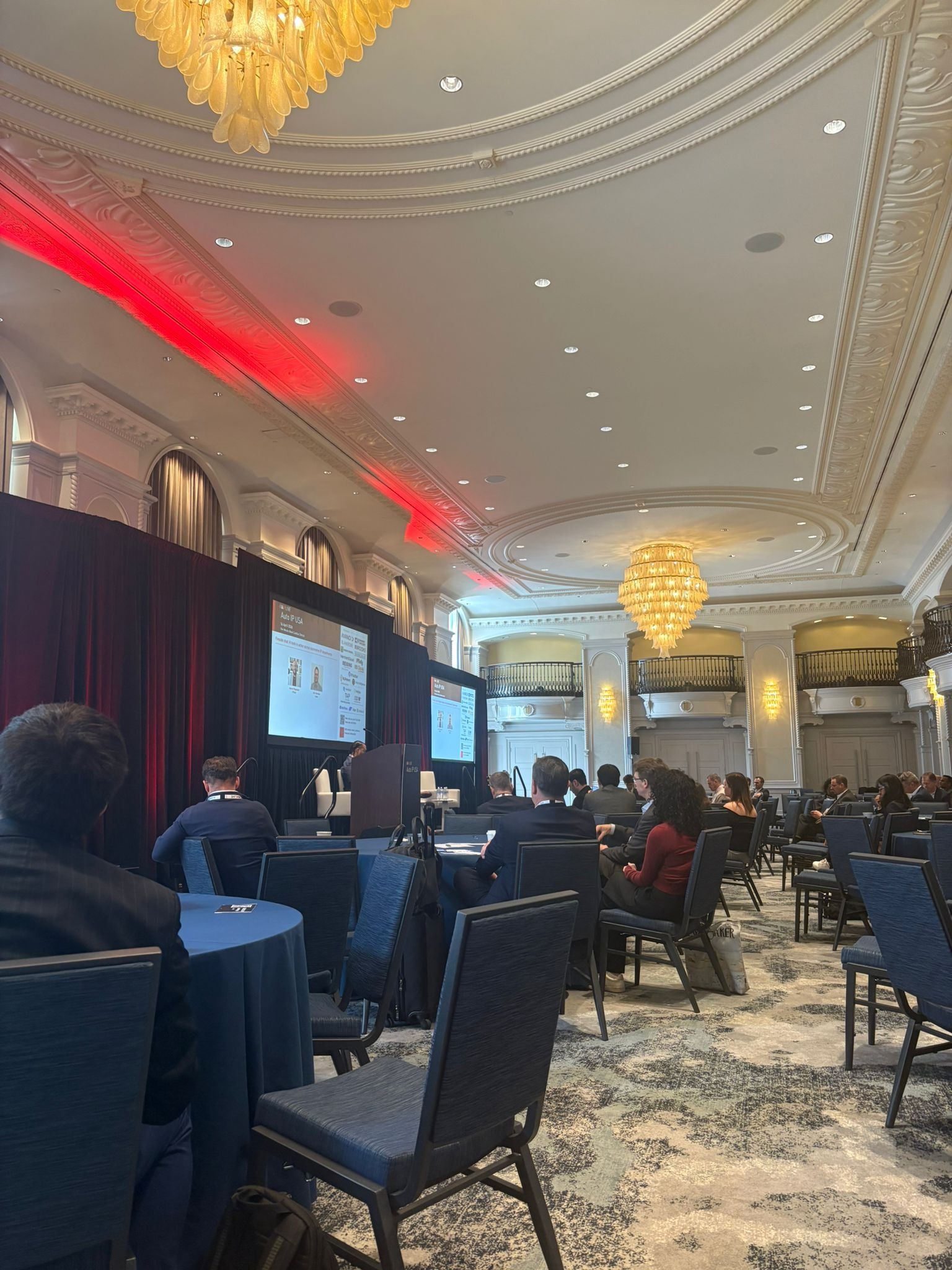
Last month, my colleagues and I attended IAM Live: Auto IP USA 2026 at the Westin Book Cadillac in Detroit. Solve Intelligence was a Silver Sponsor, which gave us a great vantage point on a discipline that is changing faster than its reputation suggests.
By the end of the day, one thing was clear to me. Automotive IP is no longer a discipline organised around mechanical engineering with some electronics on top. It is a software, standards, and strategy problem, and the teams that recognise this first are the ones quietly rewriting how their departments operate.
Here are the four themes that stayed with me on the flight home, and how we are thinking about each of them at Solve.
One of the clearest themes across the day was that automotive portfolios look very different from how they looked even a few years ago. Software, AI models, sensor fusion, vehicle to everything communications, over the air update mechanisms, and the data pipelines that feed all of it are now first class citizens in the portfolio, not afterthoughts attached to a mechanical filing. The opening keynote on software defined vehicles, and the masterclass on autonomous IP later in the day, both put this shift front and centre.
That change creates a real drafting problem. A claim that is precise enough to capture a software defined feature, durable enough to survive an evolving Section 101 landscape, and broad enough to read on the way the technology is actually deployed across vendors, is genuinely difficult to write at the speed and volume that modern automotive teams need.
This is where Solve does some of its heaviest lifting for automotive teams. Our drafting product is built around the idea that a strong specification and a strong claim set are tightly coupled, and that AI should be helping practitioners reason about scope rather than just produce text. In practice that means the copilot supports full utility application drafting, including the pieces that are easy to underweight on software heavy inventions: figure work, alternative embodiments, fallback positions, and consistent terminology across hundreds of pages. It also means full application review, so a draft can be pressure tested against the kinds of issues, ambiguities, support gaps, and claim differentiation problems that tend to surface only later in prosecution.
For automotive groups filing more software, AI, and autonomy related applications each year without growing their drafting capacity at the same rate, that combination matters. The bar is no longer "did we get something filed". It is "did we file something that holds up when the technology, the case law, and the licensing environment all keep moving".
Standard essential patents ran through several sessions, most directly the closing panel on automotive SEPs. Modern vehicles touch cellular, Wi Fi, video codecs, positioning, and a growing list of adjacent standards, and AI related standardisation is visibly on the horizon. Each of those layers brings declared SEPs measured in the thousands, sometimes tens of thousands. Licensing complexity is not a future problem for this industry. It is already here.
Sitting underneath all of that is claim charting, and specifically the work of mapping patents directly to the relevant standards to understand essentiality and read strength. Whether the goal is essentiality analysis for a licensing negotiation, an offensive read for a portfolio assertion, or a defensive read against an incoming claim, the underlying work is the same.
Limitations have to be lined up against specific sections of the standard, the supporting language has to be pulled and structured, and a practitioner has to reach a defensible view on how strongly the patent reads. Done by hand, this is exactly the kind of work that consumes weeks per family and balloons outside counsel spend.
Our Charts product is built directly for this. It supports patent to standard mapping as a first class workflow, making it seamless to upload or search for patents and map them against our integrated database of standard documents. From there, a practitioner can quickly assess read strength across a portfolio: which patents map cleanly, which are stretched, and which are genuinely essential. The same mechanics apply to mapping patents to a product or implementation for evidence of use work, so a single capability supports both standards facing and product facing analysis.
The compounding effect is what matters most. Teams can run analyses across far larger sets of patents than before, and they can do it on timelines that match how fast licensing and litigation actually move. In an environment where SEP activity in automotive keeps climbing, the ability to map patents to standards at portfolio scale, and to do it without losing the rigour a negotiation or a court would demand, becomes a strategic capability rather than a back office task.
The budget and tariffs sessions struck a pragmatic tone. IP leaders are not panicking about budgets. They are getting more deliberate. Filing strategies are being revisited. Jurisdictional spread is being narrowed in some areas and deliberately widened in others, depending on where reshoring, tariffs, and supply chain shifts are pulling the business. The "file everywhere, prosecute everything" posture, to the extent it ever really existed, is firmly over.
What this means in practice is that the value of every individual filing has gone up, and so has the value of getting it right at every stage. A weaker draft that becomes a narrower granted claim is now a much more visible loss, because there are fewer filings carrying the strategic load.
That logic flows directly into prosecution. When every filing matters more, office action responses matter more. Solve's prosecution product supports full response drafting, rejection analysis and charting, end to end custom review, and structured strategy brainstorming, which together help teams handle higher stakes responses without timelines blowing out.
Rejection analysis is crucial because many automotive patent office actions now focus on Section 101 and combining prior art with software and AI. A good response strategy decides whether claim scope survives intact. For teams that are deliberately filing fewer applications, getting more of them granted with meaningful claim scope is the obvious next lever, and it is one we are built to support.
Two years ago, conversations at events like this often started with whether AI belonged in patent work at all. This year, that debate had clearly moved on, including in the fireside chat on AI tools inside automotive IP departments.
The questions on the agenda, and in the broader industry conversation, are now operational:
These are the right questions, and they are the questions a serious vendor should welcome rather than deflect. It is also why we put so much weight on security and trust at Solve. Our architecture is designed around the reality that patent work involves some of the most sensitive material a company produces, often years before it becomes public.
You can read about our security practices and our Trust Center if that is useful, and we are always happy to walk teams through them in detail. The short version is that AI in patent work has to clear a higher bar than AI in many other domains, because the cost of a quietly wrong or quietly leaky output is borne years later, in a granted claim or a licensing position that does not do what the business needed it to do.
The honest summary of the day is this. Automotive IP has become a discipline of compounding pressures. Portfolios are more software heavy. Standards exposure is broader. Budgets are tighter. Policy and tariffs are noisier. And the volume of analytical work sitting underneath every strategic decision has grown faster than headcount.
Teams that thrive in this environment will not be the ones with the largest departments. They will be the ones who match the shape of the modern automotive portfolio with the right workflow at each stage: AI assisted drafting that respects how software and AI inventions actually need to be claimed, prosecution support that protects scope when every grant matters more, and standards mapping at portfolio scale for SEP and licensing work.
That is the spine of what we have built at Solve, and Auto IP USA was a useful reminder of why each piece of it matters.
If you lead IP at an automotive OEM, a supplier, an autonomy company, or a mobility platform, and any of the themes above sound familiar, we would be glad to compare notes. You can request a demo or reach out at partnerships@solveintelligence.com to set up a conversation.
A patent that covers technology required to comply with a technical standard, such as cellular or Wi Fi. In automotive, modern vehicles touch many standards, which means OEMs and suppliers face thousands of SEPs to evaluate.
It handles the mechanical work, mapping claim limitations against a standard or product, pulling supporting passages, and structuring the output. That lets practitioners focus on judgment calls like read strength and essentiality. Solve's Charts product is built for exactly this.
It can be, but only if the vendor is built for it. Patent material is some of the most sensitive content a company produces, often years before it becomes public, so the questions that matter are operational. Where is the data stored, who has access, how is pre filing confidentiality protected, and how do outputs hold up under scrutiny over time. Solve was designed around these questions from day one, with a security first architecture, a published Trust Center, and workflows built to fit how patent teams actually work. We are always glad to walk teams through the details.