.jpg)
How to Draft Patent Figures with Solve Intelligence
Solve’s Figure Builder is the integrated environment within the Solve platform where you can generate, edit, label and refine figures. It brings figures into the drafting process, alongside claim and specification drafting so consistency, and compliance with 37 CFR §1.84, is maintained across your application from the very first sketch to the version you file.
Key Takeaways:
- Create, edit and finalise figures for your patent filings, both manually and with AI assistance.
- Bring figure management into the heart of the drafting process to ensure you have the figures you need, when you need them.
- Propagate changes in terminology and reference numerals across your whole application with ease.
- Convert disclosure documents or claims into labelled line drawings in a single session, and then use them as the basis for your detailed description.

Why patent figures get handled outside the drafting workflow
Historically, patent drafting has involved separate tracks for text generation and drawing preparation. Often the patent practitioner will draft the description, claims and abstract in a word processor, but the figures in a dedicated drawing product. They may even outsource the preparation of figures to a dedicated draftsperson.
Separation of text and drawings used to make sense, but was not without risk. In particular, risks centred on maintaining consistency in the use of terminology and reference labels across the figures, claims, description, and abstract.
At the USPTO, 37 CFR § 1.84 makes consistency a formal requirement, not merely a matter of best practice. Non-compliance can damage patent rights, for example, by reducing Patent Term Adjustment (PTA). When drawings are generated, edited and refined outside of the text drafting environment, or even by a separate draftsperson, consistency errors inevitably arise.
How Figure Builder removes this risk
Both the importance and the effort required to check every reference numeral in every figure and on every page of the specification cannot be understated. Figure Builder is Solve’s answer to addressing and removing this risk of consistency errors.
Generating text and figures within the same platform means they are linked, so a change to a reference numeral in a figure can be automatically mirrored throughout the text of the claims, description and abstract. The same applies to figures prepared outside of Solve’s platform too.
What Figure Builder does
How Figure Builder differs from standalone drawing tools
Standalone drawing tools can enable attorneys to generate line drawings, place reference numerals on them, and arrive at patent-ready figures much faster than manually preparing drawings. What they can’t do is integrate with text generation to maintain consistency across all application documents.
Standalone drawing tools prepare figures separately to text. Once prepared, such drawings have to be exported from the drawings tool before being imported to the platform where text generation occurs. Frequently there is also a third platform or tool at play as well which manages reference numerals and element labels. Ensuring consistent alignment across potentially three platforms is cumbersome, manual, and can lead to delays.
One platform instead of three
Solve’s Figure Builder consolidates figure preparation, element label management and text generation into a single platform, removing cycles of exporting and importing as figures are edited. It also consolidates figure management for figures prepared outside of Solve.
The result is consistency maintained throughout drafting, not a check conducted at the end. The impact for the attorney is that less time is needed for manual checking and more time can be spent on strategic planning.
Standalone drawing tools vs. Solve Intelligence's Figure Builder
How to use Solve Intelligence's Figure Builder
To get started, you can either upload existing or draft figures to edit, or start from scratch by opening the integrated Figure Builder.

Within Figure Builder, you can move between figures to make the edits you need, either via the AI Chat or manually using the wide range of tools available. These tools include everything you need to build diagrams and flowcharts, annotate figures with lead lines, and much more.
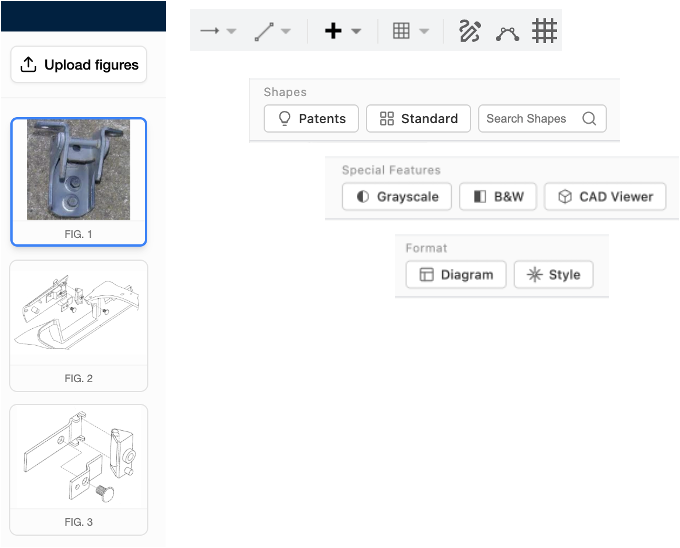
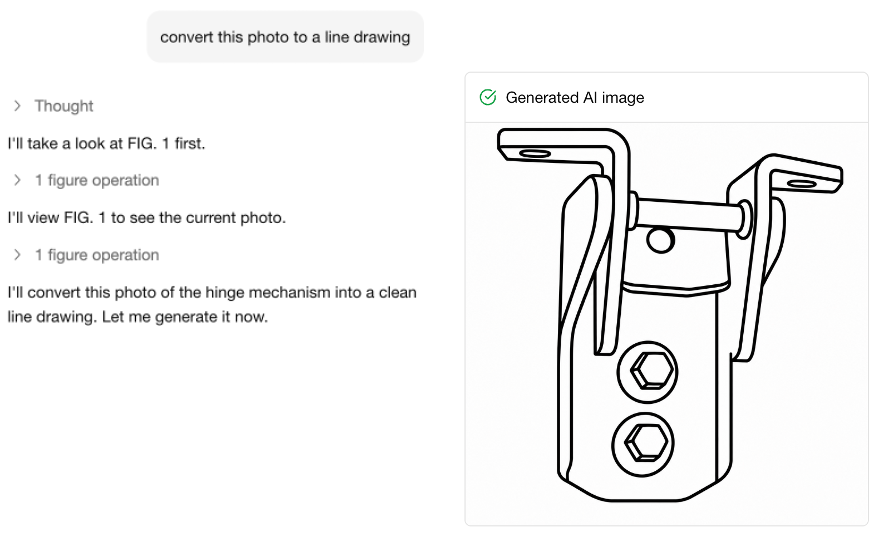
Edits using the AI Chat are easy. For example, a simple natural language prompt can be used to convert a photo to a line drawing.
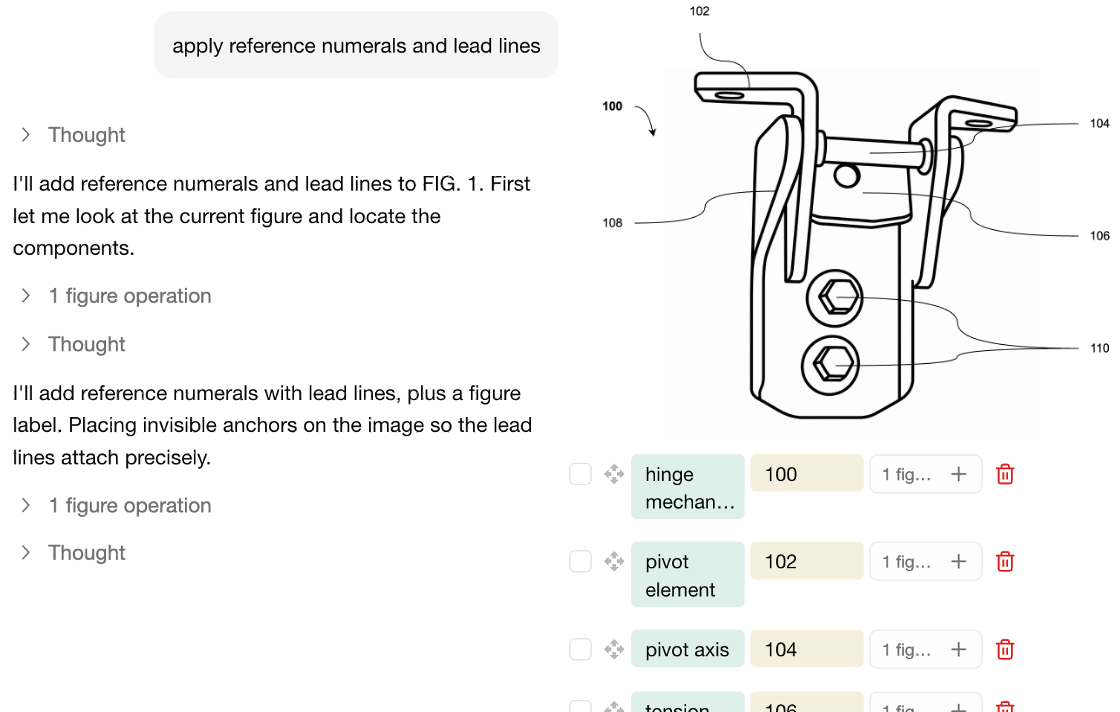
Adding element labels and lead lines is also straightforward and can be done via the AI Chat. Doing so automatically adds the reference numerals and element labels to a master list which can be edited to propagate updates across the application documents and figures.
Figures can be exported individually directly from Figure Builder or as a set for filing from the document editor itself. Before doing so though you should verify that the figures, especially those which have been generated or edited with AI, are accurate and show the features that you need them to. Figure Builder reduces the reconciliation work that ensures consistency is maintained, but the attorney remains responsible for the final figure set.
Keeping reference numerals consistent across your application
Reference numeral errors are not a result of carelessness, but of fragmented workflows. When the figures, list of reference numerals and application text are edited independently, catching errors relies entirely on an individual noticing inconsistencies as they arise.
Figure Builder collapses these independent sources into one single master registry that the figures and application text are linked to:
- New figures added: checked against the master registry, with new elements added as needed.
- Figures annotated with element labels and lead lines: labels and lines drawn from the master registry.
- Element name or reference numeral changed (in the master registry, figures, or application text): change propagated to the others via the master registry.
The result is an application where reference numerals and element labels are used consistently. For the attorney, this avoids breaking their drafting flow to independently update the figures, list of reference numerals and application text every time a change is made, however minor it might be. And more focussed attorney time means higher quality applications across the board.
How to bring in figures outside Solve Intelligence
Solve's Figure Builder can also bring in any figures you may already have prepared elsewhere, and seamlessly integrate them into your drafting. When you upload a figure as a PDF, an image, a Visio file, or one embedded in a Word or PowerPoint document) Solve does more than store it. When you upload an already prepared figure, it is read and interpreted within the context of your invention disclosure and application. A title and description are suggested, and any existing reference numerals are detected and added to the project-wide list of element labels and reference numerals. You review these before they are committed, and from that point the figure and its labels are part of your application, kept consistent with the claims, description and abstract just like figures created within Solve.
Patent figures for provisional and non-provisional applications
Although the USPTO does not impose the same formal drawing requirements for provisionals as it does for non-provisionals, reference numerals, element labels and figure descriptions introduced in provisionals can create issues down the line if not properly thought through. Consistency between a provisional and non-provisional claiming priority from it matters. Inconsistency can create unnecessary amendment work and can raise written description and clarity questions.
When you draft applications using Solve with its integrated Figure Builder, the transition from provisional to non-provisional becomes a refinement exercise. The single master registry created when drafting the provisional can be carried forwards to the non-provisional, along with the figures and application text, so changes can be made without risking consistency.
A note on confidentiality
Pre-filing figures carry the same data risk as any other unpublished content. At Solve Intelligence, we adhere to the highest security standards. We are ISO 27001 and SOC 2 Type II certified, with formalised policies around data handling, access controls, and auditability. We also comply with ISO 42001 for AI management systems, as well as GDPR and CCPA.
Additionally, we implement Zero Data Retention (ZDR) policies with our model providers, meaning client data processed through Solve's platform is not retained or used to train any of the underlying models. You can use Solve’s platform and integrated Figure Builder confident in the knowledge that your data is being handled securely.
Interested in seeing Solve Intelligence in action? Reach out to us directly or book a demo at solveintelligence.com.
FAQs
What is Solve Intelligence's Figure Builder?
Figure Builder is Solve’s integrated workspace for creating and editing patent drawings. It combines an AI Chat, a canvas for editing your figures, and a project-wide master element label registry. Solve’s Figure Builder allows you to create, upload, edit, refine and label figures in the same environment as your application text.
What input types does Figure Builder accept?
Figure Builder accepts all sorts of image formats, including images embedded in Word or Powerpoint documents, as well as 3D CAD files. Figures can also be built from scratch using words alone, e.g., the wording of an independent claim.
How does autolabeling work in Figure Builder?
The project-wide master element label registry stores all of your element labels and reference numerals. Applying them to your drawings can be done by the AI or manually. Updates are propagated throughout the master registry, figures and application text.
Does Figure Builder output meet USPTO and EPO formal requirements?
Figure Builder helps you produce consistent, well-labelled drawings but does not automatically guarantee compliance with formal drawings rules. Attorneys should still verify line weights, font size, margins, legibility and numbering conventions against applicable law.
How does Figure Builder maintain reference numeral consistency across figures?
The master element label registry is central to maintaining consistency across your figures and application text. It ensures that every component carries the same numeral across every figure and part of the application.
Do provisional patent applications need formal patent figures?
No, provisional applications do not need formal patent figures in the same way that non-provisional applications do. But reference numerals and figure descriptions introduced in a provisional often carry forward into the non-provisional. Inconsistencies between the two can create avoidable amendment work at the priority transition.
How does Solve Intelligence’s Figure Builder compare to tools like Patently Create?
Tools like Patently Create enable you to prepare figures in a dedicated drawing environment, but such figures then need to be exported from a drawing platform before being imported to a drafting platform. Figure Builder is different: your figures, element labels and application text all live in the same project on the same integrated platform.
Is it safe to use Figure Builder for unpublished application figures?
Yes. Solve treats all client data with the utmost security. Your data is encrypted in transit and at rest, and is sandboxed per user. Sharing data within Solve is possible, but requires an active step on the part of the user wanting to share data. Nothing is shared unless you choose to share it.
AI for patents.
Be 50%+ more productive. Join thousands of legal professionals around the world using Solve’s Patent Copilot™ for drafting, prosecution, invention harvesting, and more.



.png)