What FICPI's ABC Meeting 2026 Revealed About AI-Ready Patent Practice

Solve Intelligence participated as a sponsor of FICPI’s ABC Meeting 2026 in Nashville, with CEO and Co-founder Chris Parsonson, demonstrating the practical application of a purpose-built patent AI platform. Patent attorneys and litigators convened for a key session addressing a central question: what is required for AI to be ready for patent practice? 

Key Takeaways:

  • Solve Intelligence supports the full patent lifecycle across 700+ IP firms, from invention disclosure through litigation.
  • One firm that adopted Solve Intelligence mid-fiscal year exceeded its billing targets by $1 million by reallocating AI-saved time to higher-value work.
  • In-house teams now require outside counsel to use AI tools, making AI fluency a firm selection criterion rather than a differentiator.
  • Attorneys report that ROI is not simply about increasing speed, but about reallocating the time saved to higher-value strategies, cross-sell analysis, and client insights.
What FICPI's ABC Meeting 2026 Revealed About AI-Ready Patent Practice

Why specialized legal AI beats general LLMs for patent work

The session began with a resonant comparison: a general-purpose LLM is similar to a talented law student. It is knowledgeable, articulate, and efficient, but lacks experience with prosecution, familiarity with firm-specific client guidelines, and understanding of the stakes involved in each matter.

A platform designed for the complete patent workflow is distinguished by several key factors:

  • Access to legal research, case law, and prosecution databases
  • An added grounding layer sourced from actual legal doctrine rather than statistical pattern-matching
  • Sandboxing that isolates work at the matter level to prevent conflicts across the firm
  • Jurisdiction-aware formatting and compliance rules built into the platform itself

Additionally, the AI’s style should be customizable by attorney, matter, jurisdiction, and specific client instructions. Firms prefer a platform that reflects their unique practice, rather than a single, uniform voice.
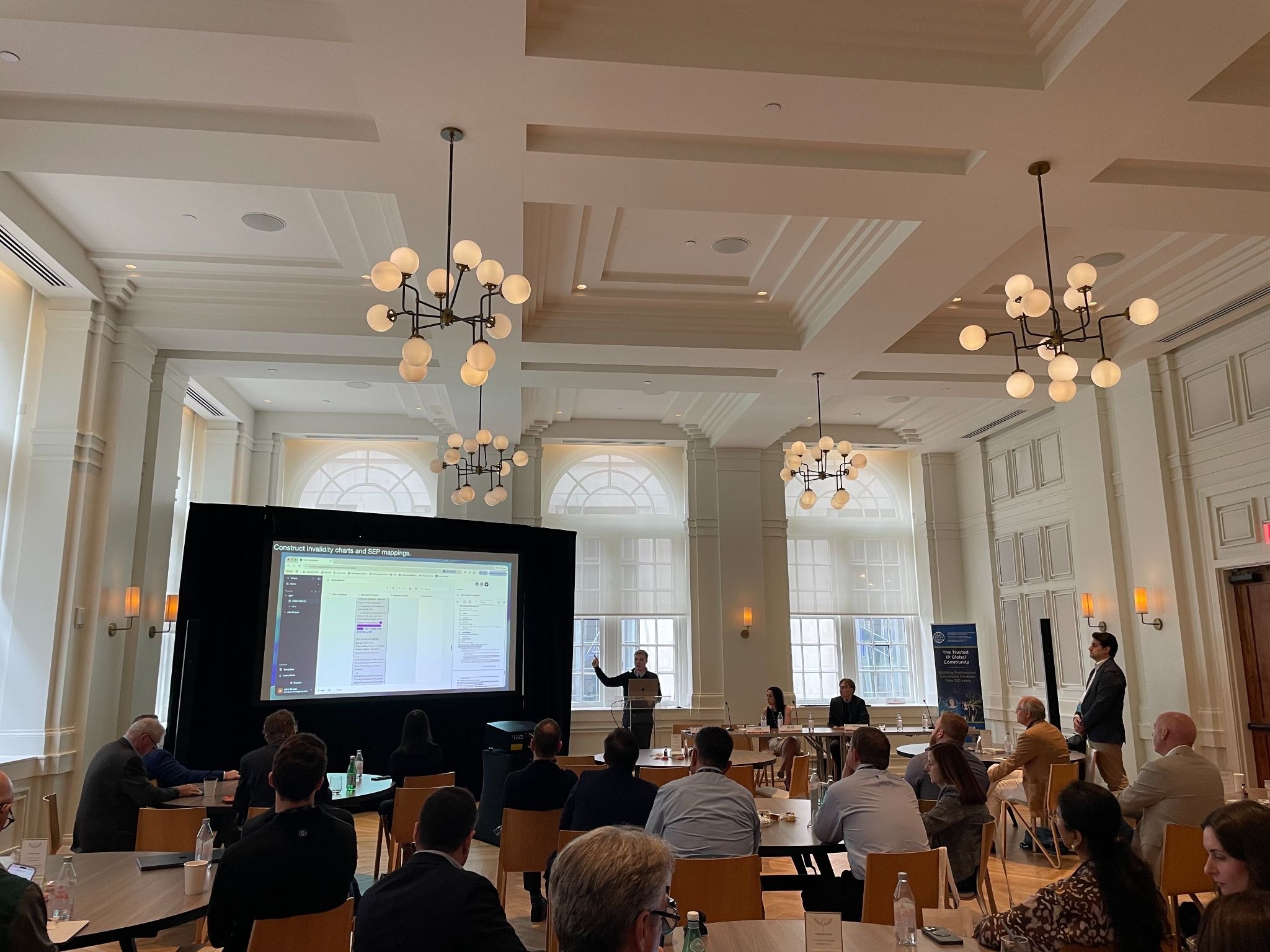
Inside Solve Intelligence’s patent workflow

Currently used by thousands of practitioners at over 700 in-house and IP firms, Solve Intelligence focuses on the entire patent lifecycle, rather than a single point solution. Solve Intelligence supports:

  • Prior art search across more than 150 million patent documents and 215 million pieces of non-patent literature
  • Invention disclosure analysis, including novelty and non-obviousness flagging and guided claim-drafting questions
  • Drafting support, from AI-assisted claim brainstorming and background writing to switching between USPTO, EPO, and PCT formats
  • Office action response, with rejection charting, examiner argument mapping, and strategy generation
  • SEP and standards analysis, mapping claims to standards with full citation sourcing
  • Portfolio-level infringement detection and pruning at scale
  • Biotech and chemistry support, including sequence extraction and genus/species claim generation
  • Cross-jurisdiction prosecution, pulling global prosecution history to inform new responses

For all of these workflows, the AI output includes clickable citations linking to the relevant source document. For attorneys, this traceability distinguishes a tool suitable for experimentation from one that can be relied upon in practice.

The ROI case: reallocating time, not just saving it

A key topic was how firms measure the return on their AI investments. Among approximately 700 firms using Solve Intelligence, attorneys consistently reallocate time saved by AI to higher-value work, advanced claim drafting strategy, portfolio cross-sell analysis, and client-facing IP insights, rather than simply increasing workload.

One team that adopted Solve Intelligence mid-fiscal year exceeded their billing targets by $1 million. However, software alone is not sufficient; effective change management is equally important. Successful adoption typically follows three stages: 

  1. Build appetite for the tool
  2. Give people a guide to realizing value from it
  3. Let internal champions drive peer adoption from there

Approximately 35% of Solve Intelligence’s team are fully qualified patent attorneys and agents dedicated to customer deployment and training, where ROI is ultimately realized.

Security and the shifting in-house mandate

Security was discussed as a critical factor for adoption, not merely a compliance requirement. Solve Intelligence’s infrastructure aligns with the standards law firm IT teams now expect:

  • Data encrypted in transit and at rest
  • No training on client data, with data sandboxed per user and per project
  • Data residency options
  • SOC 2 Type II and enterprise-grade security, reviewed and approved by law firm IT teams

A significant shift is driven by clients. In-house legal teams increasingly require outside counsel to use AI tools, and some are selecting firms based on their AI capabilities. AI fluency is now becoming a selection criterion rather than a differentiator.

What’s next for AI in patent practice?

FICPI’s ABC Nashville meeting demonstrated that patent attorneys are no longer debating whether to adopt AI. Instead, they are focused on identifying platforms that meet the rigorous demands of their work and on effective implementation. This is the core conversation Solve Intelligence seeks to address. 

Looking ahead 6 to 12 months, a few shifts stood out from the discussion:

  • Interfaces will move away from fixed software, enabling attorneys to interact more naturally and build custom workflows rather than navigate static menus
  • AI will become increasingly personalized, adapting to each attorney’s style in a manner similar to a trusted senior associate
  • Automation of routine end-to-end tasks is already underway and is expected to accelerate
  • The learning process is reciprocal: attorneys improve their use of AI over time, and this ongoing interaction generates significant compounding value

FAQs

What's the real difference between a general-purpose LLM and a specialized patent AI platform?

General-purpose models are trained broadly and reason well, but they lack grounding in legal doctrine, access to technical guidelines and case law databases, and the confidentiality standards firms are required to maintain. A specialized platform adds that legal-specific layer on top, along with jurisdiction-aware formatting so outputs are actually usable in practice, not just plausible-sounding text.

Which parts of the patent lifecycle does Solve Intelligence cover?

Solve Intelligence spans invention disclosure analysis, prior art search, claim drafting, office action response, SEP and standards analysis, portfolio-level infringement detection, and biotech/chemistry-specific claim support, with cross-jurisdiction prosecution history informing new work throughout.

How does Solve Intelligence handle confidentiality and data security?

Data is encrypted in transit and at rest, never used to train models, and sandboxed per user, enforced at the matter level. Firms can choose data residency in the US or EU, and the platform’s security has been reviewed and approved by law firm IT teams under SOC 2 Type II, ISO 27001, and enterprise-grade standards.

How do firms measure ROI from adopting Solve Intelligence?

Across roughly 700+ firms and in-house teams, the consistent pattern is that attorneys reallocate the time AI saves toward higher-value work, deeper claim strategy, portfolio cross-sell analysis, and client-facing insight, rather than simply increasing volume. Change management is treated as equally important as the software, with adoption typically moving from initial appetite to internal champions driving peer use.


AI for patents.

Be 50%+ more productive. Join thousands of legal professionals around the world using Solve’s Patent Copilot™ for drafting, prosecution, invention harvesting, and more.

Related articles

How Solve Intelligence Expands the Offerings of Small Patent Firms

Solve Intelligence cuts the time attorneys spend on patent work by half. This lets a solo practitioner or small patent firm widen their offering without widening headcount. Work that a small practice once had to outsource can now be brought in-house, including creating patent drawings and prior art searching. The results are faster turnaround and higher margins for small firms. These time savings also free up capacity to offer ancillary services like landscaping, freedom-to-operate analysis, and infringement detection, work that was historically hard to do for small firms because of the manual effort involved.

Key Takeaways:

  • AI lets small firms bring outsourced work back in-house, including patent drawings and prior art search, improving margins and shortening turnaround.
  • AI makes patent attorneys more productive, freeing capacity for landscaping, FTO, and infringement detection work.
  • Patent work is structurally complex, so purpose-built patent AI, not a general chatbot, is what delivers reliable output.

Hansson Thyresson Integrates Solve Intelligence into Patent Practice​

Founded in Malmö over three decades ago, Hansson Thyresson has built its reputation on close client relationships paired with deep technical and legal expertise. When the firm decided to integrate AI into its practice, it looked for a platform that could deliver enterprise-grade capability.

They chose Solve Intelligence.

Key Takeaways:

  • Hansson Thyresson has adopted Solve Intelligence for patent application drafting, bringing enterprise-grade AI into the firm's workflows.
  • The firm pairs Solve Intelligence with its hands-on, attorney-led service model, keeping practitioners in control of every output.
  • For Hansson Thyresson, Solve Intelligence amplifies attorney expertise, improving work quality and focus on strategic work that matters most to clients.

Bringing LexisNexis® Global Patent Litigation Data into Solve Intelligence Workflows

Solve Intelligence has teamed up with LexisNexis® Intellectual Property Solutions to bring global patent litigation insights into Solve Intelligence workflows for patent drafting, prosecution, claim charting, freedom-to-operate assessments, invalidity analysis, and related IP work.

Patent Landscape Analysis: How R&D Teams Identify Whitespace

R&D teams use patent landscape analysis to locate uncharted areas of a technology field, assess freedom-to-operate (FTO), and focus development resources on the areas of highest commercial value and broadest potential claim coverage.

Key Takeaways:

  • A patent landscape search locates whitespace; a novelty search locates prior art blockers. 
  • Patent landscape outputs require contextual analysis; volume alone does not determine opportunity or density.
  • Solve’s Charts tool scans millions of patents from a single file upload and leverages agentic searching, replacing manual iterative keyword & semantic search.