While the workflow is described with a focus on U.S. litigation, Solve Intelligence's invalidity charting tools also support European Patent Office (EPO) oppositions and other national jurisdictions.
Solve Intelligence works with in-house IP teams and litigation firms across the full patent lifecycle, from application drafting to invalidity analysis. Across the teams we work with, the charting step is consistently where cases are won or lost before they ever reach a courtroom.
This guide covers every stage of building a litigation-grade invalidity claim chart: what it is, how to structure it, the legal arguments it needs to support, and how to make the whole process efficient.
At its core, a claim chart is a table. The first column contains the patent claim language, broken down limitation by limitation. The columns that follow contain the evidence: passages, figures, or descriptions from prior art that disclose each corresponding element. For example, a §102 chart typically pairs the claim column with a single reference column; a §103 chart often runs several reference columns side by side, one per reference in the combination. For §101 and §112 grounds, the chart turns inward, mapping each limitation not to prior art but to the eligibility analysis or to the patent's own specification.
An invalidity claim chart uses this structure to argue that a patent should never have issued: because it is anticipated or rendered obvious by the prior art (§§102/103), because its claims are directed to ineligible subject matter (§101), or because the specification fails to support them (§112). It’s a core deliverable in inter partes review (IPR) proceedings, invalidity contentions served under district court local patent rules, and EPO oppositions. Many local patent rules make the requirement explicit: contentions must include a chart identifying specifically where and how, in each item of prior art, each limitation of each asserted claim is found.
The goal is to show, at the limitation level, that the patent's claims fail a requirement of patentability. Every element has to be accounted for. A gap in the chart is a gap in the argument.
A good prior art search is necessary but not sufficient. What litigators actually rely on is the chart that comes out of it, whether the attack is prior-art-based or rests on eligibility or disclosure.
Patent litigation is rising sharply: the 2025 Lex Machina Patent Litigation Report recorded a 22% increase in U.S. patent case filings in 2024, with a record $4.3 billion in damages awarded. According to the AIPLA Report of the Economic Survey 2023, median litigation costs reach $600,000 through discovery and claim construction for cases with $1 million to $10 million at risk, climbing to roughly $3 million through trial and appeal where $10 million to $25 million is at stake.
When a well-built IPR petition gets instituted, the odds strongly favour the challenger: USPTO statistics analysed by IPWatchdog show that in FY2024 the PTAB found all challenged claims unpatentable in 70% of IPRs that reached a final written decision, up from 55% in 2019. But not every invalidity attack runs through the PTAB; IPR is limited to §§102 and 103, so §101 and §112 grounds are litigated in district court (or raised in a post-grant review). Across all of them, the chart is what gets you to the outcome. A chart that juxtaposes facts without weaving them into the claim language doesn’t just weaken a case: in some districts, it gets your invalidity contentions struck entirely.
Before you start building, decide which theory the chart will press, and, for prior-art grounds, which reference supports each limitation. This shapes everything about how the chart is structured, including what goes in the evidence columns.
| Theory | Standard | What the chart maps to |
|---|---|---|
| §102 Anticipation | A single reference must disclose every claim limitation, expressly or inherently, arranged as in the claim | Each limitation → a single prior art reference |
| §103 Obviousness | The claimed invention as a whole would have been obvious to a person of ordinary skill, supported by an articulated reason to combine or modify the prior art | Each limitation → one or more references, plus the reason to combine (most combinations use 2–3) |
| §101 Eligibility | Under the Alice/Mayo framework, the claim is directed to a judicial exception (abstract idea, law of nature, or natural phenomenon) and lacks an inventive concept amounting to "significantly more" | Each limitation → the eligibility analysis (which elements recite the exception; which are well-understood, routine, and conventional) |
| §112 Written description, enablement, definiteness | The specification must show possession of the claimed invention, enable its full scope without undue experimentation, and define the claims with reasonable certainty | Each limitation or term → the patent's own specification (or the absence of support) |
For §102, the standard is precise: a claim is anticipated only if each and every element, as set forth in the claim, is found, expressly or inherently, in a single prior art reference, arranged as in the claim (MPEP § 2131).
For §103, the Supreme Court’s KSR Int’l Co. v. Teleflex Inc. requires an articulated reason why a skilled artisan would have combined or modified the references, not hindsight reconstruction that uses the challenged patent as a roadmap. And contrary to a common assumption, an obviousness ground doesn’t always need two references: a single reference combined with the knowledge of a person of ordinary skill can suffice.
For §101, the attack doesn't depend on prior art at all. Following Alice and Mayo, the chart works through two steps: whether the claim is directed to a judicial exception, and if so, whether the remaining elements add an inventive concept that is "significantly more" than the exception itself. The chart maps each limitation to that analysis, identifying which elements recite the abstract idea and which are merely generic or conventional.
For §112, the chart also turns inward, testing the patent's own disclosure rather than the prior art. A written-description chart (Ariad v. Eli Lilly) maps each limitation to the passage showing the inventor possessed it, or flags where that support is missing. An enablement chart (the Wands factors, and the Supreme Court's Amgen v. Sanofi) addresses whether the specification enables the full scope of the claim without undue experimentation. An indefiniteness chart (Nautilus v. Biosig) identifies claim terms that, read in light of the specification and prosecution history, fail to inform a skilled artisan of the claim's scope with reasonable certainty.
Most serious invalidity strategies pursue several of these in parallel. Lead with your best §102 reference if you have one, then build §103 combinations as fallback and reinforcement, and develop §101 and §112 positions where the claims or specification are vulnerable. One forum-specific caveat drives where each chart can go: if the chart is destined for an IPR, 35 U.S.C. § 311(b) limits the available grounds to §§102 and 103 based on patents and printed publications. So §101 and §112 attacks, along with system art and on-sale activity, belong in your district court charts, or in a post-grant review filed within nine months of grant for an AIA patent, which does permit §§101 and 112. In the EPO, the parallel disclosure grounds are added subject-matter (Art. 123(2)) and insufficiency (Art. 83).
Start with the independent claims. Break each one into its individual limitations: method steps, structural elements, functional requirements. Number or label each limitation clearly before you map anything against it. This step is identical no matter which ground you're pursuing; a §101, §112, §102, or §103 chart all begin from the same parsed claim.
Claim construction decisions made here determine how broadly or narrowly you read each element, which in turn determines what counts as a prior art match, whether a term is indefinite, and whether the specification supports the claim's full scope. The construction that helps an indefiniteness or written-description attack is not always the one that helps an anticipation attack, so decide which theory each construction serves before you commit.
A reference only counts as prior art if it qualifies as of the relevant date. For post-AIA patents, the effective filing date of the claimed invention is the actual filing date (for pre-AIA patents, invention-date rules can still apply).
For §§102 and 103, the evidence is prior art, and a reference only counts if it qualifies as of the relevant date. Remember that under §102(a)(2), a U.S. patent or published application can be prior art as of its own filing date even if it is published later. Moreover, grace-period exceptions can remove a reference from the art entirely. Getting a priority date wrong is a common and costly mistake: it can disqualify the reference, or hand the patent owner an easy procedural win.
Non-patent literature deserves particular attention. Research across successful U.S. IPRs shows that in more than 50% of cases, both patent and technical literature were used. In EPO oppositions, 66% of successful challenges relied on prior art that was never cited during examination. NPLs are frequently under-searched during prosecution, making them fertile ground for invalidity work.
For §101, there's usually no prior art to date; the analysis turns on the claim and the Alice/Mayo framework. The evidence you gather is whatever shows the claim is directed to an abstract idea and that the additional elements are merely conventional: the specification's own admissions, treatises, and art used to show what was routine, not to anticipate.
For §112, the evidence is the patent's own four corners. You're gathering the specification passages that do (or don't) support each limitation, the prosecution history, and any evidence of what undue experimentation the full claim scope would require. Dating is rarely the issue; sufficiency of the disclosure as filed is.
This is the core of the charting work. For each limitation, find the passage, figure, or description in the prior art that discloses it. Point to the exact page, column and line, paragraph, or figure number.
Courts and PTAB panels expect precise citations. Phrases like “the reference teaches generally that…” are a red flag in any litigation-grade chart and invite challenge from opposing counsel.
For §102 charts, every limitation must map to the same single reference. For §103 charts, you distribute limitations across references and build a combination argument, keeping the logic clear and consistent throughout. The same element shouldn’t be supplied by different references in different rows without explanation.
A limitation map alone is rarely enough; most grounds need a layer of reasoning in the chart itself.
§103 obviousness needs a motivation-to-combine rationale for each combination, grounded in what a person of ordinary skill knew at the time; from the references themselves, the general knowledge in the field, the nature of the problem, or design and market pressures. What it cannot be grounded in is the challenged patent's own disclosure: hindsight is the first objection opposing counsel will raise.
§101 needs the second-step "inventive concept" reasoning: it is not enough to show a claim recites an abstract idea; the chart has to explain why the remaining elements, individually and in combination, add nothing significantly more.
§112 needs the reasoning that connects the gap to the legal standard; why a given passage fails to show possession (Ariad), why the full claimed scope would demand undue experimentation under the Wands factors (and Amgen v. Sanofi), or why a term leaves scope uncertain to a skilled artisan (Nautilus).
In every case, document these rationales directly in the chart, not just in a separate brief. PTAB panels and courts look for them there first.
Every theory has gaps, and they look different across grounds. In a prior-art chart, a limitation may only be present inherently, which requires showing the missing element is necessarily present in the reference, not merely probable or possible. In a §101 chart, the soft spot is usually step two, where a thin "merely conventional" assertion meets a fact dispute. In a §112 chart, it's whether you can frame the gap as a true absence of support.
Flag weak coverage in your draft. Knowing where your chart is strong and where it's thin is critical for strategy: which claims to prioritise, which references or grounds to drop, where a secondary reference is needed, and where expert testimony will have to carry the argument; and on §101 and §112, expert evidence on conventionality, possession, or experimentation often is the case. In our experience working across drafting and litigation workflows, teams that run this assessment early consistently produce stronger final contentions.
Local patent rules in many federal districts require invalidity contentions in a specific format on a strict timeline, often within weeks of receiving infringement contentions. PTAB filings carry their own constraints: an IPR petition is capped at 14,000 words, and claim charts inside the petition count against that limit, so every cell has to earn its place.
In Europe, an opposition must be filed within nine months of the grant’s publication, and your attacks, novelty, inventive step, added subject-matter, and/or sufficiency, should follow the problem-solution conventions opposition divisions expect.
Make sure your chart matches the required format for the proceeding. A chart that doesn’t conform to the applicable rules risks rejection on procedural grounds alone, regardless of the substantive quality of the prior art behind it.
| Mistake | Why it matters |
|---|---|
| Juxtaposing facts without connecting them to the claim language | Courts treat this as no mapping at all and may strike the contentions |
| Leaving even one limitation unaddressed in a §102 chart | One gap defeats the anticipation argument entirely |
| Using hindsight to build §103 combinations | The rationale must reflect what a skilled artisan knew before the effective filing date, not the patent’s own roadmap |
| Getting the priority date or prior art date wrong | Can disqualify the reference from the prior art entirely |
| Broad, non-specific citation language (“teaches generally”) | Invites challenge and undermines credibility |
| Construing the same term differently across claims or charts | Inconsistency weakens the invalidity position, and opposing counsel will exploit it against your infringement positions too |
Manual invalidity charting means copying claim text, hunting for relevant passages across hundreds of documents, formatting tables, and maintaining consistency across dozens of limitations. For a patent with 20 claim elements charted against five prior art references, that’s a hundred separate mapping decisions; a substantial volume of repetitive, high-stakes work.
AI tools have changed what’s achievable here. Clarivate’s 2025 research found that AI adoption among IP professionals rose from 57% in 2023 to 85% in 2025, and firms aren’t just trialling these tools: they’re embedding them across full workflows. The shift isn’t about replacing attorney judgment; it’s about removing the mechanical labour so that judgment gets applied where it actually matters.
Charts is Solve Intelligence’s claim-charting product, built for exactly the workflow described above. It generates litigation-grade charts, including §§102 and 103 invalidity, §112 enablement, written description and indefiniteness, §101 eligibility, claim construction, and EPO opposition charts, from your own documents, with source-level citations in every cell. Here’s what building an invalidity chart looks like in practice.
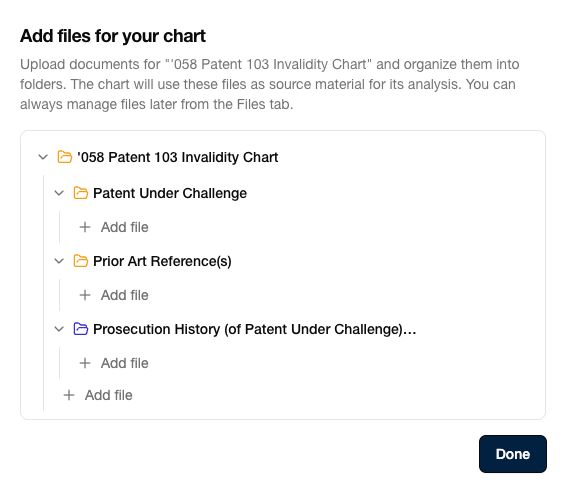
Start a new Charts project and upload the challenged patent alongside your prior art set: patent references, non-patent literature, standards contributions, and/or product documentation. Charts is built to work across large document sets, so you don’t need to pre-filter to a shortlist before you start mapping.
Choose the columns you require. For a §102 chart, that’s typically the claim-element column plus a single reference column. For a §103 combination, add a column per reference and, optionally, a synthesis column summarising what the combination teaches for each element. Column structures, citation formats, and stylistic preferences are saved as reusable templates, so firm and company conventions carry across every chart your team produces.
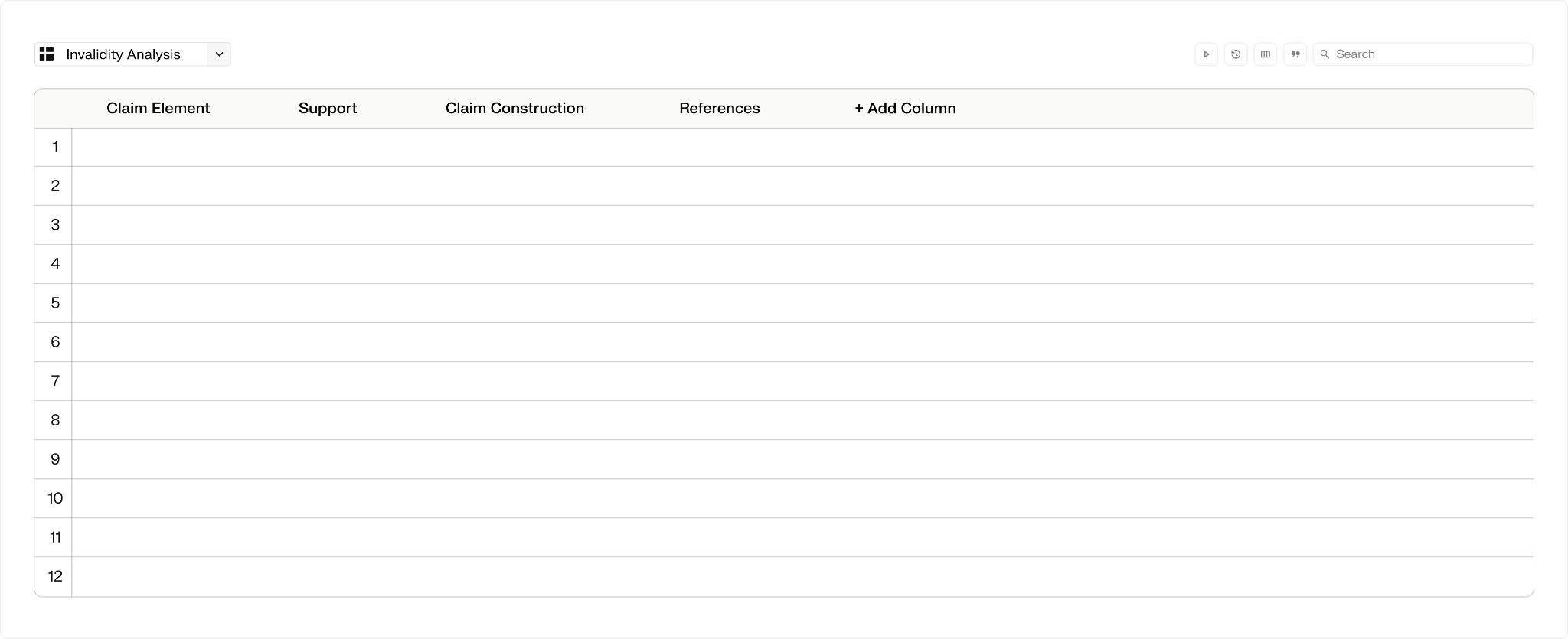
Charts generates the limitation-by-limitation mapping in seconds to minutes, depending on the size of the document set. Each cell characterises the relevant disclosure and anchors it with a pinpoint citation, including column and line numbers for patents, and page or paragraph for NPL, and embeds figures where the disclosure is pictorial.
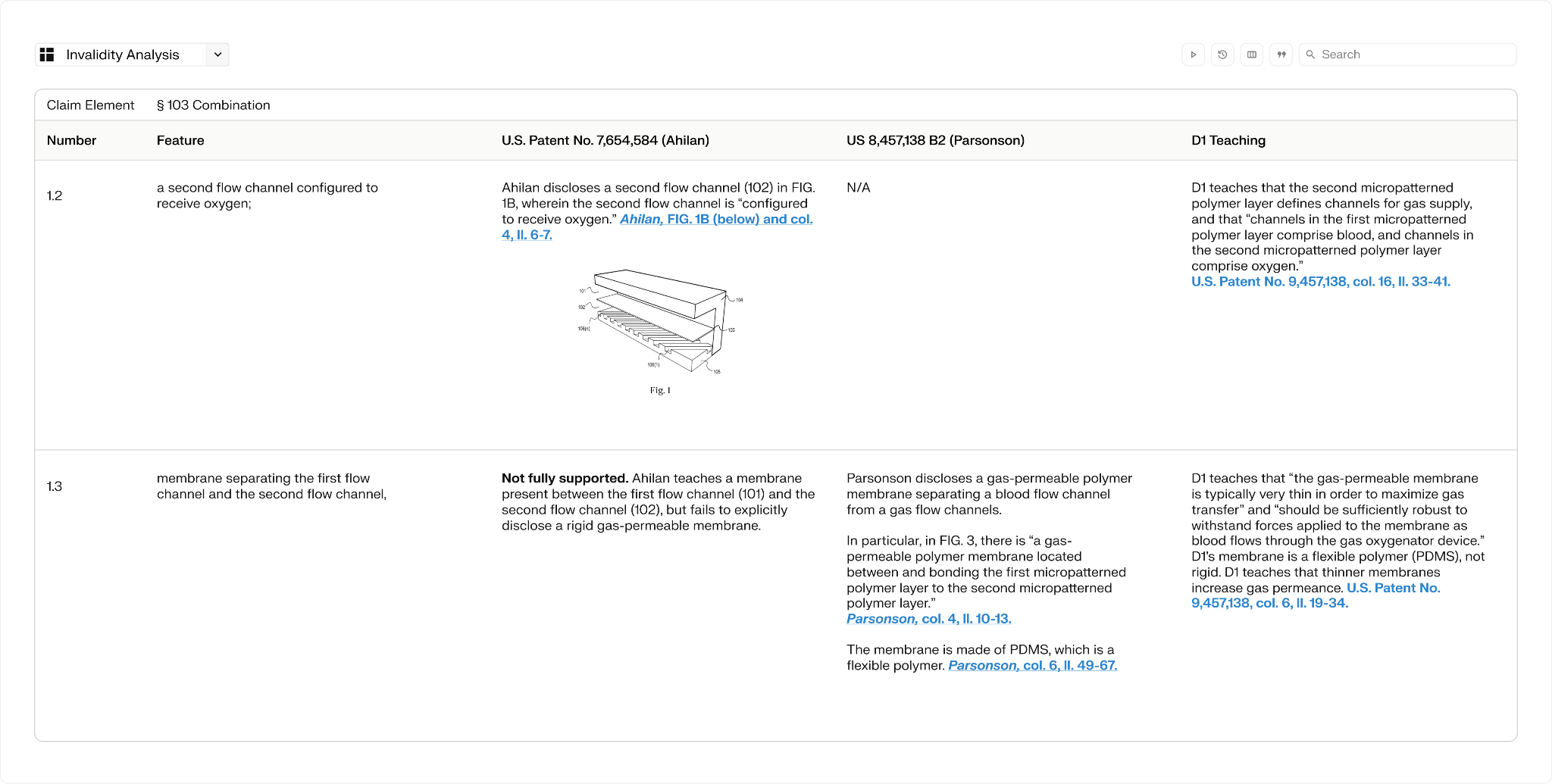
This is where attorney judgment is applied. Expand the reasoning behind any cell to see exactly why a limitation was mapped the way it was, and verify it against the source. Where a reference doesn’t fully disclose an element, Charts says so plainly. Iterate on style and substance, then export when the chart is ready for the next stage of review.
Three things distinguish the output in practice:
• Coverage across large document sets: Charts surfaces element-to-disclosure connections across hundreds of documents, including buried NPL and figure-only disclosures, that a manual reviewer might take days to find.
• Honest gap-flagging: Where a reference doesn’t disclose an element, the chart marks it (“N/A” or “not fully supported”) rather than papering over the hole.
• Citation transparency: Every mapping in a Charts-generated invalidity chart is anchored to a pinpoint, source-level citation, so reviewing attorneys verify each element-to-disclosure link against the underlying document, not against an AI summary, before anything is served or filed.
As John Rabena, Sughrue Mion’s Managing Partner, puts it:
“Solve has allowed our attorneys to … focus more on higher level strategic analysis. It allows us to give our clients more thorough, robust, and thoughtful representation for their global patent portfolios”
Invalidity claim charting sits at the centre of patent litigation strategy. Getting it right, limitation by limitation, theory by theory, and citation by citation, is what separates a contention that holds up from one that gets struck.
If your team is spending days on work that should take hours, or managing high-volume invalidity projects where consistency and speed both matter, Solve Intelligence’s Charts is built for exactly that workflow. It was built by patent attorneys and AI researchers, shaped by litigation practitioners, and designed to handle the full technical depth of invalidity analysis at scale.
Request a demo to see how it fits your team.