The specification is substantially complete, the claims have been revised several times, the figures are ready, and the filing deadline is close. One final review remains.
That review has unusual leverage. Before filing, the drafting team can still correct a missing embodiment, harmonize terminology, repair a dependency chain, or revise the claim architecture without creating a prosecution record.
After filing, the same problem may be constrained by the new-matter prohibition, loss of priority for added disclosure, narrowing amendments, or an issued claim that carries an avoidable ambiguity into enforcement.
This article presents a U.S.-focused pre-filing QA framework organized around four recurring risk areas: definiteness and antecedent basis under 35 U.S.C. 112(b); dependent-claim form under Sections 112(d) and (e); written description and enablement under Section 112(a); and consistency among the claims, specification, and drawings.
The emphasis is practical: where defects hide, why experienced drafters miss them, and how a structured workflow, including the kind of automated patent proofreading now built into platforms like Solve Intelligence’s Patent Copilot, can surface them before filing.
The case for a disciplined pre-filing review is based in asymmetry. The legal and practical options change at the moment of filing.
Under 35 U.S.C. §132, an amendment may not introduce new matter into the disclosure of a pending application. Section 251 imposes the same basic restriction in reissue. A continuation-in-part can add disclosure, but the added subject matter generally receives the later filing date. It does not retroactively cure a support problem while preserving the original priority date for the new material.
That distinction matters. A missing intermediate value, alternative embodiment, structural feature, or supporting example may limit the claims that can validly receive the original filing date. Pre-filing QA therefore should test not only whether each element of the invention disclosure appears somewhere in the application, but whether the disclosure fully encompasses the intended scope and priority position.
An amendment that narrows a claim necessarily reduces its literal scope. Under Festo Corp. v. Shoketsu Kinzoku Kogyo Kabushiki Co., 535 U.S. 722 (2002), a narrowing amendment made for a substantial reason related to patentability can create a rebuttable presumption of prosecution-history estoppel as to the territory between the original and amended language. That principle can apply to a narrowing amendment made to address Section 112. A truly cosmetic amendment does not narrow the claim and does not create the same concern, and the Festo presumption may be rebutted in appropriate circumstances.
The practical point is not that every Section 112 amendment produces estoppel. It is that a drafting choice that can be made cleanly before filing may become a scope-narrowing amendment, and a more complicated prosecution record, after filing.
The legal standard also depends on posture, and the difference is practical rather than merely formal. During examination, the USPTO applies its own framework: it gives claims their broadest reasonable interpretation and, under In re Packard, 751 F.3d 1307 (Fed. Cir. 2014), may require clarification whenever claim language is ambiguous, vague, incoherent, opaque, or otherwise unclear.
That threshold is comparatively easy for an examiner to invoke, precisely because the applicant can still respond by amending; the objection is an invitation to sharpen the language, not a final verdict on the claim. Once the patent issues, the posture reverses. Under Nautilus, Inc. v. Biosig Instruments, Inc., 572 U.S. 898 (2014), a court will hold a claim invalid for indefiniteness only if, when read in light of the specification and prosecution history, it fails to inform a person skilled in the art of the scope of the invention with reasonable certainty, and it reaches that question against the statutory presumption of validity, on clear and convincing evidence, and without redrafting the claim to save it.
Because the standards differ, the same words can be treated very differently at the two stages. Take a claim reciting a material of "high" tensile strength. During examination, an examiner may flag "high" as unclear and ask the applicant to anchor it, either to a numerical threshold, or to a standard disclosed in the specification, which is a correction the applicant can make freely and at little cost. If the term instead issues unaddressed, its definiteness falls to be decided under Nautilus: the claim may survive if the specification already gives a skilled reader a reasonably certain yardstick for "high," but it is exposed if it does not, and there is no longer any opportunity to add one.
A routine clarification in prosecution thus becomes a validity question in litigation, which is exactly why the pre-filing pass should resolve terms of degree and comparable ambiguities while amendment is still free and wholly within the drafter's control.
Pre-filing QA is also a matter of professional discipline. USPTO Rule 11.101 requires the legal, scientific, and technical knowledge, skill, thoroughness, and preparation reasonably necessary for the representation. A repeatable review process supports that standard, improves supervision, and reduces avoidable client cost and delay.
The strongest framing is simple: pre-filing is the last point at which the drafting team can address the widest range of problems without the constraints of an existing filing record.
Not every issue deserves the same response. A useful QA system ranks findings by legal and practical significance so that attorney attention goes first to the issues that can affect priority, scope, patentability, or validity.
| Tier | Character | Representative issues | Typical response |
|---|---|---|---|
| Tier 1 - Substantive risk | Potentially affects priority, validity, or commercially important scope | Written-description gaps; possible nonenablement across a claimed range or genus; missing support in a priority application; material indefiniteness | Pause filing and escalate for substantive attorney review |
| Tier 2 - Prosecution and scope risk | Usually correctable, but may create delay, cost, or narrowing | Unclear antecedent basis; improper or contradictory dependencies; non-nested numerical ranges; terminology conflicts; claim terms with only uncertain disclosure support | Attorney review and targeted correction, followed by a full re-scan |
| Tier 3 - Formal and editorial risk | Usually low substantive risk, but creates friction and can mask larger problems | Reference-character mismatches; claim-number errors; typographical defects; formatting noncompliance | Correction and verification |
The taxonomy is not a legal conclusion. It is a triage tool; it tells the attorney where substantive review is needed. Likewise, an orphaned reference character may be cosmetic, but it can reveal that a figure, embodiment, or paragraph has fallen out of step with the rest of the application.
Antecedent basis is a common and easily misunderstood pre-filing issue. As a drafting convention, an indefinite article such as "a" or "an" ordinarily introduces an element, while "the" or "said" ordinarily refers to an element already introduced. Thus, "the controller" usually should trace a previous reference to "a controller" in the claim or in a claim from which it depends.
The difficulty is that antecedent relationships are nonlocal. An element introduced in claim 1 may be referenced many claims later, through several dependency levels, after claim 1 has been revised repeatedly. A local edit can therefore break several downstream claims without changing their text.
Two patterns recur:
But the absence of an express antecedent is not automatically a Section 112(b) defect. In Energizer Holdings, Inc. v. International Trade Commission, 435 F.3d 1366 (Fed. Cir. 2006), the Federal Circuit held that "said zinc anode" was not indefinite even though the claim lacked an express introduction using "a zinc anode," because the antecedent was present by implication and the claim remained understandable. MPEP §2173.05(e) takes the same general approach: an express word-for-word antecedent is not always required if the claim's scope is reasonably ascertainable.
The correct QA response is therefore to flag a definite reference that lacks an obvious antecedent, then ask:
1. Is the referent necessarily or reasonably implied by the claim language?
2. Would a person of ordinary skill understand which element is meant?
3. Does the reference create more than one reasonable reading?
4. Can the wording be clarified without changing intended scope?
Terms of degree require the same discipline. Words such as "substantially," "about," "high," and "effective amount" are not indefinite per se. The question is whether the claim, read in context, provides objective boundaries that a skilled artisan would understand.
Those boundaries may come from the specification, the prosecution record, a stated test or measurement protocol, or an art-recognized standard. Automated review should surface the terms; counsel must determine whether the intrinsic record and the knowledge in the art supply an adequate anchor.
Section 112(d) requires a dependent claim to refer to a previous claim and to specify a further limitation. By statute, the dependent claim incorporates every limitation of the claim from which it depends.
That last point is essential. A dependent claim does not shed or replace a parent limitation merely because its text appears to use broader or different language.
Consider three examples:
1. No further limitation
Claim 1 recites "a housing formed from stainless steel." Claim 5 recites "the apparatus of claim 1, wherein the housing is formed from metal." Because stainless steel is already a metal, claim 5 adds no further limitation unless it includes some additional narrowing feature.
2. Contradictory ranges
Claim 1 requires a concentration of "at least 50%." Claim 4 recites "the composition of claim 1, wherein the concentration is from 30% to 40%." Because the dependent claim incorporates the parent limitation, no concentration satisfies both requirements. The problem is internal inconsistency, not simple broadening.
3. Partially overlapping ranges
Claim 1 recites 5% to 15%, and claim 4 recites 2% to 8%. Because claim 4 still incorporates claim 1, the combined limitations may be read as the 5% to 8% intersection. That may preserve some scope, but the drafting is needlessly confusing and invites a Section 112 issue. A properly nested range should be stated directly.
A methodical range check can identify these relationships instantly. The attorney then decides whether the dependent claim should be rewritten with a nested range, converted to independent form, or reorganized under a different parent.
Multiple dependent claims require a separate validation under Section 112(e) and 37 C.F.R. 1.75(c). They must refer to prior claims in the alternative only, not cumulatively. A multiple dependent claim may not serve as the basis for another multiple dependent claim. For each alternative, the claim incorporates the limitations of the selected parent, and fee counting follows the applicable USPTO rules.
A dependency-graph review should therefore verify:
Antecedent basis and dependency checks are largely structural. Section 112(a) review is substantive.
Written description and enablement are distinct requirements. Ariad Pharmaceuticals, Inc. v. Eli Lilly & Co., 598 F.3d 1336 (Fed. Cir. 2010) (en banc), confirms that written description asks whether the disclosure demonstrates possession of the claimed invention as of the filing date. Enablement asks whether the disclosure teaches a person of ordinary skill to make and use the full scope of the claim without undue experimentation, evaluated in light of the considerations associated with In re Wands, 858 F.2d 731 (Fed. Cir. 1988).
The Supreme Court's decision in Amgen Inc. v. Sanofi, 598 U.S. 594 (2023), reinforces the full-scope principle: the more a claim covers, the more the specification must enable. That does not mean every embodiment must be individually described or exemplified. It means the disclosure must provide a workable teaching commensurate with the scope claimed, rather than leaving the skilled artisan to undertake an unreasonable research program.
Genus written description remains context dependent. Representative species and common structural or other identifying characteristics can be important, particularly when a genus is defined primarily by function. AbbVie Deutschland GmbH v. Janssen Biotech, Inc., 759 F.3d 1285 (Fed. Cir. 2014), illustrates the risk of disclosing a narrow portion of a genus while claiming much more.
But the Federal Circuit's 2026 decision in Teva Pharmaceuticals International GmbH v. Eli Lilly & Co. rejects a bright-line rule that a disclosed species must always be structurally similar to the accused product to be representative. The inquiry depends on the claimed invention, the state of the art, and what the specification would convey to a skilled artisan.
A claim to a pH range of 4 to 9 supported by working examples at pH 5 and 7 is not automatically non-enabled. It is, however, a sensible review trigger. The answer depends on factors such as predictability, the specification's guidance, the significance of the endpoints, the amount of experimentation required, whether the variable is known to affect a result, and what was known in the art.
Likewise, a claim term that does not appear verbatim in the detailed description is not automatically unsupported or indefinite. The disclosure may use an equivalent expression, the meaning may be implicit, and original claims themselves may contribute written-description support. A vocabulary comparison is valuable because it identifies where counsel should investigate; it should not be treated as an automatic legal verdict.
A useful drafting default is: one concept = one term. It is not a rule of law, and deliberate variation may be appropriate, but unintentional terminology drift creates avoidable uncertainty.
Suppose the detailed description calls a component a "fastening member," the claims call it a "coupling element," and the figures identify it as an "attachment device." The terms may be coextensive, partially overlapping, or intentionally distinct. Unless the document makes the intended relationship clear, the inconsistency can create written-description questions, complicate claim construction, and slow examination.
A consistency review should compare the lexicons of the claims, description, abstract, and drawings, rather than reading each section in isolation. It should flag:
Reference-character integrity is a related but distinct formal check. Under 37 C.F.R. 1.84(p)(5), reference characters mentioned in the description should appear in the drawings, and reference characters used in the drawings should be mentioned in the description. The same feature should use the same reference character throughout. This is narrower and more accurate than saying that every numeral in the text must appear in a figure.
Transitional phrases deserve deliberate review as well. "Comprising," "consisting of," and "consisting essentially of" carry different scope implications. A phrase that changed during editing, or that differs across parallel claims without a strategic reason, can materially alter the intended coverage.
The causes are structural:
These are not arguments against attorney review. They are reasons to structure it so that attorneys spend their time on legal and technical judgment rather than exhaustive clerical comparison.
Human and automated review are strongest in different areas.
The attorney remains essential for questions of judgment: what the invention is, how broadly to claim it, whether a functional genus is adequately supported in the relevant art, whether an implied antecedent is clear, whether a term of degree has an objective boundary, and how a proposed change affects prosecution and enforcement strategy.
Automation is well suited to exhaustive comparison: tracing antecedent chains across a claim set, validating the dependency graph, comparing ranges, reconciling terminology across the application, and checking reference characters between text and figures. Software does not become less attentive at claim 40 or skip the second scan because the deadline is close.
The synthesis follows directly. Automated patent proofreading is not a replacement for the attorney; it is a force-multiplier for the attorney’s judgment. Its job is detection and triage: to find every candidate defect, rank it by severity, and present it so that scarce, expensive judgment is spent on decisions rather than on hunting. The machine narrows the field to what needs a human, and the human decides next steps. A QA process built on that division of labor is faster and more thorough than either could be alone.
A checklist is useful, but reliability comes from a repeatable process. The following seven-step workflow is practical for both law firms and in-house teams.
1. Freeze the near-final draft. Run QA after substantive drafting is substantially complete but before the filing package is finalized. Establish a rule that filing cannot proceed until the review is signed off, and that the review is performed on the most updated draft.
2. Run a full-document first pass. Review the claims, description, abstract, and drawings together. Test antecedents, dependencies, ranges, terminology, reference characters, and apparent claim-to-disclosure support.
3. Triage by significance. Escalate possible priority, written-description, enablement, and material definiteness issues. Route formal issues for batch correction.
4. Adjudicate with attorney judgment. Confirm whether an implied antecedent is clear, a range is supported, a genus is enabled, or a terminology difference is intentional.
5. Re-scan after edits. Corrections can create new problems. For example, renumbering can break dependencies, terminology changes can introduce fresh inconsistency, and narrowing one range can cause it to conflict with another.
6. Record sign-off. Document that the review occurred, who resolved substantive items, and which issues were intentionally accepted. The purpose is to establish internal supervision and process consistency.
7. Feed recurring issues upstream. Use repeated findings to improve templates, drafting guidance, training, and client-specific style rules.
The re-scan is critical. A QA process that identifies defects but does not validate the corrected document leaves the loop open.
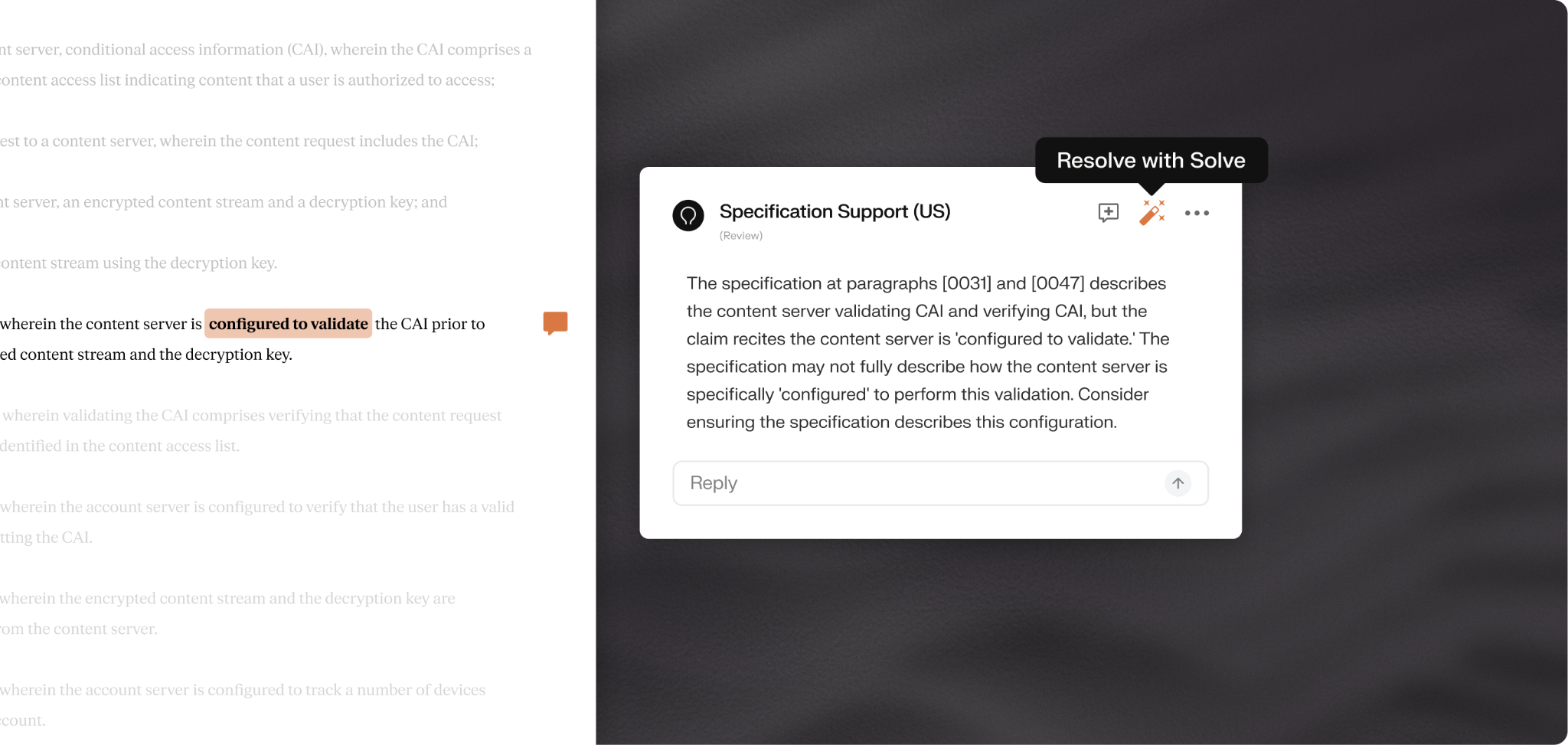
This is the review problem Solve Intelligence was built to solve. Solve reads the claims, specification, and drawings together, and checks the document against §112 requirements, the same way a meticulous reviewer would if a meticulous reviewer never tired and never ran out of time.
In a pre-filing context, that can include:
Because Solve works across the full patent lifecycle, that same review discipline carries downstream: the terminology and support checks that harden an application before filing are the same ones that speed office action responses and claim chart generation later in prosecution.
Throughout, the attorney remains the decision-maker. Solve does the exhaustive detection, triage, and even suggests how to resolve flagged issues, while the practitioner exercises the judgment that only a practitioner can.
The final pre-filing review is one of the highest-leverage steps in patent prosecution because it occurs before the drafting record hardens into a filed application. At that point, the team can still repair disclosure, clarify claim language, restructure dependencies, harmonize terminology, and correct figures without adding new matter or creating an amendment record.
Treating that review as a structured, risk-ranked workflow is not clerical perfectionism. It is part of building a patent application that is easier to prosecute, more defensible after issuance, and better aligned with the client's commercial objectives.
Over 700 IP teams across six continents use Solve Intelligence across the full patent lifecycle, from invention harvesting and drafting through prosecution and litigation. Whether you want to harden applications before filing, cut your office action response time, or accelerate claim chart generation, the platform is built around how patent attorneys actually work. Request a demo at solveintelligence.com.
For teams still evaluating options, Solve Intelligence’s guide to choosing patent drafting software and its breakdown of the best AI patent drafting tools set out the full evaluation framework, including the security, patent-specific training, and attorney-review integration that a professional practice requires.
Isn't automated proofreading too risky for a patent filing?
The risk depends on how the tool is used. Automated review should not file an application, make final legal decisions, or replace attorney sign-off. Its role is to surface candidate issues for counsel to evaluate. Used that way, it addresses a different risk: the defect that no one notices during a compressed final review.
Counsel should also validate the tool's performance on representative work, understand its limitations, and maintain a review process appropriate to the matter's technical and commercial significance. Every edit made by the tool should be traceable.
Does every claim term without an express antecedent need to be corrected?
No. Energizer Holdings and MPEP 2173.05(e) recognize that antecedent basis may be implicit when the claim remains reasonably clear to a skilled reader. The appropriate approach is to flag the reference and decide whether the intended referent is unambiguous. Automatic amendment can be as problematic as automatic acceptance if it changes scope or introduces unnecessary wording.
Can automated QA identify Section 112(a) issues, or only formal defects?
It can surface patterns that warrant Section 112(a) review, such as a claim term that appears only in the claims, a range that extends substantially beyond the disclosed examples, or a functional genus supported by a narrow set of embodiments. Those are issue-spotting signals, not legal conclusions. Written description and enablement remain fact-intensive attorney determinations.
How does the process change for PCT national-phase entries and foreign filings?
The core consistency checks remain useful, but local law and practice vary. National-phase and foreign-filing work can introduce additional drift because claims may be adapted to local practice, specifications may be inherited from priority documents, and translations may be prepared by different teams. Review should therefore include terminology alignment across languages, preservation of support and priority, local dependency rules, and jurisdiction-specific formal requirements.
Should automated QA run before or after the final attorney review?
It should be integrated into that review. A practical sequence is: automated first pass on the near-final draft, attorney adjudication and correction, then a second automated pass to verify the edited document. The tool changes what the attorney spends time on - from hunting for every possible inconsistency to deciding the significance of identified issues - but it does not eliminate the final legal review.
What about client confidentiality when using an AI review tool?
Confidentiality is a threshold diligence issue. Before using any AI platform on client work, counsel should assess the applicable professional-conduct rules, engagement terms, client policies, data use, retention, access controls, subprocessors, hosting location, incident response methodology, and whether disclosure or consent is required.
Solve Intelligence is SOC 2 Type 2, ISO 27001 and ISO 42001 certified; all data is encrypted with AES-256 at rest and TLS 1.3 in transit; and client data is never used to train AI models. The platform is designed to meet the confidentiality requirements of leading law firms and corporate IP departments, including those with strict data-governance policies.
View Solve Intelligence's security certifications