The patent landscape search is routinely conflated with novelty, knockout, and patentability searches. While all may be associated with surveying the public domain, the deliverable of a patent landscape search is unique for at least two key reasons.
All of these searches may inherently indicate a saturation level of art within a particular area (e.g., technical field, country, applicant, etc.). Whereas other searches are aimed at finding barriers, namely novelty-destroying references for knockout searches and patentability-hindering references for patentability searches, a patent landscape is primarily conducted for the purposes of locating gaps that may indicate areas of potential investment, for example.
Non-patent literature (NPLs), such as in the form of journal articles/manuscripts, whitepapers, and defensive publications, may be relevant for establishing potential rejections during patent prosecution. Patent landscape searches are, however, generally focused on patents and published applications.
The patent landscape search utilized in research and development (R&D) is thereby akin to the review of literature typical to academic research. It is no surprise that the remainder of these processes bear a striking resemblance, as exemplified below:
| Stage | Academic Research | R&D |
|---|---|---|
| Step 1: Identify the gap | Literature Review | Patent Landscape Search |
| Step 2: Testing | Experimentation | Product Development |
| Step 3: Public disclosure | Publication | Patent Filing |
| Step 4: Incentive to innovate | Citation and collaboration | Limited monopoly + licensing |
Patent landscape searches thus act as the unifying factor between the research and development stages in the innovation process. By providing insights regarding underexplored territory within the art, they provide patent practitioners and clients with the ability to focus development efforts onto those products of potentially highest commercial value, as well as those of highest opportunity for broad claim coverage.
Additionally, patent landscape search results may assist with freedom-to-operate by confirming uncharted areas of innovation such that R&D teams may proceed with commercialization with reduced fear of unintentional infringement of competitors. Alternatively, by identifying areas of overlap with other patent holders, landscapes may also help assess the advantages and risks of growth opportunities, such as acquisitions and joint ventures.
It is important to note that in comparison to other parts of the patenting process, the results of a patent landscape search can be highly subjective, depending on the technology areas, companies, and/or jurisdictions being assessed: A result of 1,000 active patents may signify a research discipline that is ripe for progress in some cases while proving overdeveloped in others.
For this reason, the value of a patent landscape search lies primarily in the analysis of the outputted art rather than the identity of the publications themselves. In fact, many institutions including WIPO publish landscape reports for selected areas produced both internally and by external organizations to assist with the search process.
Each review team may set unique thresholds for the answers to these questions depending on their specific goals, which may vary over time. The intention is to highlight potential opportunities rather than conclusively steer decision-making.
More than 500 art units and 250,000 classification codes are employed by the U.S. Patent & Trademark Office (USPTO) to classify the subject matter of filed applications into technical fields, a reflection of the highly robust and diverse nature of the current patent landscape. While many may still rely on keyword and Boolean search mechanisms to sift through this landscape of pending, issued, and expired patents, such methods are becoming increasingly limited.
For one, new technology such as automated drafting tools is spearheading the rise in complexity of filed applications, reducing the likelihood that even a thorough keyword search will uncover the most relevant applications.
For two, the recent shift towards flat-fee billing may place pressure on practitioners to optimize time dedicated to searching cases, discouraging the time-consuming cycle of iteratively changing and shifting search terms.
AI platforms are consequently becoming an invaluable resource for patent practitioners, technology transfer offices, and R&D companies that rely on such searches for sanctioning of development endeavors. For instance, the Competitive Landscape & White Space Analysis template provided in Solve Intelligence’s Charts module is capable of:
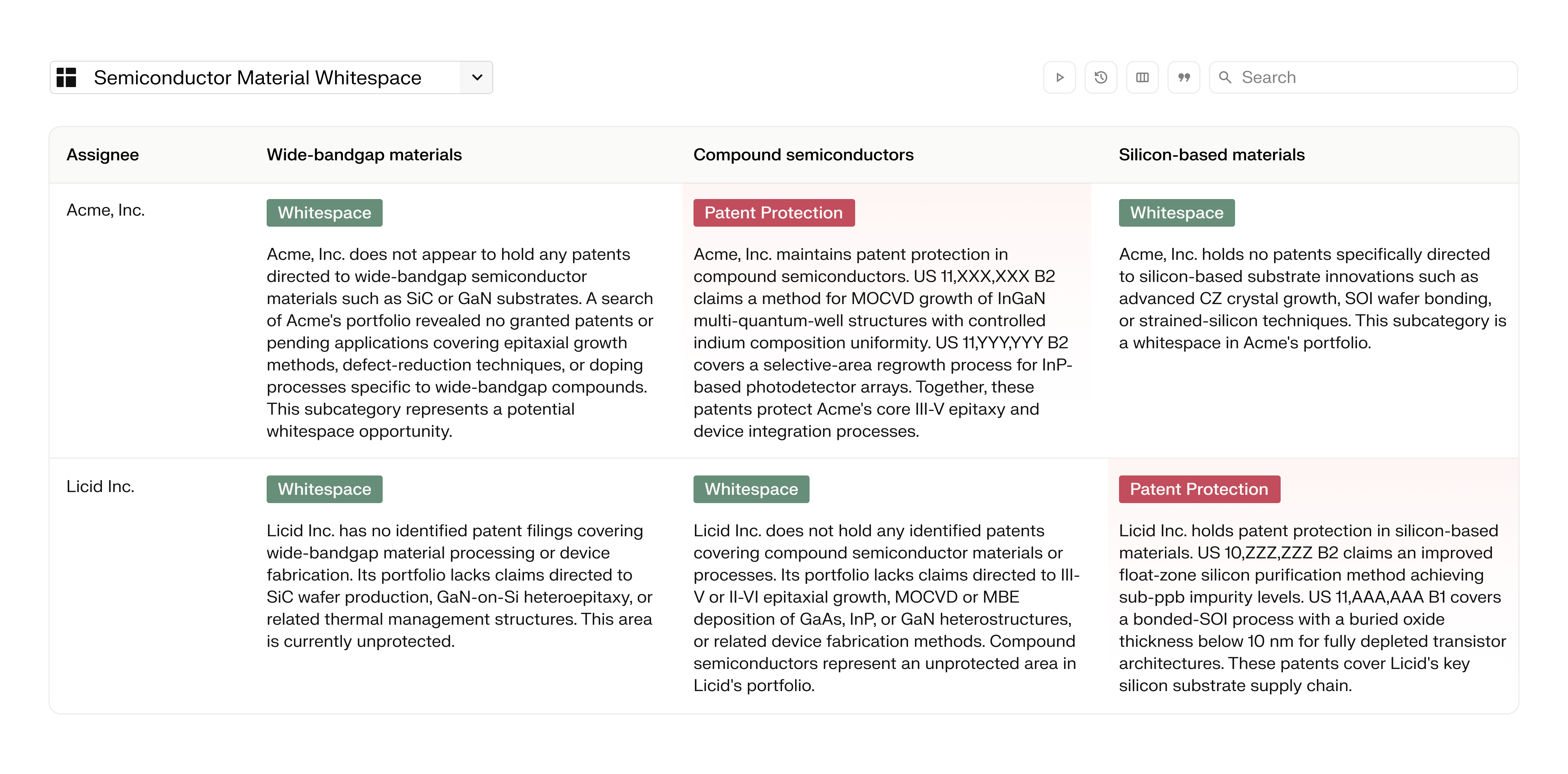
Human oversight is of course always desirable when it comes to using AI as a resource for client deliverables. However, owing to the broad nature of landscape searches, the degree of human scrutiny required for processes such as drafting claims or interacting with clients may not be necessary when reviewing landscape opinions generated by AI, substantially reducing the mental and temporal load associated with traditional landscape searches.
AI-assisted patent landscape searches may consequently offer one of the highest returns-on-investment (ROI) with respect to purely human review owing to the sheer volume of content (often several thousands of patents/publications) analyzed and comparatively low risk. It can therefore be expected that the Charts module by Solve Intelligence and the advent of other such AI-integrated searching assistants may lead to the improvement in accuracy, utility, and cost of these searches in the coming future.
There is no overarching way to assemble the various patents that may be returned as a result of a patent landscape search, as each user may have his or her own preferences. While some may prefer the visual nature of three-dimensional renderings in the form of heat maps or topographical landscapes, others may find charts or tables more informative.
Not necessarily. The duty of candor is generally only applicable to references that are deemed relevant and could reasonably be relied upon in prosecution by an examiner. It is up to the reviewer’s discretion which references this applies to, usually a small minority of the results in the patent landscape.
The AI may attempt to reconcile the often vast number of references located by outputting contradictory or unclear interpretations of the landscape. Users can mitigate the occurrence of inconclusive results by interacting directly with the AI in chat and clarifying the objectives of the search. In addition, users can take advantage of citations automatically provided by the tool when performing the search to review and confirm the accuracy of generated analyses.
As with all other AI tools both within and outside the Solve umbrella, the Charts tool will produce optimal output when provided as much detail as possible. Users can assist the AI with the search and analysis by optimizing the quality of their inputted materials (e.g., description of technical field at hand) and spot-checking references as desired.