Patent drafting has always rewarded efficiency. Practitioners who move from invention disclosure to a high quality draft faster, without sacrificing technical precision, consistently take on more client work and retain it. Solve Intelligence's Patent Drafting Copilot was built specifically for that problem: a purpose-built AI drafting tool covering the full patent lifecycle so attorneys spend their time on claims and strategy, not boilerplate.
This article covers what AI assisted patent drafting looks like in practice today, the workflows it touches, the efficiency gains legal professionals are reporting, and what separates the firms getting results from those still experimenting.
Lumenci's 2026 guide to AI in IP workflows identifies that AI now improves IP workflows across five key areas: faster and more comprehensive prior art search, AI-assisted patent drafting that reduces attorney hours, automated office action analysis during prosecution, continuous portfolio analytics, and more efficient litigation support including document review and claim charting. Reported time savings vary by task and workflow: Solve Intelligence’s ROI analysis describes a conservative 30 percent efficiency gain per draft, with experienced users reaching 40 to 60 percent time savings on individual tasks when AI integrates into their workflows.
The five core areas where patent professionals are deploying AI today:
The Sterne Kessler 2025 AI and IP Year in Review confirmed that AI in IP practice is no longer experimental. Major IP firms launched proprietary tools for specification drafting in 2025, the USPTO issued revised inventorship guidance for AI-assisted inventions, and key obligations under the EU AI Act, the world’s first comprehensive AI legal framework, took effect.
AI systems handle the repetitive drafting tasks. Attorneys keep everything that requires legal judgment.
In practice, that split looks like this:
The areas AI doesn't touch: legal analysis, prosecution strategy, and final claim scope. Those require the attorney's judgment, knowledge of the client's competitive position, and understanding of the relevant prior art landscape.
The patent drafting process splits into two layers: the mechanical layer and the judgment layer. AI can assist with the first. The practitioner remains responsible for the second, and owns the work product.
The patent drafting process starts with an invention disclosure that can range from a thorough technical document to a rough email thread where the inventive concepts are buried. Getting from that to a coherent draft is where most non-billable time used to disappear.
With AI drafting assistance, the attorney inputs the invention details, and AI systems structure the disclosure, produce a description drafting pass covering detailed embodiments, and return a working draft in minutes. The attorney then reviews the draft against the original disclosure, refines the technical accuracy, and directs the claim drafting strategy.
Claim strategy is central to the commercial and legal value of a patent application. AI assists with generating initial claim sets, proposing dependent claims that cover alternative embodiments, and flagging potential issues with claim language consistency.
What AI can't do is determine the optimal claim scope given a specific competitive landscape or advise on prosecution strategy in view of cited prior art. That analysis requires the attorney's judgment on every application.
Modern AI patent drafting tools run on generative AI models, combined with patent-specific tooling, legal sources, templates, prompts, and workflow controls. These generative AI systems can propose claim alternatives, rewrite sections to improve consistency, subject to technical verification, and flag technical terms that don't match the description elsewhere in the document.
As Baker Botts reported in their January 2025 analysis of AI for patent drafting, the complex task of patent drafting still requires skills that AI systems can't deliver, and relying on AI to fill those gaps poses substantial risks. Every piece of AI generated output requires attorney review before the document progresses.
Most patent applications take 30 to 40 hours to draft, according to Childs Patent Law's filing guide. Prosecution adds further work. The USPTO’s FY2025 workload tables report that first actions rose to nearly 590,000 in FY2025, up from approximately 545,000 the previous year. Each rejection requires practitioners to analyse the examiner’s reasoning, assess cited prior art, and prepare amendments or arguments, potentially taking many hours of practitioner time for each response.
Well-implemented AI assistance can reduce patent drafting time substantially. Marbury Law founding partner Bob Hansen reported that complex applications and office actions that previously took 10 to 20 hours could be completed in two to three hours using Solve Intelligence.
The efficiency gains show up consistently in practitioner accounts. One attorney reviewing Solve Intelligence's Patent Copilot on G2 reported 60 percent or greater reduction in drafting time after integrating AI into a 25-year workflow. A second reviewer reported being “minimally 50% more efficient,” redirecting that time toward higher value strategic thinking. A third practitioner noted that Solve Intelligence saves even more time on office action responses than on initial drafts.
Thomson Reuters’ 2025 Future of Professionals Report found that legal professionals now expect to free up nearly 240 hours per year through AI adoption, up from 200 hours in 2024. For U.S. lawyers, that translates to an average annual value of $19,000 per practitioner, and law firms with a visible AI strategy are almost 4 times more likely to see benefits compared to firms without one.
Adoption and reported benefits vary substantially across practices around AI adoption. According to the 2025 Clio Legal Trends Report, among legal professionals who’ve widely adopted AI, 69 percent report a positive revenue impact, compared to just 36 percent overall.
The prosecution economics reinforce this. Roughly 86 percent of utility patent applications receive a non-final rejection at first action, according to a Yale Journal of Law & Technology study of 2.15 million applications. Legal teams that verify AI output against the original technical disclosure before finalizing a draft consistently produce high quality patents compared to those treating the first AI draft as close to done.
Prosecution is where AI patent tools deliver some of their sharpest competitive advantages. The firms seeing the biggest gains aren’t using AI only for drafting: they’re deploying it across the full prosecution lifecycle.
Sughrue Mion, the firm that has obtained more U.S. patents than any other law firm in the world, adopted Solve Intelligence enterprise-wide after firm-wide testing. The evaluation covered semiconductor design, pharmaceutical, chemical, cellular and network technologies, software, and automotive systems.
John Rabena, Sughrue’s Managing Partner, described the outcome: “Solve has allowed our attorneys to reduce time spent on routine aspects of patent drafting, prosecution, and analyses, and focus more on higher level strategic analysis. It allows us to give our clients more thorough, robust, and thoughtful representation for their global patent portfolios.”
Sughrue’s attorneys now use Solve Intelligence across core workflows:
Hauptman Ham, headquartered steps from the USPTO, integrated Solve Intelligence after a broad testing program spanning attorneys with both domestic and international expertise.
Firm leader Ron Embry described the impact: “The Patent Copilot system allows practitioners at Hauptman Ham to use more creative strategies in pursuit of broad, defensible patent claims for our clients.”
The firm uses Solve Intelligence for:
AI compresses the time needed to apply prosecution judgment, freeing attorneys for the strategic decisions that determine claim scope and client outcomes.
Large law firms hold a structural advantage in patent prosecution: more attorneys, more support staff, and more capacity to absorb the non-billable hours that prosecution demands. AI is changing that equation.
The Marbury Law case study demonstrates exactly how. Founding partner Bob Hansen tracked his own drafting time before and after integrating Solve Intelligence and saw a 3 to 4 times efficiency gain, which meant the firm could finally meet fixed-fee caps comfortably at partner rates. Faster turnaround also produced better applications: Hansen now delivers 120-paragraph applications covering more alternatives and details than the 70 to 80-paragraph applications he produced before AI assistance.
Clio’s 2025 Legal Trends Report reinforces the pattern: growing firms are twice as likely as stable firms, and nearly three times as likely as shrinking firms, to use time-saving automation. For solo practitioners and small IP boutiques, that creates a real window to compete on quality and speed without growing headcount.
What solo and small-firm practitioners are doing with the recovered time:
The difference between firms seeing measurable efficiency gains and those still running pilots isn’t just the tool. It’s how they’ve integrated it.
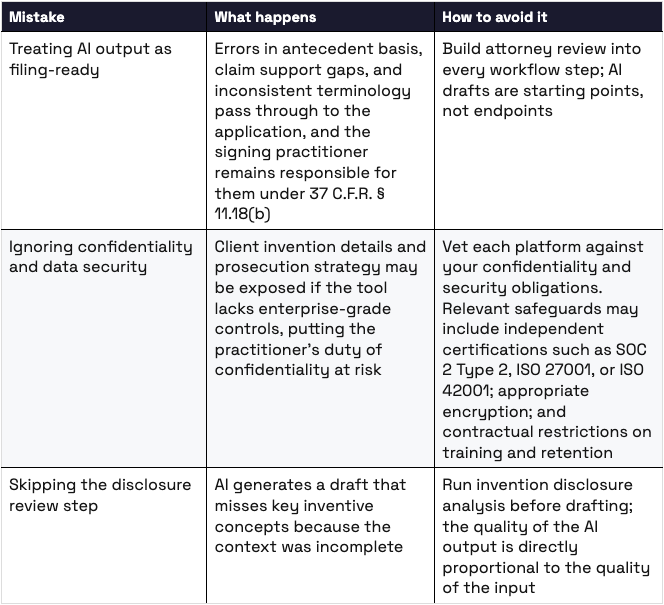
The firms getting the most from AI patent drafting share three characteristics. First, they treat AI output as a first draft, not a final draft. Every AI-generated claim set, response draft, or specification section gets reviewed by the supervising attorney before it moves forward. Second, they’ve built AI into the workflow at the disclosure stage, not the filing stage. Getting invention disclosures into the system early means the AI has the full technical context to produce better drafts. Third, they configure the AI system on their specific drafting style, claim preferences, and client requirements. Generic AI output and firm-tuned AI output are meaningfully different in quality.
The firms still experimenting tend to use AI for isolated tasks rather than integrating it across the drafting and prosecution lifecycle. They get incremental gains. The firms that have rebuilt their workflow around AI as a drafting layer, with attorney review as the standard step, are the ones seeing the kinds of efficiency gains documented in leading adopter case studies.
The key question for any IP practice isn’t whether to adopt AI patent drafting. It’s whether to build the process around it now or let competitors build theirs first.
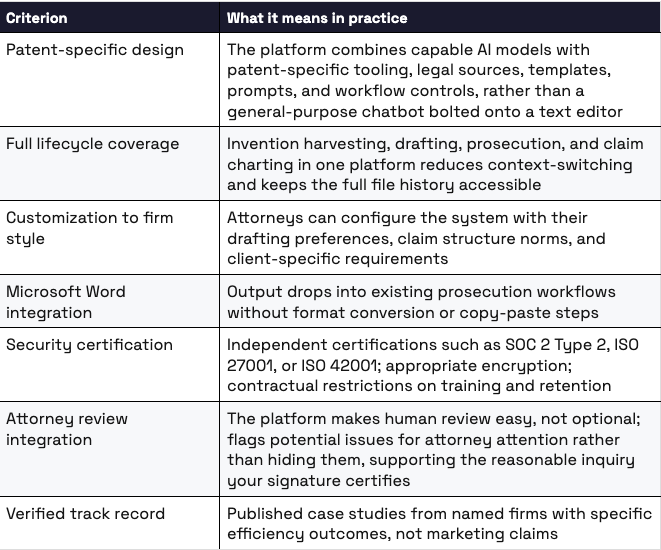
Solve Intelligence’s how to choose patent drafting software guide and breakdown of the best AI patent drafting tools cover the full evaluation framework in detail.
The firms pulling ahead aren’t the ones with the most AI. They’re the ones who built a hybrid model early, kept human review non-negotiable, and used AI to take on more complex work and serve more clients.
The regulatory and industry landscape shifted just as fast. Major IP firms launched proprietary drafting tools, the USPTO issued revised inventorship guidance for AI-assisted inventions, and key obligations under the EU AI Act took effect, all in 2025 alone. Solve Intelligence’s own platform grew by over 560 percent in user numbers that year, according to its 2025 Year in Review.
The question facing IP practices now isn’t whether AI belongs in the patent workflow. It’s how fast to build the process around it and how to do so without sacrificing the attorney judgment that determines claim quality and prosecution outcomes.
Over 700 IP teams across six continents use Solve Intelligence for invention harvesting, patent application drafting, continuations, divisionals, and office action responses. Whether you’re looking to cut your office action response time, accelerate claim chart generation, or build a more efficient drafting workflow from disclosure to filing, the platform is built around how patent attorneys actually work. Request a demo at solveintelligence.com.
Yes, measurably. AI patent drafting tools such as Solve Intelligence can reduce application drafting time by up to 80 percent for the description and initial claim drafting stages. In a published case study, Marbury Law reported that complex applications and office actions that previously took 10 to 20 hours were completed in two to three hours. The efficiency gains are consistent across firm sizes, though they depend on how thoroughly AI is integrated into the drafting workflow rather than used for isolated tasks.
Not without attorney review. AI patent drafting tools produce working drafts, not filing-ready documents. Antecedent basis issues, claim support gaps, and technical inaccuracies need to be caught and corrected by a supervising attorney before any application advances. The best results come from firms that treat AI output as a high-quality starting point and build review into every step of the process.
There is no general duty to disclose the use of AI drafting tools. The USPTO's April 2024 practice guidance confirmed that existing rules govern: the duty of disclosure under 37 C.F.R. § 1.56 applies only where information is material to patentability, and the signature certifications under 37 C.F.R. § 11.18(b) apply to every paper regardless of how it was prepared. What matters is that a practitioner has verified the accuracy of everything filed.
Thomson Reuters’ 2025 Future of Professionals Report found that legal professionals now expect to free up nearly 240 hours per year through AI adoption, translating to an average annual value of $19,000 per practitioner. Organizations with a visible AI strategy are 3.5 times as likely to see critical benefits compared to those without one. In patent-specific practice, case study evidence documents efficiency gains of 3 to 4 times on drafting workflows, with the biggest time recoveries coming from office action analysis and response drafting.
Solve Intelligence is SOC 2 Type 2, ISO 27001, and ISO 42001 certified. All data is encrypted with AES-256 at rest and TLS 1.3 in transit. Client data is never used to train AI models. The platform is designed to meet the confidentiality requirements of leading law firms and corporate IP departments, including those with strict data governance policies.
Solve Intelligence works from the invention disclosure through the full drafting lifecycle: structuring the disclosure, generating the detailed description, proposing claim sets, flagging antecedent basis and support issues, and assisting with office action responses. Attorneys direct and review at each stage. Customers consistently report 50 percent or greater efficiency improvements across drafting and prosecution workflows.
Solve Intelligence is built specifically for patent professionals, not adapted from a general-purpose AI platform. The platform combines capable AI models with patent-specific tooling, legal sources, templates, prompts, and workflow controls built around patent language, jurisdiction-specific drafting requirements, and prosecution workflows. Over 700 IP teams across six continents use it across the full patent lifecycle, from drafting to prosecution and litigation. General AI tools lack the patent-specific design, security, privacy, and AI-governance evidence, and workflow integration that professional patent practice requires.