This case study follows a fictional Markush claim from filing through EPO opposition to show why claim breadth survives pressure only when the application as filed contains explicit, self-contained fallback positions that can be defended under the EPC. A broad genus with no defensible retreat is worth less than a more modest claim drafted with sub-genera held in reserve from day one.
In 2026 an Opposition Division maintains a European patent in amended form. The claim that survives covers a subset of the originally claimed compounds. It is not the claim that was granted, and it is not any of the claims that were filed. It is a new claim based on a paragraph from the middle of the description that the examiner pointed at once, in 2022, that nobody thought about again, and that took perhaps twenty minutes to write on a Friday afternoon in March 2021, almost five years earlier.
This article works from that decision through a constructed case study, featuring a small-molecule compound series and application directed to the same, an EPO search opinion, an amendment by the applicant, an opposition, and finally a decision from the Opposition Division. Everything in this case study is fictional, and is built to be instructive rather than predictive. No part of it should be read as a forecast of what any division would decide on comparable facts.
The argument this article exists to make is narrow: breadth is not the asset; recoverable breadth is. A far-reaching Markush claim with no defensible fallback positions is worth less than a modest claim drafted with fallbacks. As every patent practitioner knows, and particularly those acting before the EPO, the difference between these two positions is settled entirely before filing, at the one moment in the life of a patent when adding subject-matter is a non-issue.
One note on tooling before we start, because it matters for how the product passages in this piece should be read. Software does not decide scope questions. What software can do is make scope decisions visible earlier, and cheap enough that they actually get made rather than deferred, but every judgment call is the attorney's.
A Markush claim enables a patent to cover many compounds inside one claim. These compounds will have a shared structural core and a shared technical effect. Three words describe the levels involved, and the whole of this case study turns on the relationship between them:
Our fictional applicant is Helion Therapeutics, a small cardiovascular biotech. Its compound series activates cardiac myosin for systolic heart failure, and structurally these compounds are ureas. One urea nitrogen carries an aryl or heteroaryl group. The other carries a benzene ring, and that ring carries a saturated six-membered amine (almost always a piperazine) attached through a one-carbon linker.
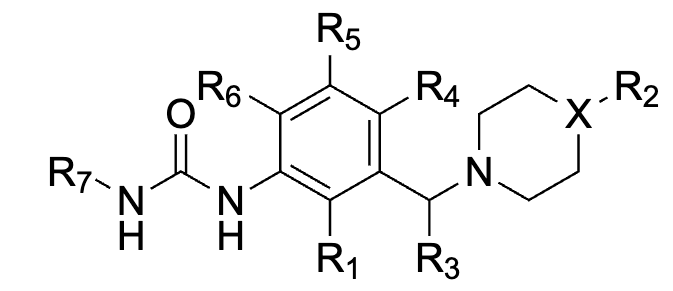
Claim 1 as filed defines eight variable positions as follows:
A list of species was handed over with an assay sheet. Some exemplary species are shown below, and the full species list is available for download at the end of this article.
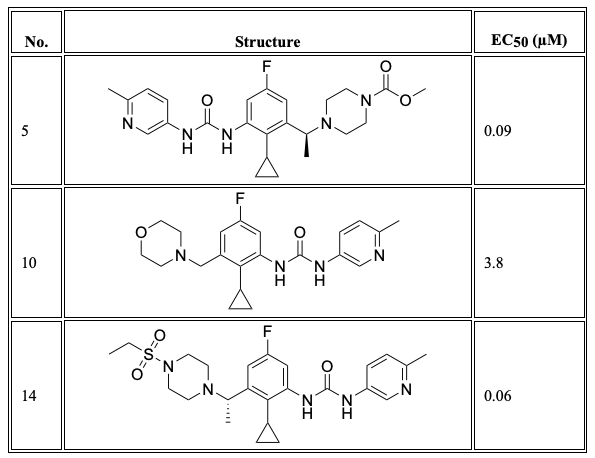
One housekeeping point to note upfront: compound 1 is not Helion's. It is a known drug in the field, included in the species list as a reference compound, with an EC50 of 1.2 µM.
Our fictional applicant's patent attorney uses Solve Intelligence. Upon receipt of the species list, they head to the Chemical Structures tab in Solve Intelligence's Drafting module, where they upload the list of species along with their assay data.
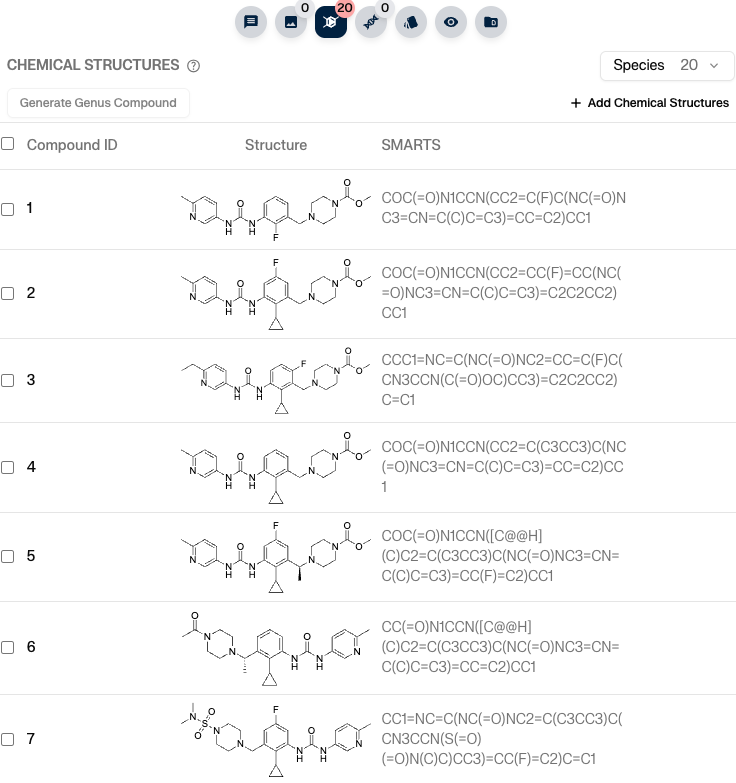
They use Solve Intelligence's Generate Genus Compound functionality to prepare an initial genus based on all of the species. This functionality simplifies the uploaded species and finds common structural patterns. In the present case study, because the linker carbon carries mixed R/S stereochemistry across the set, the generated genus leaves the stereochemistry unspecified.
That is worth holding onto. Genus generation finds what the species share, so it will not preserve stereochemistry the species do not share. In this case study, the stereochemistry turns out to be critical.
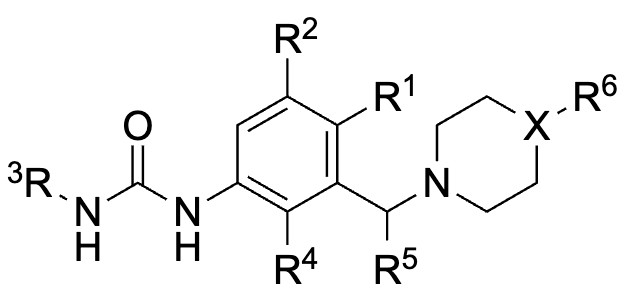
Still within the Solve Intelligence platform, our attorney iterates on the generated genus in the ChemDraw interface until they arrive at the genus that will become the subject of claim 1. That includes adding an additional R-group that the species do not exemplify at all to broaden the scope of protection. Keep that decision in mind; it comes back.
Here is the drafting rule this article exists to install, and it is deliberately unglamorous:
Every commercially meaningful sub-genus should appear in the application as filed as an explicit, self-contained statement.
Sub-genera are not directly and unambiguously derivable if they can only be assembled by the skilled person from several separate lists of preferences. Sub-genera should be disclosed as individualized paragraphs that recite the whole combination of features together. Why? Because when you later want to retreat to a sub-genus, you have to point at a disclosure of that combination of features in the application as filed. A skilled person's ability to construct a sub-genus by picking items from several lists is not the same thing, and the difference between these two situations is the difference between an available fallback and an added-matter objection.
Helion's attorney does this. Within Solve Intelligence, they generate further genera from different subsets of the species and write each into the description as paragraphs [0041], [0042], [0043] and [0044]. Only two become claims.
It is worth commenting on the shape of these sub-genera. They are not concentric rings of ever-narrowing scope but instead represent overlapping, partly disjoint regions. This is exactly why one of them remains at the end of this study.
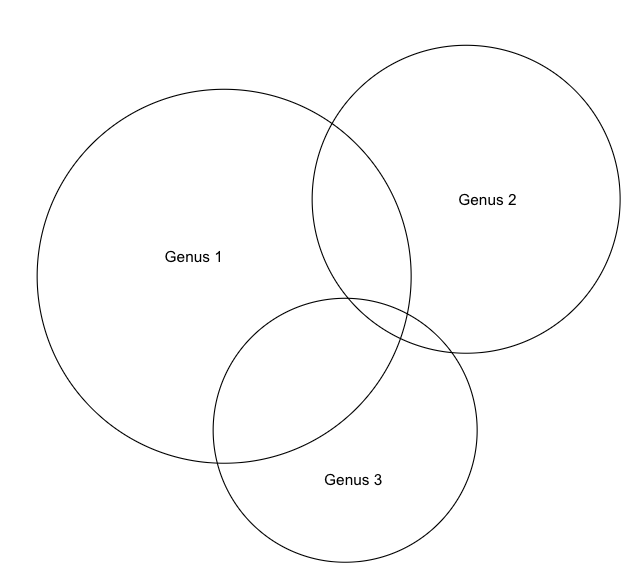
Solve Intelligence makes this exercise faster: the attorney can add or remove species from an already-generated genus, regenerate the genus using the Regenerate Genus functionality, compare changes side by side, and accept or reject them, leaving the attorney fully in control of the decision. In practice this meant around twenty minutes of work to create several candidate fallbacks; time well spent by the attorney in our case study.
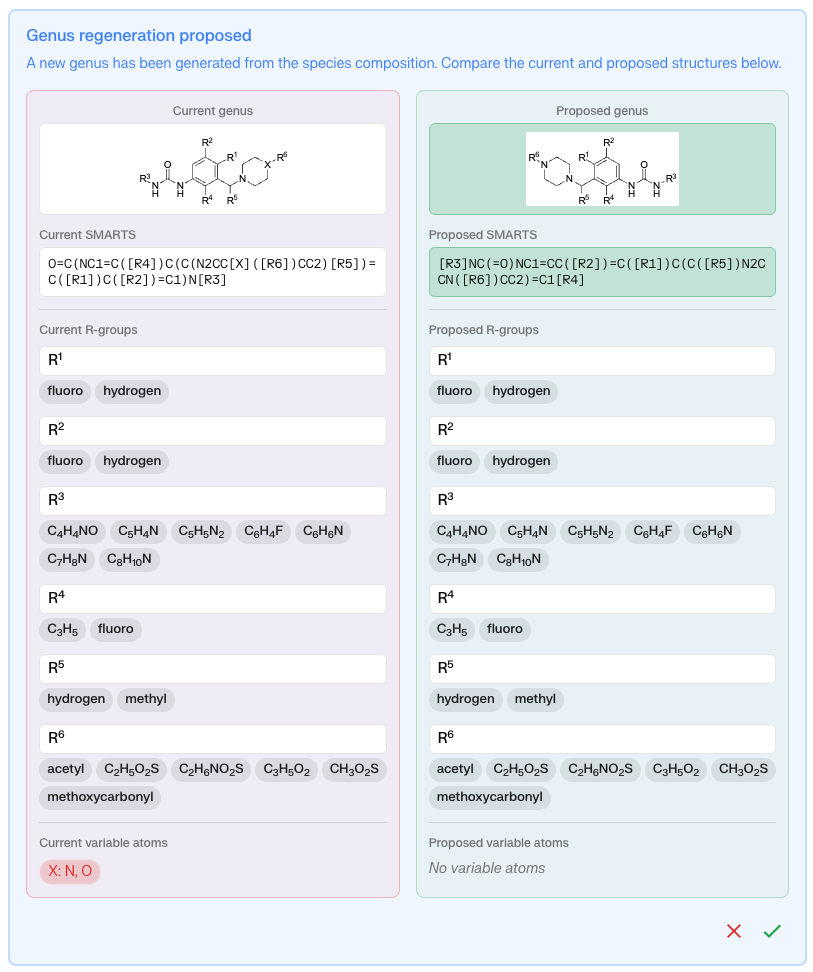
Without an efficient workflow, this work is easy to defer because the future objection is unknown. Facilitating this process efficiently is the key value proposition here, and it is worth considerably more than any individual judgment software might offer.
Note where we are in time. Nothing has been filed. There is no such thing as an amendment yet, and no as-filed disclosure to be constrained by. Our attorney is simply editing a draft. This is the first of three states, and the asymmetry between them is the spine of this article:
On support, the test is generous and the burden matters. A generic claim may be very broad, provided there is fair support and no reason to suppose the invention cannot be worked across the field claimed. An objection needs well-founded reasons for believing the skilled person could not extend the teaching by routine experimentation. But once a reasoned case is made, the onus shifts to the applicant to prove otherwise.
The practical takeaway is about the distribution of your species, rather than their volume. Where your examples sit within the scope of the genus matters far more than how many of them there are. A claim with many examples clustered around the lead compound supports less breadth than one with fewer examples spread across the whole scope of the genus.
At this point, Helion's attorney runs a review over the draft directly within Solve Intelligence. Solve Intelligence's Review functionality includes reviews intended for small-molecule applications filed at the EPO.
With Annotate Document enabled, the review results are presented as margin comments in the draft application itself. Two notable flags come back.
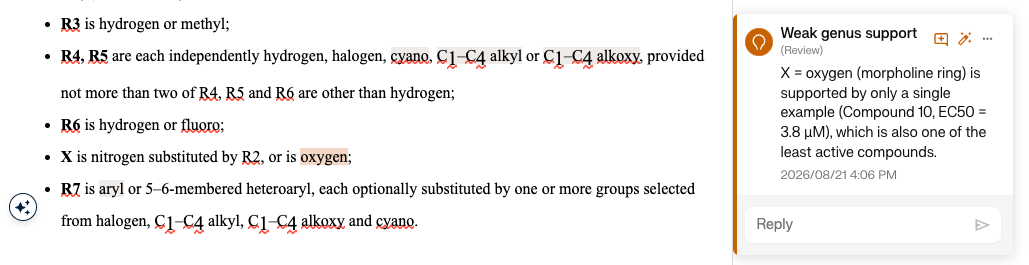
There are three honest options: generate more data, which would take six weeks or more; delete the weak portions of the genus now; or file and accept the exposure risk. A disclosure by Helion at a conference in ten days makes the first option unavailable. Not wanting to lose claim scope, Helion takes the decision to file the application as-is, and our attorney writes a dated file note recording exactly why.
That is the right ending for this section, and it is worth saying why: patent practitioners triage against deadlines and missing information constantly, and a case study in which every flag gets fixed is simply unrealistic.
Before the search opinion arrives, let us look at the data in our application. Three things are worth noting.
For inventive step to be acknowledged, a technical effect must be derivable from the application as filed. Later evidence can reinforce a teaching that is already there, but it cannot supply one that is not.
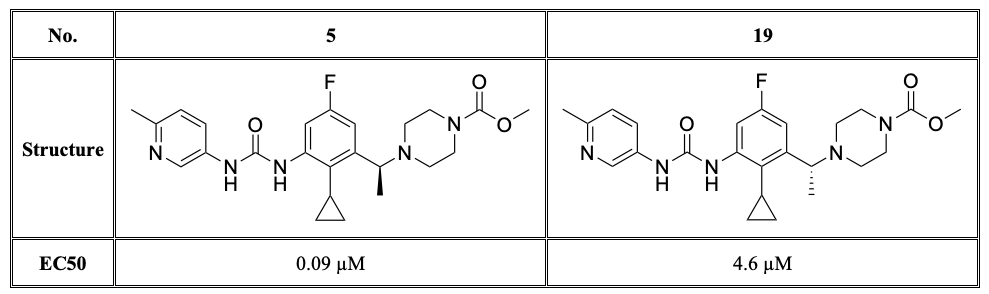
The stereochemical result is recorded in the application as filed in two sentences of paragraph [0045]:
"The configuration at the carbon bearing R3 is material to activity. Compound 5 and compound 19 are enantiomers differing only in that configuration, and differ in EC50 by a factor of approximately fifty. Compounds in which that carbon is in the (S)-configuration are preferred."
That is all the application says about it. The feature is not claimed, not separately exemplified, and not emphasized.
The EPO's search opinion issues in December 2022, and the objection our attorney braced for is not the one that arrives first.
Two doctrines frame what follows. Regarding novelty, where a specific combination requires selections from two or more lists of a certain length, the combination is novel unless the prior art points to it, and shortening lists does not help while they remain above the required length, usually two or three elements. This applies expressly to Markush formulae. Regarding unity, if one alternative in a Markush grouping is shown not to be novel together with the property relied on, the unity of the remaining alternatives has to be reconsidered.
The search opinion raises five issues.
First, the compound 1 oversight
The examiner finds claim 1 not novel over D1, which discloses the known drug referred to as compound 1 in our application. The search opinion states:
"The subject-matter of claim 1 is not new. D1 discloses at Example 118 methyl 4-{[2-fluoro-3-({[(6-methylpyridin-3-yl)carbamoyl]amino})phenyl]methyl}piperazine-1-carboxylate, together with data for its activity as an activator of cardiac myosin."
D1 is our opponent-to-be's own 2009 genus. It is directed to the same medical use, includes 214 worked examples, and discloses a generic formula broad enough to encompass Helion's formula (I). That generic overlap does not by itself anticipate every narrower genus; novelty is lost here because D1 Example 118 is a specifically disclosed species within claim 1. Our attorney had seen part of this coming, and had kept compound 1 out of the enumerated compound claim:
"It is noted that the compound of Example 118 of D1 is not among the compounds recited in claim 5, but that claim 1 is not limited so as to exclude it."
Good instinct, but incomplete execution. Claim 1's R1 list still offers fluoro, so the genus definition reaches compound 1 anyway.
Second, the reference no keyword search finds
A second document, D2, is a methodology paper on palladium-catalyzed carbonylative coupling. Entry 11 of its substrate-scope table is a compound that falls squarely inside claim 1. The paper contains no mention of myosin, of the sarcomere, or of biological activity of any kind; the compound exists in it purely as a synthetic demonstration. Nothing built from the target, the mechanism or the indication will ever surface it. Only a search on structure will. Solve Intelligence's Life Sciences sources support exactly that, which would unearth a compound buried in a methodology paper with no biology.
Third, the inventive step squeeze, made worse by the applicant's own words
The distinguishing feature of the narrower claims is the cyclopropyl at R1. A 2011 review, D3, says this at page 409:
"Introduction of small lipophilic groups ortho to the urea nitrogen has repeatedly improved metabolic stability in this series, and in several cases potency, by restricting rotation about the aryl–nitrogen bond."
And here is paragraph [0051] of Helion's own application as filed:
"Without wishing to be bound by theory, it is believed that a small lipophilic substituent at the position between the urea and the aminomethyl group restricts rotation about the aryl–nitrogen bond and favors the active conformation."
The examiner notices the similarity. What was written as a mechanistic flourish to support a technical effect has become a pointer toward the claimed modification. And, worse, the comparison against compound 1 that might have rescued the position was never framed as one. The search opinion states:
"In the absence of a comparison derivable from the application as filed, no technical effect can be attributed to the distinguishing feature."
The data was in the application as filed from the start: compound 1 with an EC50 of 1.2 µM against compound 5 with an EC50 of 0.09 µM represents a thirteen-fold improvement over the closest prior art. What is missing is not the data but the framing. Compound 1 was never identified as a comparative example and no comparison was drawn anywhere in the application as filed, so the examiner declines to attribute any technical effect to the distinguishing feature and the applicant is left arguing a comparison the description never made. Both numbers are on the page, so the argument is not hopeless, but it has to be won against a reasoned objection rather than read off a paragraph. The lesson is not that a comparator label is magic; comparative design and narrative framing must support the technical effect on which inventive step will depend.
Fourth, the morpholine
The objection the pre-filing review flagged arrives as a support point in section 4 of the opinion:
"That is more than sixty times weaker than the most active exemplified compound, and weaker than Example 118 of D1. … Claim 1 is accordingly not supported over the whole of its breadth."
The 4-fluorophenyl branch goes the same way, and so does the unexemplified fluoro at R6 that was added to broaden the claim. The honest lesson is not that the pre-filing review was wrong. It was right, three years early, and wrong only about the rank of the risk.
The search opinion also includes a footnote which bites:
"Since at least one alternative within that grouping is known from D1 together with the property relied upon, the alternatives cannot be regarded as sharing a technical feature which is special."
Fifth, a closing note that nobody acts on
"The applicant's attention is drawn to paragraphs [0044] and [0045] of the description, which are not reflected in any claim."
The examiner has found the best two paragraphs in the application as filed and has said so, in writing, in 2022. Hold that thought.
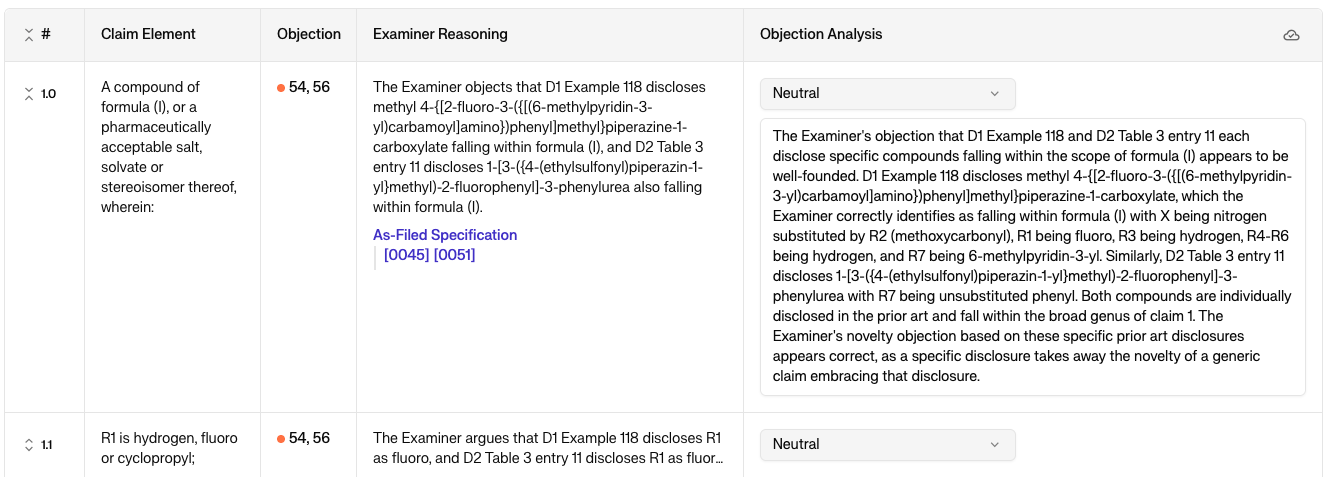
Our attorney turns to Solve Intelligence’s Prosecution module to analyze the search opinion and prepare a response. The first step is to generate an Objection Chart mapping the examiner's objections and reasoning onto the claim elements. Each entry carries a fully editable analysis, marked Neutral, Disagree or Ambiguous, which helps our attorney get started on a response strategy.
Amendment by deletion from lists is allowable where the result creates no new technical information and is directly and unambiguously derivable from the application as filed. Two routes get you there. The first weaker route is that what remains is still a generic group differing from the original only in size, so nothing has been singled out. The second and far stronger route is that the application as filed contains a pointer to the particular combination that remains, for instance by reference to particular embodiments.
Relying on the first route is risky. Deleting one option from a list of four might leave a shorter list, but deleting three options leaves no list at all: the variable has become a fixed feature. A deletion that empties a list down to its last member is therefore a selection, not a shortening of a list, and once you do that at more than one position, what remains is a combination of specific features. It does not help to say that each deletion was made from a separate list, as the number of amendments combined to arrive at the claim is not the test. Instead the test is whether the resulting subject-matter is disclosed, directly and unambiguously, in the application as filed. Four individually safe-looking moves can produce an unsafe claim.
Applied to this file, our attorney considers the following:
Four deletions are made, and each of them empties its list. The granted claim fixes four features that were variable as filed, and that combination is allowable for one reason: paragraph [0041] recites it as a unit. Claim 1 as filed is simply abandoned as co-extensive with D1, and new claim 1 based on the paragraph [0041] embodiment is pursued. The attorney is not relying on the arithmetic of single-list deletions, which would not survive contact with an opponent. They are pointing at a paragraph.
Which invites the obvious question: how did exactly the right paragraph come to exist three years before the search opinion arrived? It did not, exactly. Paragraph [0041] was one of a graded series of sub-genus paragraphs written on drafting day, each reciting a whole combination of features in one place, none of them written with any knowledge of which would be needed. Most of them never were, and that is the argument of this article in a single line: you cannot predict which fallback you will need, so the discipline is to write the series and accept that most of it will be dead weight.
Two observations carry this section.
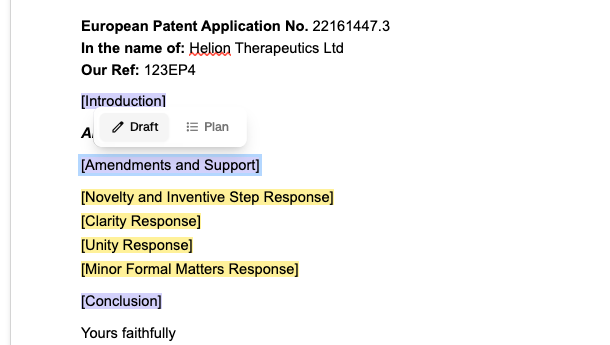
Our attorney amends the claims and prepares a response directly within Solve Intelligence's Prosecution module, but under budget pressure, the description is adapted only minimally. The morpholine and 4-fluorophenyl embodiments stay in the description. The data table keeps all species, and compound 1 remains unlabeled. Paragraph [0001] still reads "The invention relates to compounds of formula (I) which activate cardiac myosin", and the broad genus paragraph at [0038], which is nested within D1’s generic disclosure, stays with it.
The patent is granted in November 2023, with claims to a reasonably scoped genus. Everyone is pleased.
Inconsistency between description and claims is to be avoided where it casts doubt on the subject-matter for which protection is sought. Passages that appear to disclose ways of carrying out the invention but are not encompassed by the claims are inconsistent, and it makes no difference whether that inconsistency was present as filed or created by amendment. Features required by the independent claims must not be described as "preferably", "may" or "optionally".
The counterweight matters as much as the rule, because readers who take only the first half of it will over-delete: further unclaimed features in a described embodiment are not an inconsistency where the combination as a whole is encompassed by the independent claim. Adapting a description is not a license to strip it.
Why does this rise above housekeeping? Because the description is consulted in construing the claim. Retained passages are therefore not cosmetic; they can change what the claim means.
This is precisely how the opponent plays their argument.
The opposition is filed by the owner of D1, with a day of the nine-month period to spare.
Novelty is pleaded but never argued. The mandatory cyclopropyl at R1 removed both D1's Example 118 and D2's compound, so the amendment made during examination did exactly the job it was made for. The attacks that matter arrive on other axes entirely.
In short, the opposition turns on the following:
"Granted claim 1 thus embraces, on the Proprietor's own data, a compound which does not achieve the asserted effect. No adaptation of the description can cure this, because the compound is claimed."
That is the sharpest paragraph in the opposition, and it is the one the proprietor cannot argue away. To rely on the improved-potency effect, amendment is required.
Before the outcome, let us consider the fallback positions in the abstract, because the point of this article is that each fallback has a disclosure prerequisite, and the prerequisite has to be satisfied before you need the fallback:
Helion takes the first fallback, and the amendment is based on paragraph [0044] of the application as filed:
"In a further embodiment, R1 is cyclopropyl; R3 is methyl and the carbon bearing R3 is in the (S)-configuration; X is nitrogen substituted by R2, wherein R2 is C1–C4 alkoxycarbonyl or C1–C4 alkylsulfonyl; R7 is 6-(C1–C4 alkyl)pyridin-3-yl; R4 is hydrogen; R5 is hydrogen or fluoro; and R6 is hydrogen."
For that amendment to work, five things have to be true, and all five are:
The maintained claim 1 reads:
"A compound of formula (I)
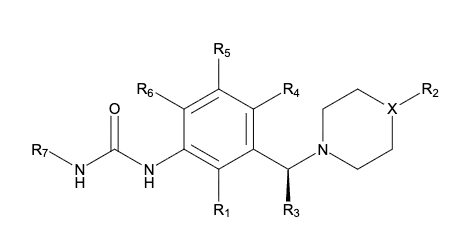
wherein R1 is cyclopropyl; R2 is C1–C4 alkoxycarbonyl or C1–C4 alkylsulfonyl; R3 is methyl, and the carbon bearing R3 is in the (S)-configuration; R4 is hydrogen; R5 is hydrogen or fluoro; and R6 is hydrogen; X is nitrogen substituted by R2; R7 is 6-(C1–C4 alkyl)pyridin-3-yl."
Pulling paragraph [0044] into the claim reopens Article 84 EPC, so the description adaptation skipped during examination gets done now, within Solve Intelligence. Doing it destroys the opponent's construction argument and, with it, the limb of the sufficiency attack that depended on it.
A price has been paid though. Compound 6 falls outside the maintained genus. Its R2 substituent is an acetyl group, which is not covered by the sub-genus of paragraph [0044], now the subject of maintained claim 1. It was a useful compound with an EC50 of 0.62 µM that fell comfortably inside the granted claim, but it has to be surrendered here. That is the honest proof that the sub-genus was defined by chemistry: it was not assembled after the fact to cover that which the opponent had failed to attack.
Nevertheless, the outcome is not a bad one. The patent is maintained in amended form with claims to a genus covering the most potent compounds in the series, with the composition, medical-use and process claims following. The proprietor loses breadth it was never entitled to and keeps the clinical candidate and its close analogues.
Without paragraph [0044], the fallback would have been a single compound. Without paragraph [0045], there would have been no technical effect and quite possibly nothing patentable at all. Both paragraphs were written on drafting day by someone who did not know which of them would be needed, or indeed whether either would be.
This is not general advice, but instructions. Each is tied to a specific failure in the case study above:
We have already mentioned Solve Intelligence's Review functionality, but its flexibility is worth emphasizing. Custom reviews can be written as freeform instructions, saved to your own library, and shared with colleagues. This means a standard can hold across a team, or between in-house counsel and outside firms, rather than living in one person's head.
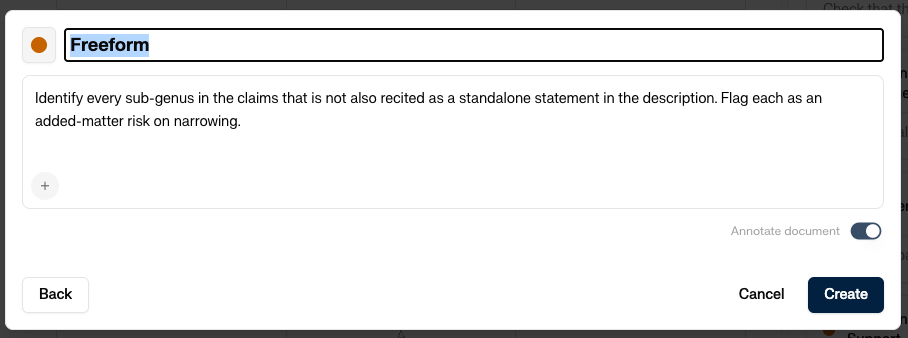
Here are five example review instructions to get you started:
One closing calibration, which is also the disclaimer this article needs. An objection is a reasoned allegation that opens a burden. It is not a finding. Objections routinely fall away on amendment or on evidence, with the burden sitting in different places at different stages, and a constructed case study of this kind can only show what could be argued, but never what a division would decide.
The case study's own record makes the point better than any general statement. The opponent abandoned the novelty attack before arguing it, lost the added-matter ground outright, and carried only half the sufficiency ground once the claim was amended. On the examination side, five issues produced one deletion that cost nothing, two that cost a little, and one comparison that could never be made. None of them was a conclusion at the moment it was written.
In this case study, the difference between a claim to a genus and a claim to a single compound was one paragraph, written in twenty minutes, three years before anyone knew it would matter.
Import our applicant's species list with the assay data attached and work through Solve Intelligence's functionality in your own time. See for yourself where Solve Intelligence can help across the full patent lifecycle.
If you don't yet have a Solve Intelligence account, you can book a demo here.
Q: What's the practical difference between a sub-genus and simply narrowing a list in the claim?
A narrowed list is still assembled by the reader from separate options; the skilled person has to pick one item from each of several lists to arrive at it. A sub-genus, as this article uses the term, is a specific combination of features written out as its own self-contained statement in the description. In the case study, generating several sub-genera from different subsets of the species is exactly what Solve Intelligence's Generate Genus Compound and Regenerate Genus functionality is used for. Once generated, using the AI to write each into the description as its own paragraph, rather than leaving the reader to reconstruct them from independent lists later, is easy.
Q: If I've already filed without building in fallback sub-genera, is there anything I can still do?
Not much, and that's the point of the article's three-state table: post-filing, any amendment is limited to what the description already discloses. What's worth doing is checking whether anything resembling a self-contained combination already exists in your as-filed application, even if it wasn't written with a fallback in mind. Running a custom review instruction saved to Solve Intelligence’s instruction library over an existing description is one way to surface a paragraph you'd otherwise have to find by re-reading the whole specification by eye.
Q: Doesn't writing out a dozen fallback sub-genus paragraphs just bloat the application for no reason?
Most of them probably will go unused. In the case study note that Helion's attorney wrote four sub-genus paragraphs but only one ended up mattering, three years later, in a way nobody could have predicted at drafting time. What kept the cost down was that generating and iterating on each sub-genus took the attorney around twenty minutes in total, not twenty minutes per paragraph. Measured against that, writing the extra paragraphs is cheap insurance against not having the one you eventually need.
Q: Where does software like Solve Intelligence actually add value here, versus just being a faster way to draft?
No tool decides scope questions; attorney judgment is always needed. What Solve Intelligence does is make the fallback-generation and support-checking work fast and cheap enough that it actually gets done rather than deferred under deadline pressure. Solve Intelligence can also surface risks a keyword search would never catch, like the structurally-identical compound buried in a methodology paper with no biology data attached in the case study, which only a structure search would find.

.webp)