Blog
.png)

Solve Intelligence, Powered by Claude
At Solve Intelligence, we believe the future of intellectual property belongs to professionals who can combine deep legal expertise with the most capable AI available. That's why our platform is powered by Claude, and why we're expanding what's possible for patent professionals and inventors worldwide.

The Speed-Quality Trade-Off in UPC Provisional Measures
Preliminary injunctions, or “provisional measures” in Unified Patent Court (UPC) terminology, have become the most consequential procedural tool in European patent litigation. In under three years, the UPC has issued 63 decisions across 88 cases, with filings accelerating year on year. The analytical rigour courts demand has increased at precisely the moment timelines have compressed.
For patent teams on both sides, the procedural reality is stark: court-ready claim analysis that once took months must now be produced in days, at a depth that no longer rewards manual workflows.
Tools like Solve Intelligence’s Charts are emerging as a response to that structural pressure, compressing the mechanical phases of claim charting while preserving the practitioner-led judgment that courts expect.

Shumaker Leverages Solve Intelligence to Enhance Service for Intellectual Property Clients
Shumaker is reinforcing its commitment to innovation and client service with Solve Intelligence. By integrating Solve Intelligence, Shumaker is strengthening its ability to help clients move from invention to protection faster while maintaining the precision required for successful patent prosecution.
Solve Intelligence allows Shumaker’s IP lawyers to focus more on crafting strong claims, identifying potential risks, and aligning patent strategy with each client’s broader business objectives. As innovation accelerates across industries, companies are under increasing pressure to protect their IP quickly and effectively.
Patrick Horne, Partner and Intellectual Property National Service Line Leader at Shumaker, describes the value of Solve Intelligence.
“Solve Intelligence provides our team with powerful tools that enhance the patent drafting process. This technology allows us to focus even more of our time on strategy, claim development, and protecting our clients’ innovations, while improving efficiency in the preparation of high-caliber patent applications.”
.png)

Prompt Engineering Masterclass – German Patent Workflows
Solve Intelligence is co-hosting a live webinar with Patenza on Thursday, 30 April 2026 at 11:00 AM CEST. The session is a hands-on masterclass on prompt engineering, tailored specifically to the workflows, drafting conventions, and procedural realities of German patent practice.
Interested attendees are encouraged to register in advance to secure their spot and to submit questions ahead of the live Q&A. Register here.

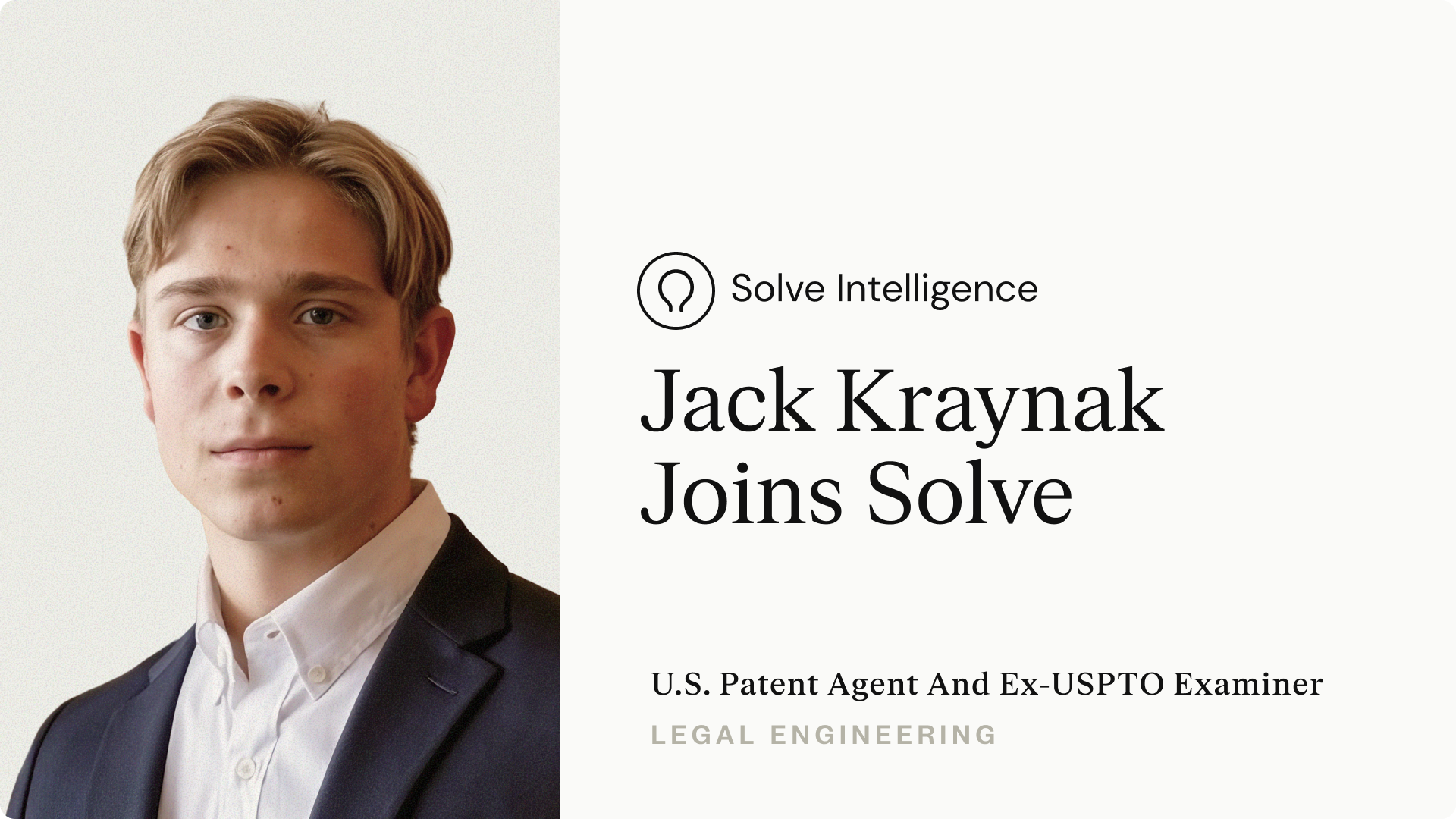
Barrett Cole Joins Solve
We're excited to announce that Barrett Cole is joining Solve Intelligence!

Drafting for the UPC: What Early Equivalents Decisions Tell Us About Claim Scope
The Unified Patent Court has been open since June 2023, but how far claim scope extends beyond literal wording is only now taking shape. The UPC Agreement says nothing about equivalents; Article 2 of the Protocol on Article 69 EPC provides the only legal hook, and what it means in practice is being written case by case, across local divisions with no binding Court of Appeal ruling to anchor them.
For practitioners drafting claims today, this is not abstract: it shapes claim structure, functional language choices, and whether your description helps or hurts at enforcement. Solve Intelligence helps practitioners navigate this uncertainty before cases reach court.

How Solve Intelligence Handles Invention Disclosures and Unstructured Data
If you've been drafting patents for any length of time, you know the real bottleneck is often not the drafting itself. It's the messy inputs that precede it: partial forms, internal review decks, or email threads where the inventive aspects are buried. Getting from that to a coherent starting point for a draft consumes time most practices simply can't afford.
AI can perform much of that translation work: extracting what matters, flagging what's missing, and generating the necessary follow-up questions based on holes and shortcomings. But it must operate inside proper confidentiality controls, and its output requires attorney review before going near a draft. This guide covers how that works in practice in Solve Intelligence's platform .
Key takeaways
- The disclosure bottleneck is upstream; AI structures messy inputs before the drafting phase begins.
- AI extracts features, normalises terminology, surfaces gaps, and generates inventor questions, but attorney review is mandatory.
- The danger is plausible but fabricated detail, not obvious errors. Watch for AI-generated parameters or 'helpful' specifics.
- Disclosures contain trade secrets and unpublished IP. Use only tools with verified zero-training, zero-retention policies and enterprise-grade security.
- A sensible pilot, without client approval, uses anonymised or historical disclosures to define 'good' output and track key metrics over limited timeframe.
.png)

How Nielsen Is Scaling Patent Operations with AI
Nielsen, a global leader in media audience measurement operating in over 50 countries, manages an industry-leading patent portfolio protecting innovations across a variety of fields, including data science, media measurement technology, and viewer analytics. Operating at the intersection of data science and an ever-changing media landscape requires constant innovation to keep pace. Supporting this innovation velocity requires IP operations that can scale without compromising quality.
Nielsen's in-house team adopted Solve Intelligence as their AI patent platform following a comprehensive evaluation process in Q4 2025. The partnership between Nielsen and Solve Intelligence reflects a shared commitment to precision and enabling practitioners to do their best work more efficiently.