Clients are not buying “AI”. They are buying drafting quality, long-term patent enforceability, and reduced invalidity risk.
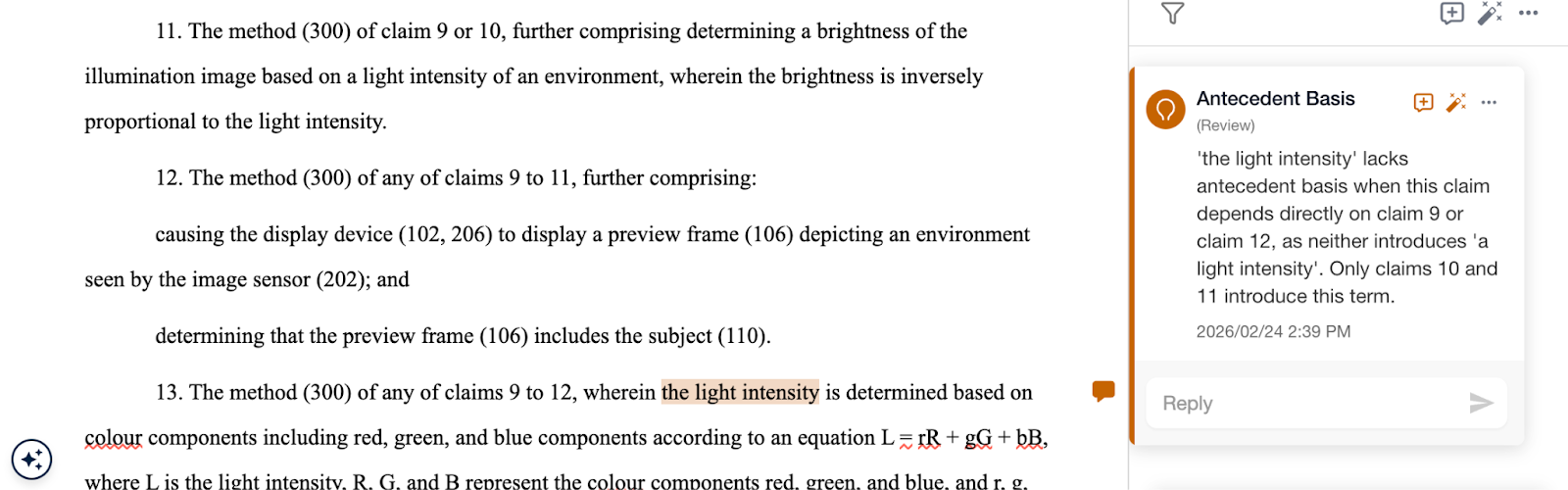
Used properly, AI-supported drafting and review can improve structural discipline in a way that is difficult to achieve consistently through manual workflows alone. Importantly, this is not just about spotting issues at the end of the process; AI can also help prevent them from arising in the first place.
For example, AI tools can:
In patent practice, many downstream problems arise not from flawed legal strategy, but from avoidable internal inconsistencies introduced during drafting. These issues may only become visible years later, perhaps during opposition proceedings or litigation, by which time amendment flexibility is limited.
When AI is embedded within the drafting workflow itself, it functions as a form of structured guardrail. It not only supports the attorney while the document is being built, but also audits it before filing.
At Solve Intelligence, we see AI not as a drafting replacement but as the provision of structured attorney support and a consistent review layer. Applications drafted with the support of Solve’s AI benefit from real-time structural assistance, while drafts prepared outside the platform can still be analysed for terminology alignment, consistency, and support.
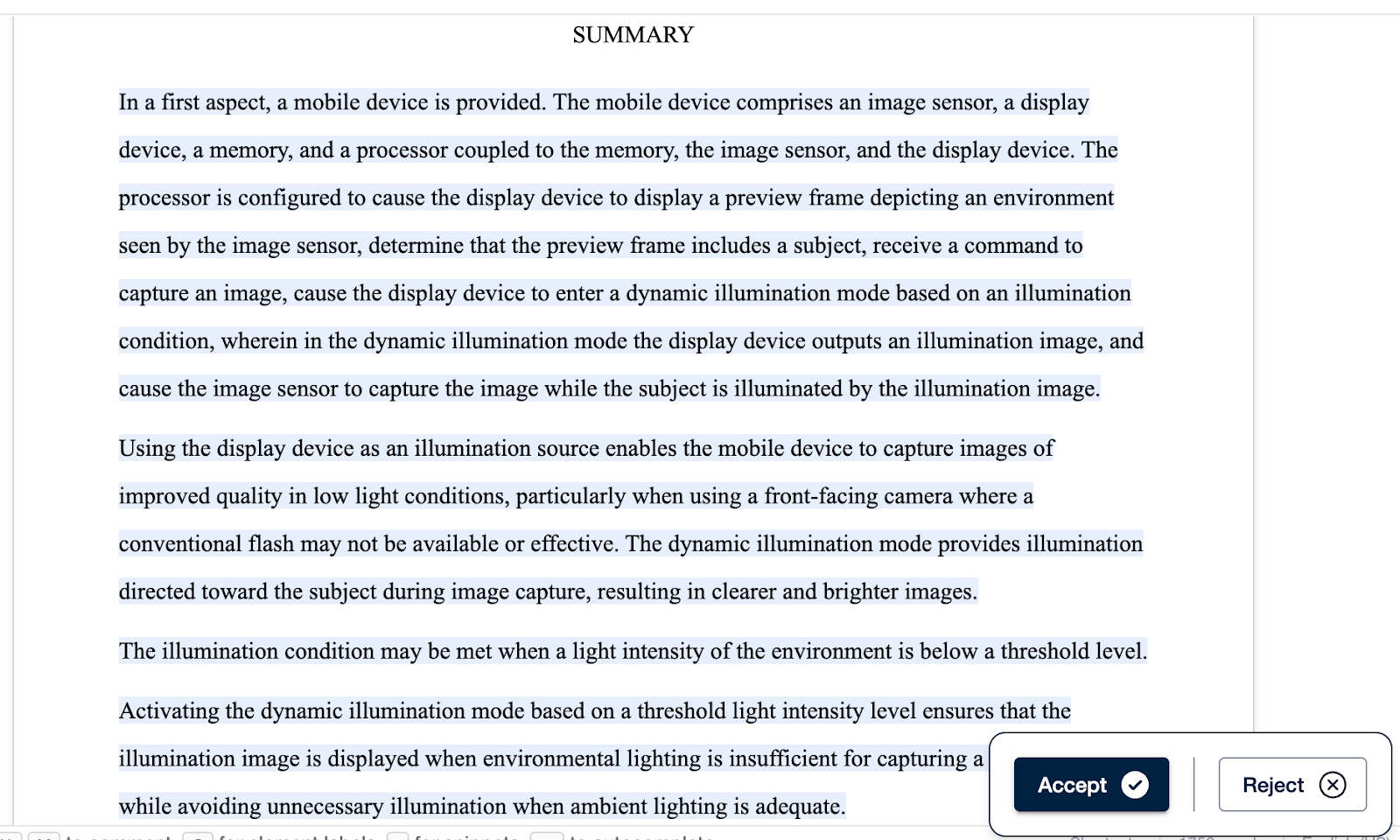
In both cases, the attorney retains full control. The system surfaces risks and structural issues, but professional judgment determines the final text.
Framed this way, the conversation shifts from “Are you letting AI write patents?” to “How are you reducing avoidable drafting risk?”
For most sophisticated clients, the primary concern is data security.
They want to know where their invention disclosure goes, if and where it is stored, whether it is used to train external models, and what contractual safeguards exist.
It is crucial to distinguish between consumer AI tools and enterprise-grade legal AI systems.
At Solve Intelligence, we adhere to the highest security standards, including ISO 42001, and are SOC 2 certified, with formalised policies around data handling, access controls, and auditability. We also comply with ISO 42001 for AI management systems, as well as GDPR and CCPA.
Solve Intelligence enforces Zero Data Retention (ZDR) with its model providers: client data processed through Solve's platform is never retained or used to train any underlying AI models.
From a client perspective:
If you are using AI in your workflow, you should be able to clearly and confidently explain how client data is treated and what safeguards are in place.
Open conversations with clients build trust far more effectively than avoidance.
Inventorship concerns occasionally arise from a broader narrative that AI “creates” content.
From a patent law perspective, the position is clear. Inventors must be natural persons and so inventorship relies on human conception of an inventive concept. AI-assisted drafting does not alter that analysis.
AI systems can assist with structuring text, refining language, and identifying inconsistencies but they do not conceive inventions. The inventive contribution remains entirely human.
A more nuanced concern relates to quality. Clients may worry about hallucinated features, formulaic drafting, or over-reliance on automated suggestions.
To mitigate concerns, a responsible AI-assisted drafting process should include:
At Solve Intelligence, our tools are designed around this principle. Our platform will surface potential issues, but it will not autonomously amend the draft. Instead, the attorney must evaluate flagged issues and decide how best to respond.
The safeguard is not the absence of AI; it is structured human oversight
Rather than asking clients whether they are “comfortable with AI”, it is more effective to explain precisely how it is used in your workflow and invite questions.
Be explicit about these three things:
Be ready to answer client concerns. These are often centred on:
Whatever the agreed position, record it. A short, documented understanding reflects procedural maturity and avoids ambiguity later.
Handled this way, the discussion becomes straightforward. The focus shifts from whether AI is being used to how drafting quality and risk control are being strengthened.
The real issue isn’t whether AI should be used in patent drafting, but whether it’s used responsibly.
When deployed thoughtfully, AI can strengthen structural consistency, reduce avoidable drafting risk, and enhance long-term enforceability.
By providing your clients with clear explanations, robust safeguards, and human accountability, AI can reinforce professional standards.
No. To highlight a few jurisdictions, under US, European and UK patent law, inventors must be natural persons. Inventorship depends on who contributed to the inventive concept, not who assisted with drafting.
AI tools can help structure text, flag inconsistencies, or suggest improvements, but they do not conceive inventions. The inventive contribution remains entirely human. Thus, using AI as a drafting support tool does not alter the legal analysis of inventorship.
That depends entirely on the system being used.
Consumer AI tools may retain or use data for training. In contrast, enterprise-grade legal AI platforms should operate under strict data handling frameworks, including zero data retention arrangements with model providers.
When assessing any AI provider, firms should be able to answer clearly:
If those answers are unclear, the system is not appropriate for confidential patent drafting work.
Used improperly, it could. Used responsibly, it should improve structural quality and reduce avoidable drafting errors.
AI is most effective when embedded as a structured review layer within an attorney-led workflow. It can help:
However, quality ultimately depends on human supervision. AI should function as a guardrail, not a replacement for professional judgment.
There is no universal rule requiring proactive disclosure in every jurisdiction. That said, transparency builds trust.
The better question is not whether AI is being used, but how it is being used. If AI forms part of a structured, secure, attorney-supervised workflow designed to improve quality and reduce risk, explaining its role can reassure clients.
Where clients have outside counsel guidelines addressing AI, firms should of course comply with those requirements.
The risk does not arise from AI itself. It arises from inadequate supervision.
Professional responsibility remains with the signing attorney; “the AI suggested it” is unlikely to be an acceptable defence for drafting deficiencies.
For that reason, responsible AI use requires:
When these safeguards are in place, AI can reduce overall drafting risk rather than increase it.

.webp)