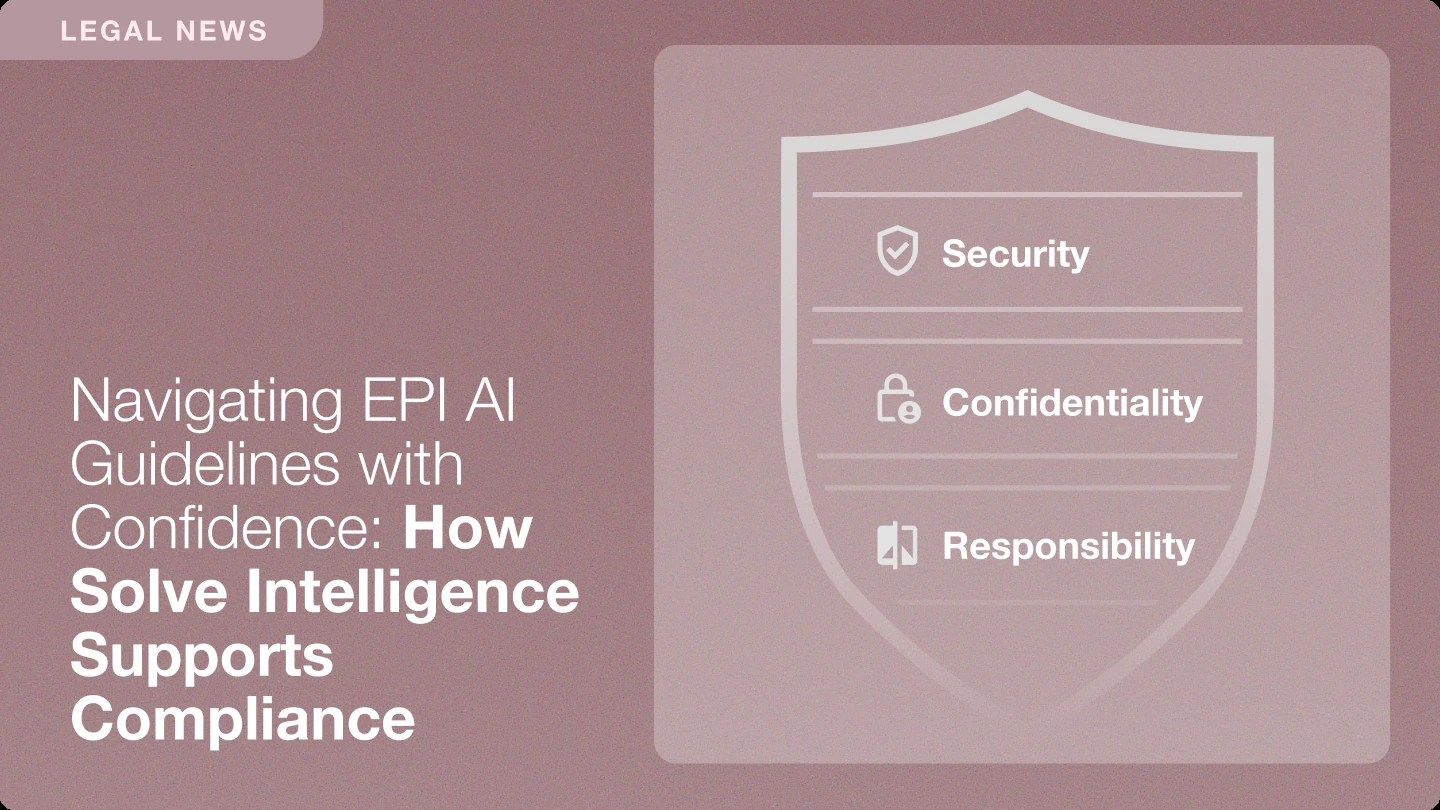
At their core, the epi Guidelines reaffirm a simple principle: the patent attorney remains fully responsible for all professional work, regardless of whether generative AI tools are used.
In practical terms, the Guidelines expect Members to:
The epi Guidelines stress that Members must understand the limitations of generative AI, including the risk of inaccurate or unsupported outputs.
At Solve Intelligence, we reduce this risk by grounding AI responses in verifiable legal and patent sources. AI chat outputs include clickable citations, allowing attorneys to review original source material and confirm accuracy before relying on any output. The platform integrates authoritative sources directly into the workflow, including the EPO Guidelines for Examination, EPO Boards of Appeal Case Law, the USPTO MPEP, and USPTO Subject Matter Eligibility Examples, each with explicit, clickable references.
In the platform, we also apply layered guardrails to minimise unsupported speculation. These include prompt-level source restrictions, structured output constraints, post-generation citation validation, and real-time output checks. Together, these measures help ensure AI outputs remain accurate, verifiable, and suitable for professional review.
Protecting client data and maintaining confidentiality are foundational obligations for patent attorneys and are central to the epi Guidelines on the use of generative AI.
At Solve Intelligence no data uploaded to or generated within the platform is ever used to train any AI model. Neither Solve Intelligence nor any third party monitors, stores, or repurposes client data outside the user’s control or matter context. All data is sandboxed to the customer’s account and remains strictly confidential.
The platform applies industry-leading encryption standards, including AES-256 encryption at rest and TLS 1.3 encryption in transit. Data is stored on enterprise-grade infrastructure aligned with recognised compliance frameworks, including SOC 2, GDPR, CCPA, and ISO 42001. We also enable firms to choose where their data is stored and processed, ensuring information remains within a selected legal jurisdiction where required.
The epi Guidelines make clear that AI-assisted output must be reviewed and accepted by the attorney before it can form part of any client deliverable.
At Solve Intelligence, we support this by requiring the attorney to review and accept any AI-generated output. Edits made by the AI in any document are always shown in tracked changes with author identification. Furthermore, AI-generated output is accompanied by clickable citations, enabling efficient verification of legal and factual sources.
The product also includes a review functionality allowing the attorney to run custom reviews for draft applications against internal quality standards, client requirements, or professional obligations before finalisation. Responsibility for the final work product therefore always remains with the patent attorney.
The epi Guidelines require Members to establish their clients’ wishes regarding the use of generative AI before applying such tools to a client’s matter.
At Solve Intelligence, we support this process by providing clear documentation and guidance explaining how AI is used within the platform, including relevant safeguards and limitations. These materials help attorneys communicate AI use clearly and consistently to their clients.
The epi Guidelines confirm that Members may state, for example on their websites, that their work is produced using AI tools, provided such statements are accurate, fair, and dignified.
Solve Intelligence supports this by being transparent about how AI is used within our products. We work with customers to explain our AI workflows and safeguards, enabling accurate and measured communication about AI use in public-facing materials.
The epi Guidelines caution against unintended disclosure of client information through shared AI systems.
At Solve Intelligence, we ensure that data entered into the platform is not used for training of any kind. Client information, prompts, and outputs remain confined to their original context and sandboxed to the user.
The platform provides separate, individual user accounts, and any sharing of data between users requires the explicit permission of the originating user. This approach ensures attorneys retain absolute control over client information.
The epi Guidelines emphasise that patent attorneys must remain aware of applicable laws and regulations affecting the use of generative AI, including data protection requirements and emerging AI-specific legislation.
At Solve Intelligence, we continuously monitor relevant legal and regulatory developments, including frameworks such as the EU Artificial Intelligence Act, to ensure that the platform remains compliant and aligned with evolving requirements. As regulations develop, we assess their impact on AI use in patent practice and adapt platform policies and safeguards accordingly.
The epi Guidelines note that fees should fairly reflect the work performed and the level of professional oversight required when AI tools are used.
At Solve Intelligence, we support this principle through clear and transparent pricing, allowing customers to understand how use of the platform may affect workflows and cost structures. This transparency enables firms to plan how AI-assisted work is reflected in client fees in a fair and informed manner.
The epi Guidelines make clear that generative AI can play a valuable role in patent practice, provided it is used responsibly and under appropriate professional oversight.
Solve Intelligence is designed to support this approach by embedding verification, confidentiality, transparency, and attorney control directly into the platform. By aligning product design with the expectations set out in the epi Guidelines, we help patent professionals adopt AI with confidence while maintaining the standards their clients and regulators expect.