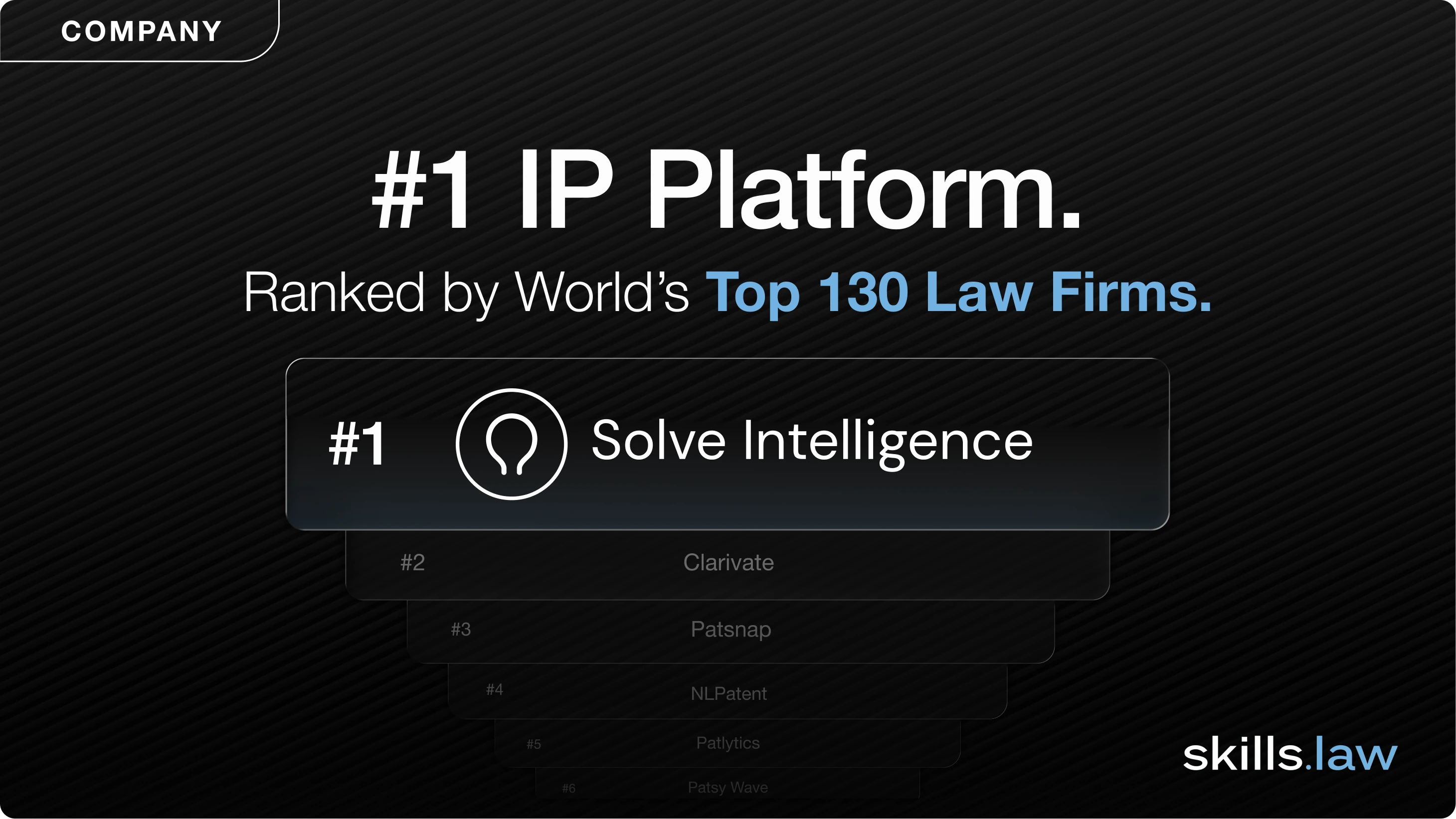
Solve Intelligence Ranked #1 IP Platform by the World's Leading Law Firms

Solve Intelligence has been ranked the number one intellectual property platform in the latest Legal AI survey published by SKILLS (the Strategic Knowledge & Innovation Legal Leaders Summit). The study surveyed 130 leaders at the world's top law firms about their legal AI product usage across every major practice area, scoring platforms based on live deployments, active pilots, and tools under consideration. In the Patents/IP category, Solve Intelligence placed first with a weighted score of 67, making it the most widely-used platform in the category. See the full report here.

Solve Intelligence Ranked #1 IP Platform by the World's Leading Law Firms

Solve Intelligence has been built on the belief that patent professionals need AI that is shaped by real patent expertise, intuitive UX, and state-of-the-art security. With over 500 IP teams across six continents now on the platform, the momentum we're seeing tells us the market agrees. Being the most widely used IP platform by global leading law firms is meaningful validation of that approach.

Why practitioners choose Solve

Our team of US, UK and European qualified patent attorneys works alongside software and AI engineers to design features, evaluate output quality, and shape the prompting logic that determines what the platform produces. The result is a purpose-built tool, where chemistry practitioners can embed Markush structures into detailed descriptions as easily as hardware practitioners can generate labeled figures from CAD files, reporting time savings of 60-90% in workflows across drafting, prosecution, charting and more.

Of course, providing a functional platform is not the whole picture. Our engineers and attorneys also work incredibly closely with our customers - on hand to customise the platform to particular guidelines, styles, and templates. Customer feedback shapes our product roadmap directly, and that attention to detail is reflected in our testimonials.


Jeff Draeger, Vice President and Director, Intel

"Solve Intelligence stands out for their genuine customer obsession, particularly in how they partner with users to co-create tailored templates. Their hands-on engagement ensures that the platform isn't just a tool, but a well-calibrated solution for different client or technology specific patent applications."

Peter Finnie, Partner, Potter Clarkson

“Solve Intelligence is tackling practical challenges in patent drafting and prosecution in a way that recognises the central importance of professional experience and judgement. I’m looking forward to contributing my perspective to help shape AI tools that genuinely support patent attorneys in delivering excellence for their clients.”


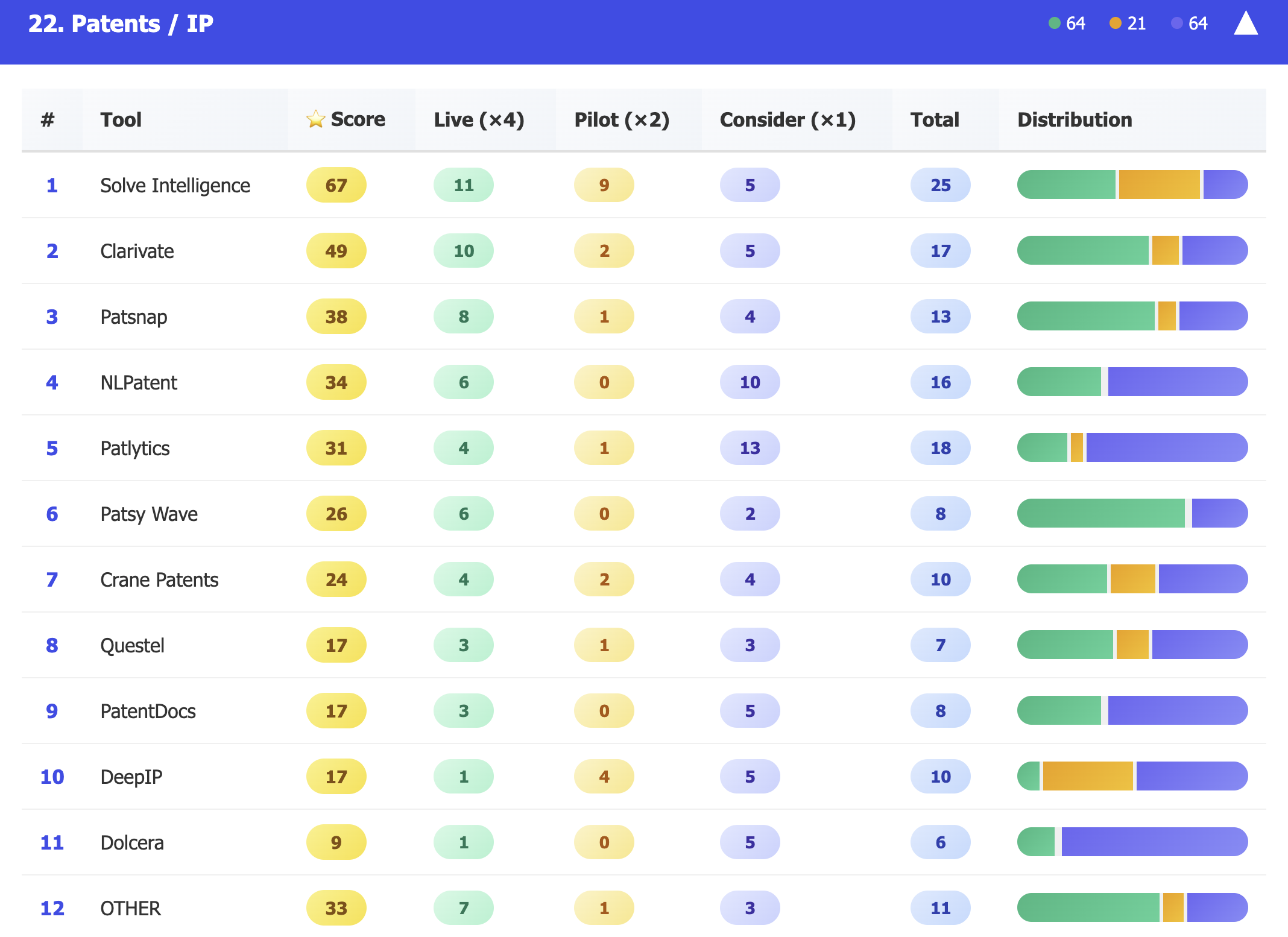
Our approach is showing up in the numbers. In a survey of 130 leading law firms, Solve led the Patents/IP category with a weighted score of 67, driven by 11 live deployments, 9 active pilots, and 5 firms with the platform under active consideration, placing far ahead of players like Clarivate (49), Patsnap (38), and Patlytics (31).
Looking ahead

The combination of deep patent expertise and close customer partnership continues to drive the pace of our product evolution. Solve began with patent application drafting, expanded into prosecution, and this year launched Charts for claim charting, freedom-to-operate analyses, invalidity assessments, and more. Each product follows the same approach: built by patent attorneys, shaped by customer feedback, and designed to handle the full technical depth of the work.

We are expanding our global presence with new offices in New York and Munich, and deepening our collaboration with customers through initiatives like our Customer Advisory Board. We are grateful to be recognised by the world's leading law firms as the top IP platform, and we remain committed to the practitioner insight that got us here. 

We're still only just getting started, and have so much more we want to build.

To learn more about Solve Intelligence, request a demo.

AI for patents.

Be 50%+ more productive. Join thousands of legal professionals around the world using Solve’s Patent Copilot™ for drafting, prosecution, invention harvesting, and more.

Related articles

Page White Farrer Adopts Solve Intelligence for AI-Assisted Patent Drafting

Page White Farrer Adopts Solve Intelligence and Solve's AI Templates

Page White Farrer ("PWF"), a specialist intellectual property firm with a longstanding focus on technology-driven innovation, has selected Solve Intelligence to support patent application drafting following an extensive evaluation of available AI tools. The firm has initially deployed the platform within its technology-focused patent teams, supporting work across sectors such as AI, software, telecommunications, electronics, semiconductors and engineering. 

The firm's objective was not to automate legal judgement or replace attorney expertise, but to accelerate the preparation of high-quality first drafts of patent applications. By combining AI-assisted drafting with custom templates tailored to the firm's preferred drafting approaches, Solve Intelligence helps attorneys move from an initial claim set to a reviewable first draft more efficiently while maintaining consistency and technical accuracy. 

For this partnership, PWF's primary focus was on configuring the platform around the firm's own drafting conventions, client preferences and established best practices, ensuring that the technology supports the way its attorneys already work. 

The Honest Risks of Using AI in Patent Prosecution

AI is changing how patent prosecution gets done, and the upside is real. So are the downsides: hallucinated citations, confidentiality exposure, export-control pitfalls, and prosecution-history estoppel. This is an honest account of the risks of AI patent software in prosecution, and what actually reduces each one.

Key takeaways

  • Anyone presenting AI-assisted content to the USPTO must reasonably review it; relying on the tool's accuracy alone is not enough.
  • Courts have already sanctioned attorneys for AI-hallucinated citations, and similar risk applies to office-action responses and PTAB briefs.
  • The USPTO warns that AI tools on foreign servers can raise export-control, foreign-filing-license, and national-security problems.
  • Grounded citations, exposed reasoning, zero data retention, and attorney oversight are what materially reduce AI risk in patent prosecution.

Maiwald Chooses Solve Intelligence for Selected AI-Supported IP Workflows

Solve Intelligence is proud to share that Maiwald, one of Germany’s largest and most progressive intellectual property firms, works with Solve Intelligence on selected AI-supported workflows in its patent and legal practice groups. Following an evaluation period during which selected functionalities were assessed for approved internal use cases, Maiwald and Solve have formed an enterprise partnership for 2026.

The rollout reflects the same careful approach Maiwald brings to its client work. Solve enables customers in Europe to process data on servers located within Europe and holds recognized information-security certifications. In addition, Solve offers contractual commitments designed to protect confidential professional information in line with applicable statutory confidentiality obligations and professional conduct requirements. Against that background, any use of AI-supported tools took place only within approved governance structures and under applicable professional, contractual, confidentiality and data-protection requirements.

That balance of innovation and professional judgment is characteristic of Maiwald. The firm has spent decades setting a standard for IP work in Europe: rigorous prosecution, a formidable contentious practice, and interdisciplinary teams of patent attorneys and attorneys-at-law working side by side. The firm approached AI the same way, methodically, with a clear sense of where it adds leverage and where an experienced attorney’s judgment remains irreplaceable. 

PTAB Case Studies of AI Disclosure Requirements: Part II

This article is the second of a series of Patent Trial & Appeal Board (PTAB) case studies (see Part I), which aims to inform applicants’ approach to satisfying the written description and enablement requirements for patenting artificial intelligence (AI) and machine learning technologies.