Latest from Solve

FEATUREDAugust 24, 2026Thomson Reuters and Solve Intelligence Partner to Deepen AI Adoption Across Leading Patent PracticesSolve Intelligence’s partnership with Thomson Reuters brings together Solve’s patent and IP platform and practitioner-led support with Thomson Reuters’ longstanding experience helping global law firms adopt professional technology.
Solve Intelligence brings patent-specific AI capabilities to Google Cloud's Gemini Enterprise for LegalSolve Intelligence is pleased to announce that it is a launch partner for Google Cloud’s Gemini Enterprise for Legal.
Page White Farrer Adopts Solve Intelligence for AI-Assisted Patent DraftingPage White Farrer Adopts Solve Intelligence and Solve's AI Templates Page White Farrer ("PWF"), a specialist intellectual property firm with a longstanding focus on technology-driven innovation, has selected Solve Intelligence to support patent application drafting following an extensive evaluation of available AI tools. The firm has initially deployed the platform within its technology-focused patent teams, supporting work across sectors such as AI, software, telecommunications, electronics, semiconductors and engineering. The firm's objective was not to automate legal judgement or replace attorney expertise, but to accelerate the preparation of high-quality first drafts of patent applications. By combining AI-assisted drafting with custom templates tailored to the firm's preferred drafting approaches, Solve Intelligence helps attorneys move from an initial claim set to a reviewable first draft more efficiently while maintaining consistency and technical accuracy. For this partnership, PWF's primary focus was on configuring the platform around the firm's own drafting conventions, client preferences and established best practices, ensuring that the technology supports the way its attorneys already work.
Maiwald Chooses Solve Intelligence for Selected AI-Supported IP WorkflowsSolve Intelligence is proud to share that Maiwald, one of Germany’s largest and most progressive intellectual property firms, works with Solve Intelligence on selected AI-supported workflows in its patent and legal practice groups. Following an evaluation period during which selected functionalities were assessed for approved internal use cases, Maiwald and Solve have formed an enterprise partnership for 2026. The rollout reflects the same careful approach Maiwald brings to its client work. Solve enables customers in Europe to process data on servers located within Europe and holds recognized information-security certifications. In addition, Solve offers contractual commitments designed to protect confidential professional information in line with applicable statutory confidentiality obligations and professional conduct requirements. Against that background, any use of AI-supported tools took place only within approved governance structures and under applicable professional, contractual, confidentiality and data-protection requirements. That balance of innovation and professional judgment is characteristic of Maiwald. The firm has spent decades setting a standard for IP work in Europe: rigorous prosecution, a formidable contentious practice, and interdisciplinary teams of patent attorneys and attorneys-at-law working side by side. The firm approached AI the same way, methodically, with a clear sense of where it adds leverage and where an experienced attorney’s judgment remains irreplaceable.
PTAB Case Studies of AI Disclosure Requirements: Part IIThis article is the second of a series of Patent Trial & Appeal Board (PTAB) case studies (see Part I ), which aims to inform applicants’ approach to satisfying the written description and enablement requirements for patenting artificial intelligence (AI) and machine learning technologies.
How Successful Patent Practitioners Are Putting AI to WorkThe most effective patent practitioners are already using AI patent drafting to draft faster, catch claim inconsistencies earlier, and free up hours for the strategic work that actually wins allowances. Key takeaways AI patent drafting tools can reduce application drafting time by up to 80 percent, with Solve Intelligence customers consistently reporting 50 percent or greater efficiency gains across drafting and prosecution Roughly 9 out of 10 utility patent applications receive at least one office action rejection, so prosecution efficiency matters as much as drafting speed Solo attorneys use AI to match larger law firms on turnaround speed and client capacity The strongest reported results come from iterative AI–attorney collaboration, with practitioners directing the process and owning the final work product
Adopting AI in Patent Work: A Practical Playbook for IP TeamsSolve Intelligence works with over 700+ patent teams as they bring AI into daily practice, and the same pattern shows up again and again: recognising that AI helps is easy, but building consistent, team-wide use is not. Adoption tends to stall for a handful of reasons, from informal early experiments to unclear decision making, and a promising trial can fade out without anyone establishing whether the tool or the rollout was at fault. This playbook lays out the process that gets a team from first experiment to settled habit, with the attorney's judgment in control at every step.
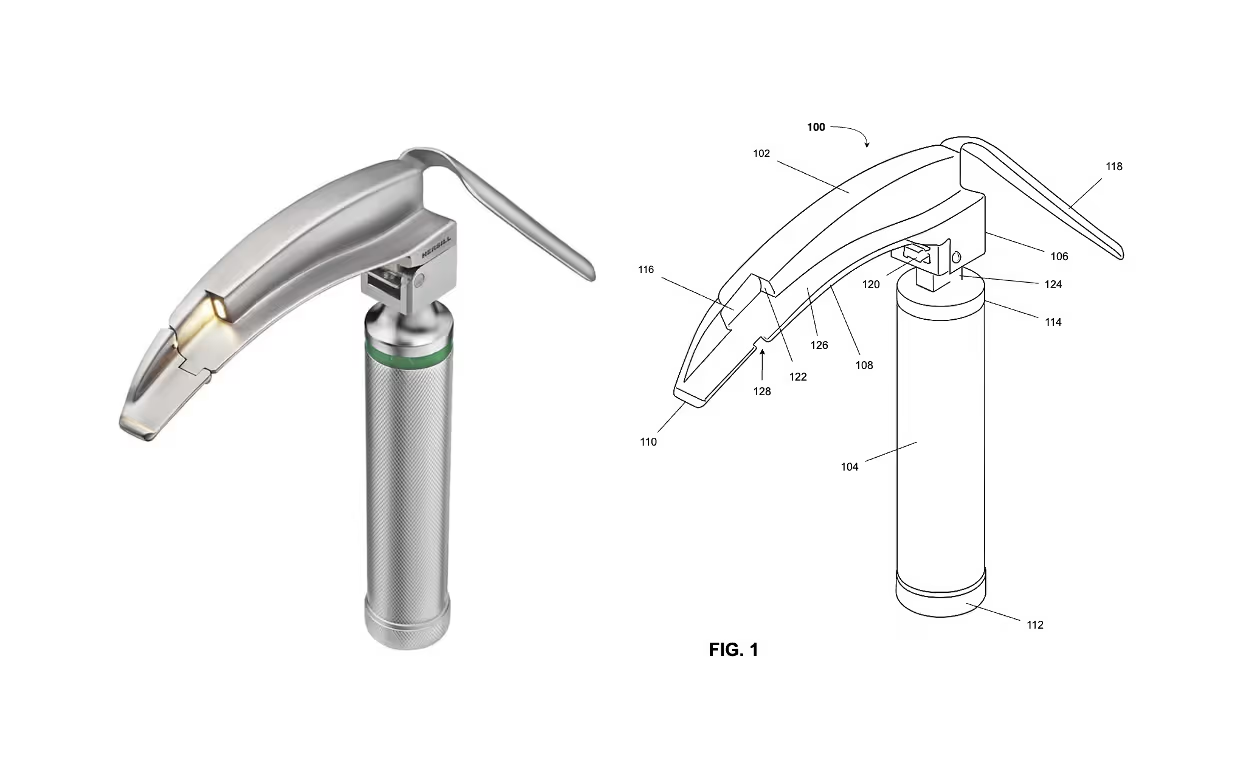
AI for Patent Drawings: Figure Generation and LabelingRecent developments in artificial intelligence have significantly simplified once complex tasks for patent professionals. One area that has recently seen a significant leap is patent figure generation, moving beyond simply analyzing drawings and figures to full generation capabilities, intelligent labeling, visual refinement, and rule-based output validation. These tools are evolving quickly to meet the increasing demands for patent professionals, allowing them to be more accurate and provide more compliant visual documentation of inventions quickly and easily.
The Strategic Value of Conducting a Novelty or Prior Art Search For patent attorneys, in-house counsel, and R&D teams, a well-timed novelty or prior art search is one of the most effective ways to validate inventive output and mitigate risk early in the patenting process. It also forms the foundation of a broader patentability assessment, offering critical insight into the state of the art and supporting informed decisions about whether and how to pursue patent protection. This article outlines the strategic function of a novelty search, optimal timing, best-practice methods, and how they relate to commercial IP objectives.
Attention Is All You Need: Prior Art in the Age of AIAs AI-generated content floods the digital landscape, how should we rethink prior art in patent law? In this deep dive, Andrew Zhang and Stephen Hou explore the USPTO’s recent questions on the impact of AI, the evolving knowledge of a person having ordinary skill in the art, and whether we should consider a new legal standard for prior art eligibility and assessment.
4 Steps to Ensure Data Confidentiality when using AI for Patent Application DraftingProtect confidential patent data when using AI. Follow 4 essential steps to ensure security, compliance, and safe data use.
8 Critical Patent Application Mistakes That Can Cost You ProtectionLearn how to avoid 8 common mistakes companies make when filing a patent application. This article highlights critical pitfalls that can jeopardize your IP protection and offers practical tips and tools.
Solve Intelligence Is Exhibiting at the INTA Annual Meeting 2025
EPO to Use AI Tools for Minuting Oral ProceedingsThe European Patent Office (EPO) has announced a pilot project to implement artificial intelligence tools to assist in the preparation of minutes during oral proceedings conducted by videoconference. This development represents a notable evolution in the EPO's approach to procedural documentation, but aligns with the recent trend of increasing AI adoption by the EPO generally.
Solve Intelligence Raises $12M Series A to Build AI for PatentsSolve Intelligence raises $12M Series A to scale its AI-for-patents platform with backing from Microsoft (via M12), Thomson Reuters (via TRV), & 20VC.
How AI Patent Drafting Software Streamlines Intellectual Property ProtectionAI patent drafting software is transforming intellectual property protection by significantly accelerating the drafting process, improving consistency, and freeing up attorneys to focus on strategic aspects like claim coverage. These tools can generate high-quality initial drafts in minutes, ensure uniform language across documents, and reduce human error. While AI boosts efficiency, expert review remains essential to ensure technical accuracy and strategic alignment, and strong confidentiality protocols are key when integrating AI into legal workflows.
Solve Intelligence Partners with Top Israeli Law Firm, MeitarSolve Intelligence has partnered with one of the largest law firms in Israel, Meitar, to continue building the leading AI platform for patent law.
EPO Guidelines 2025: What's Changing?The EPO has released previews of the updated Guidelines for Examination that will come into force on April 1, 2025. Here at Solve Intelligence, we've analyzed the changes to understand their impact on European Patent Practice. Here are just some of the notable proposed changes.
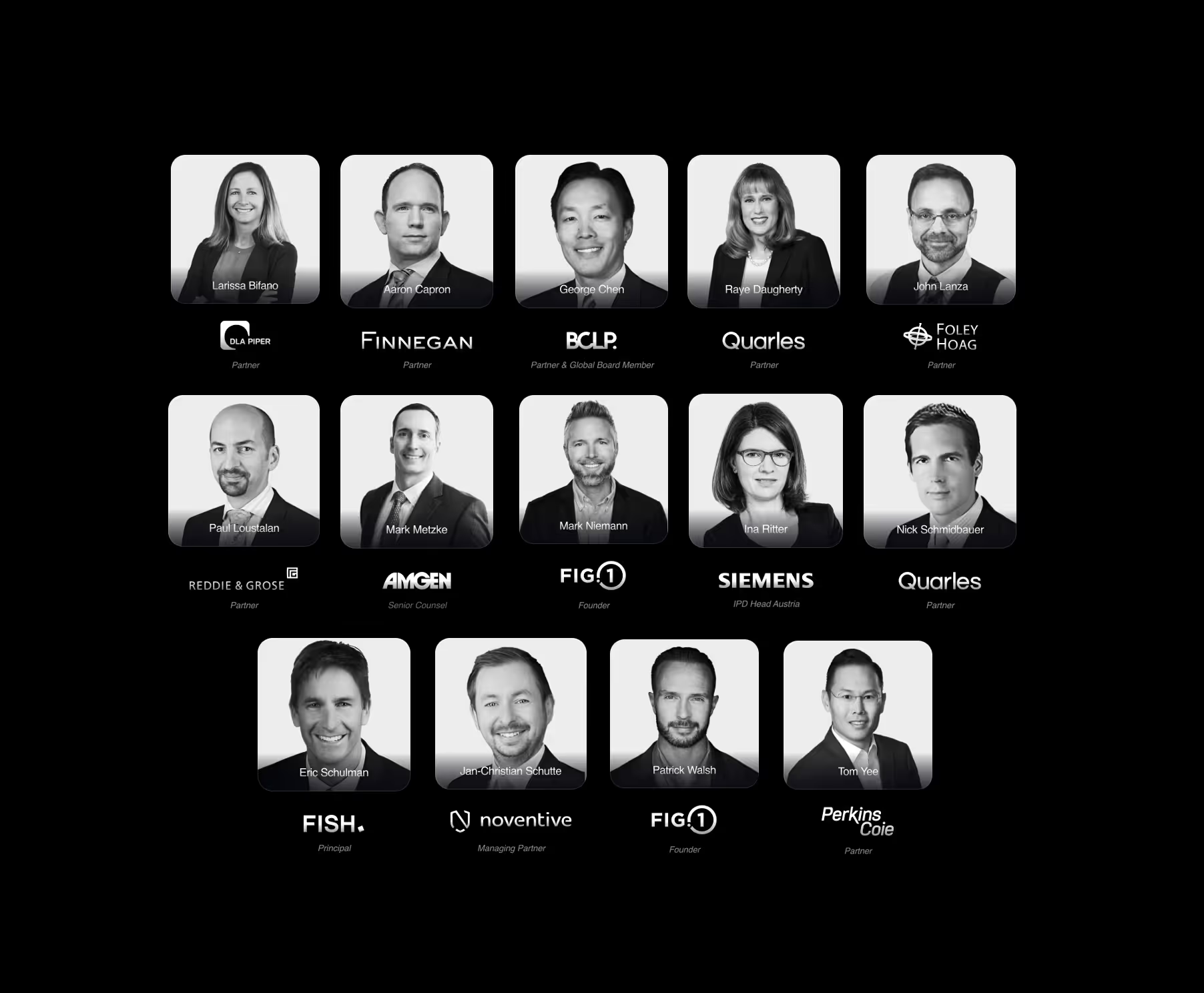
Announcing Solve Intelligence's Customer Advisory BoardWe are excited to announce the formation of our Customer Advisory Board, bringing together distinguished intellectual property practitioners who are at the forefront of the patent space to help advise Solve on building the go-to AI platform for IP professionals.
Top Intellectual Property (IP) and Legal Conferences of 2025As the legal industry continues to evolve, staying ahead of the curve with the latest advancements in intellectual property (IP), legal technology, and artificial intelligence (AI) is crucial. Attending top-tier conferences not only helps legal professionals stay updated but also provides networking opportunities, insights into future trends, and the chance to meet industry leaders. Whether you're a seasoned attorney, a tech enthusiast, or someone navigating the complexities of IP law, these events are a must-attend in 2025.
Navigating Objections to AI in IP - Patent DraftingArtificial Intelligence (AI) is reshaping industries worldwide, and the field of intellectual property (IP) is no exception. AI’ s new role in patent drafting has sparked both excitement and skepticism. Understanding and addressing common objections is key to fostering confidence in AI solutions for patent drafting.
Best 5 AI Patent Prosecution Tools in 2026Navigating the complexities of patent prosecution can be daunting, but advancements in AI have ushered in tools that make the process more efficient and accurate. In this article, we’ll explore the top AI patent prosecution tools of 2025, highlighting their features, benefits, and how they’re revolutionizing the field of intellectual property.
Patent Attorneys at Solve Intelligence: Building AI for Patent PracticeAt Solve Intelligence, we build AI tools for patent attorneys. This means a design philosophy of developing, testing and refining our platforms specifically with our end-users in mind. We recognize that in order to build the best AI tools for patent attorneys, patent attorneys themselves must be involved in the development process. Their domain expertise, combined with the advanced technical knowledge of our AI and engineering teams, ensures our Patent Copilot isn’t just innovative—it’s tailored to the realities of patent practice, delivering solutions that truly work for attorneys. In this article, we explain what our patent attorneys do here at Solve, and how they collaborate with our wider team and customers to deliver our AI solutions.
AI Patent Tools for 20252024 marked a pivotal year for AI adoption in the patent industry, with early adopters reporting significant efficiency gains and improved application quality. As we look ahead to 2025, we're poised to witness an unprecedented surge in AI implementation across patent offices and law firms worldwide. For patent attorneys looking to stay competitive and efficient, understanding these emerging AI tools is no longer optional - it's essential. In this guide, we'll explore the transformative capabilities these technologies can bring to your practice in 2025.
UK Supreme Court grants permission for Emotional Perception AppealThe UK Supreme Court has granted permission for Emotional Perception AI to appeal the decision of the Court of Appeal of 19 July 2024, in the latest chapter in this potentially pivotal case addressing the patentability of computer-implemented inventions, specifically those involving artificial neural networks (ANNs).
AI Patent Claim DraftingThe integration of artificial intelligence (AI) into the field of intellectual property is transforming the way patent professionals approach their work. One of the most significant advancements in this area is the use of AI tools for drafting patent claims. These claims, the cornerstone of any patent, define the legal scope of an invention’s protection, making their accuracy and clarity critical. With the advent of AI-assisted tools, drafting patent claims is becoming more efficient, precise, and accessible. This article explores the benefits of using AI to draft patent claims, compares leading AI tools in the market, and highlights important considerations for implementing these tools effectively.
EPI Guidelines - Use of Generative AI for Patent AttorneysGenerative AI is already changing how patent attorneys work, and those that use AI platforms, such as Solve Intelligence’s Patent Copilot, are reporting efficiency gains and higher quality outputs . As the uptake of generative AI increases amongst patent attorneys, professional bodies are starting to consider best-practice and standards for using this technology. The European Patent Institute (epi) recently released comprehensive guidelines detailing how patent attorneys can responsibly integrate AI into their workflows. These guidelines emphasise ethics, professionalism, and accountability when using AI. In this article, we set out the key takeaways of the guidelines, and how, at Solve Intelligence, we empower attorneys to use AI in line with these guidelines, ensuring that our Patent Copilot remains a powerful but controllable tool for assisting in patent practice.
AI Patent Application DraftingArtificial intelligence (AI) is rapidly transforming industries, and the field of intellectual property is no exception. Patent application drafting, traditionally a labor-intensive and detail-oriented process, has witnessed remarkable improvements with AI-powered tools. These technologies are helping patent professionals streamline workflows, enhance precision, and reduce costs. This comprehensive article explores the benefits, use cases, best practices, and tools for drafting patent applications with AI.
10 Tips for Patent Attorneys to use AI effectivelyPatent attorneys often face high workloads, tight deadlines, and the pressure to deliver impeccable work. AI-powered tools like Solve Intelligence’s Patent Copilot are revolutionising how patent applications are drafted and prosecuted, offering attorneys significant efficiency gains. Here’s how to make the most of these tools and transform your workflow.
How AI is Helping Patent AttorneysDrafting patent applications can be an arduous task. The process often requires several interactions with inventors to extract enough information to start the process, and then begins the exercise of turning that information into a coherent and detailed ~30 page patent specification. This of course takes time (and sometimes more than the proposed/estimated fee for the draft would allow). For this reason, patent drafting is sometimes considered a loss leader by those in private practice. From another perspective, the cost of engaging a patent attorney to draft a patent application can be a huge barrier to the uptake of IP, particularly for start-ups and SMEs. Registered IP rights can mean a great deal to these types of applicants, both in terms of carving out a slice of the market and attractiveness to potential investors. Drafting patent applications has thus historically presented a ‘problem’ to both patent attorneys and their would-be clients. Artificial intelligence (AI) is changing the game in this regard. Forward-thinking attorneys that have already started utilising AI, and those using Solve Intelligence’s Patent Drafting Copilot have reported considerable improvements in their drafting practices. Such improvements are capable of tackling the drafting problem, providing benefits to both attorneys and their clients or companies alike. We’ve highlighted some of these improvements below.
AI Patent TranslationsPatent protection across multiple jurisdictions has become increasingly important for businesses and inventors. However, the complexity and cost of patent translations have long been a significant barrier to international patent protection. The emergence of artificial intelligence (AI) technologies is changing this landscape, offering new possibilities for faster, more accurate, and more cost-effective patent translations.
Customers report 50%+ efficiency and quality improvements.
Cookie settingsBy clicking “Accept all”, you agree to the storing of cookies on your device to enhance site navigation, analyze site usage, and assist in our marketing efforts. For further details see ourManage cookie preferencesChoose which cookies we may store on your device. Essentials keep the site working and cannot be turned off.EssentialsNecessary for the site to function. Always on.Always activeAnalyticsMeasures usage and improves your experience.MarketingUsed for targeted advertising.Cookie preferences