FEATUREDAugust 24, 2026Thomson Reuters and Solve Intelligence Partner to Deepen AI Adoption Across Leading Patent PracticesSolve Intelligence’s partnership with Thomson Reuters brings together Solve’s patent and IP platform and practitioner-led support with Thomson Reuters’ longstanding experience helping global law firms adopt professional technology.
Solve Intelligence brings patent-specific AI capabilities to Google Cloud's Gemini Enterprise for LegalSolve Intelligence is pleased to announce that it is a launch partner for Google Cloud’s Gemini Enterprise for Legal.
Page White Farrer Adopts Solve Intelligence for AI-Assisted Patent DraftingPage White Farrer Adopts Solve Intelligence and Solve's AI Templates Page White Farrer ("PWF"), a specialist intellectual property firm with a longstanding focus on technology-driven innovation, has selected Solve Intelligence to support patent application drafting following an extensive evaluation of available AI tools. The firm has initially deployed the platform within its technology-focused patent teams, supporting work across sectors such as AI, software, telecommunications, electronics, semiconductors and engineering. The firm's objective was not to automate legal judgement or replace attorney expertise, but to accelerate the preparation of high-quality first drafts of patent applications. By combining AI-assisted drafting with custom templates tailored to the firm's preferred drafting approaches, Solve Intelligence helps attorneys move from an initial claim set to a reviewable first draft more efficiently while maintaining consistency and technical accuracy. For this partnership, PWF's primary focus was on configuring the platform around the firm's own drafting conventions, client preferences and established best practices, ensuring that the technology supports the way its attorneys already work.
Maiwald Chooses Solve Intelligence for Selected AI-Supported IP WorkflowsSolve Intelligence is proud to share that Maiwald, one of Germany’s largest and most progressive intellectual property firms, works with Solve Intelligence on selected AI-supported workflows in its patent and legal practice groups. Following an evaluation period during which selected functionalities were assessed for approved internal use cases, Maiwald and Solve have formed an enterprise partnership for 2026. The rollout reflects the same careful approach Maiwald brings to its client work. Solve enables customers in Europe to process data on servers located within Europe and holds recognized information-security certifications. In addition, Solve offers contractual commitments designed to protect confidential professional information in line with applicable statutory confidentiality obligations and professional conduct requirements. Against that background, any use of AI-supported tools took place only within approved governance structures and under applicable professional, contractual, confidentiality and data-protection requirements. That balance of innovation and professional judgment is characteristic of Maiwald. The firm has spent decades setting a standard for IP work in Europe: rigorous prosecution, a formidable contentious practice, and interdisciplinary teams of patent attorneys and attorneys-at-law working side by side. The firm approached AI the same way, methodically, with a clear sense of where it adds leverage and where an experienced attorney’s judgment remains irreplaceable.
PTAB Case Studies of AI Disclosure Requirements: Part IIThis article is the second of a series of Patent Trial & Appeal Board (PTAB) case studies (see Part I ), which aims to inform applicants’ approach to satisfying the written description and enablement requirements for patenting artificial intelligence (AI) and machine learning technologies.
How Successful Patent Practitioners Are Putting AI to WorkThe most effective patent practitioners are already using AI patent drafting to draft faster, catch claim inconsistencies earlier, and free up hours for the strategic work that actually wins allowances. Key takeaways AI patent drafting tools can reduce application drafting time by up to 80 percent, with Solve Intelligence customers consistently reporting 50 percent or greater efficiency gains across drafting and prosecution Roughly 9 out of 10 utility patent applications receive at least one office action rejection, so prosecution efficiency matters as much as drafting speed Solo attorneys use AI to match larger law firms on turnaround speed and client capacity The strongest reported results come from iterative AI–attorney collaboration, with practitioners directing the process and owning the final work product
Adopting AI in Patent Work: A Practical Playbook for IP TeamsSolve Intelligence works with over 700+ patent teams as they bring AI into daily practice, and the same pattern shows up again and again: recognising that AI helps is easy, but building consistent, team-wide use is not. Adoption tends to stall for a handful of reasons, from informal early experiments to unclear decision making, and a promising trial can fade out without anyone establishing whether the tool or the rollout was at fault. This playbook lays out the process that gets a team from first experiment to settled habit, with the attorney's judgment in control at every step.
EPO Practice Update: Disclosure Requirements for AI Patent ApplicationsEarlier this year, the EPO introduced new guidelines for examination relating to inventions concerning artificial intelligence (See G-II-3.3.1). The last paragraph of these guidelines suggest that applications to AI-related inventions may require specific disclosure surrounding any algorithms used by an AI invention, as well as any training data used to train the AI, where such training data is required to achieve the technical effect of the invention. A change in the Guidelines usually reflects a change in thinking or application of the law by the EPO. Indeed, it’s always interesting to see how such changes are actually implemented in practice. The recently issued decision T1669/21 of the EPO Board of Appeal provides useful insight into exactly what sorts of specific disclosure may be required to satisfy the sufficiency requirements for patent applications relating to AI inventions.
AI-Generated Prior Art: Navigating the Future of Patent ExaminationThe unprecedented scale of content generated by AI presents an interesting challenge, in terms of prior art, to established patent law practice. With AI capable of autonomously producing technical content, future patent applications may face an unprecedented wave of AI-generated prior art disclosures that could be relevant in the assessment of novelty and nonobviousness (or inventive step). This article explores how AI-generated content may reshape how we consider prior art, and what might need to be done, as we navigate a new era of innovation influenced by machine-generated insights.
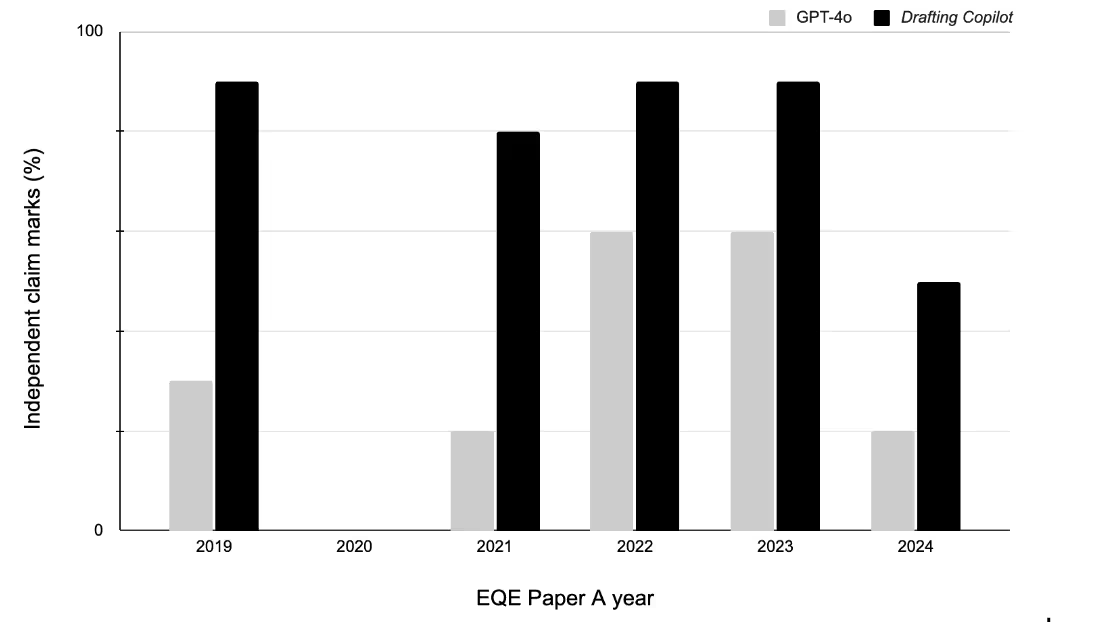
AI Patent Drafting: Patent Drafting Copilot vs GPTRecent comparative testing reveals that Solve Intelligence's Patent Drafting Copilot consistently outperforms GPT-4o in European patent claim drafting. Here we explore the technical and practical limitations of using GPT-4o for drafting claims suitable for European practice, and how using Solve’s Patent Drafting Copilot can deliver substantial improvements.
AI Patent Drafting Tools at AIPLAThe American Intellectual Property Law Association (AIPLA) has long been a leading force in advancing the practice of intellectual property law and is one of the most popular IP conferences . Numerous AI Patent Drafting Tools were present at AIPLA this year, showcasing a technological breakthrough that promises to reshape the way patent attorneys and intellectual property professionals work. As artificial intelligence (AI) finds applications in almost every industry, patent professionals are discovering how it can simplify the complexities of drafting patents and accelerate AI patent prosecution processes. In this article, we explore how drafting patents with AI is transforming the field, the tools available to attorneys, the benefits of AI-powered drafting solutions, and what the future might hold for intellectual property law.
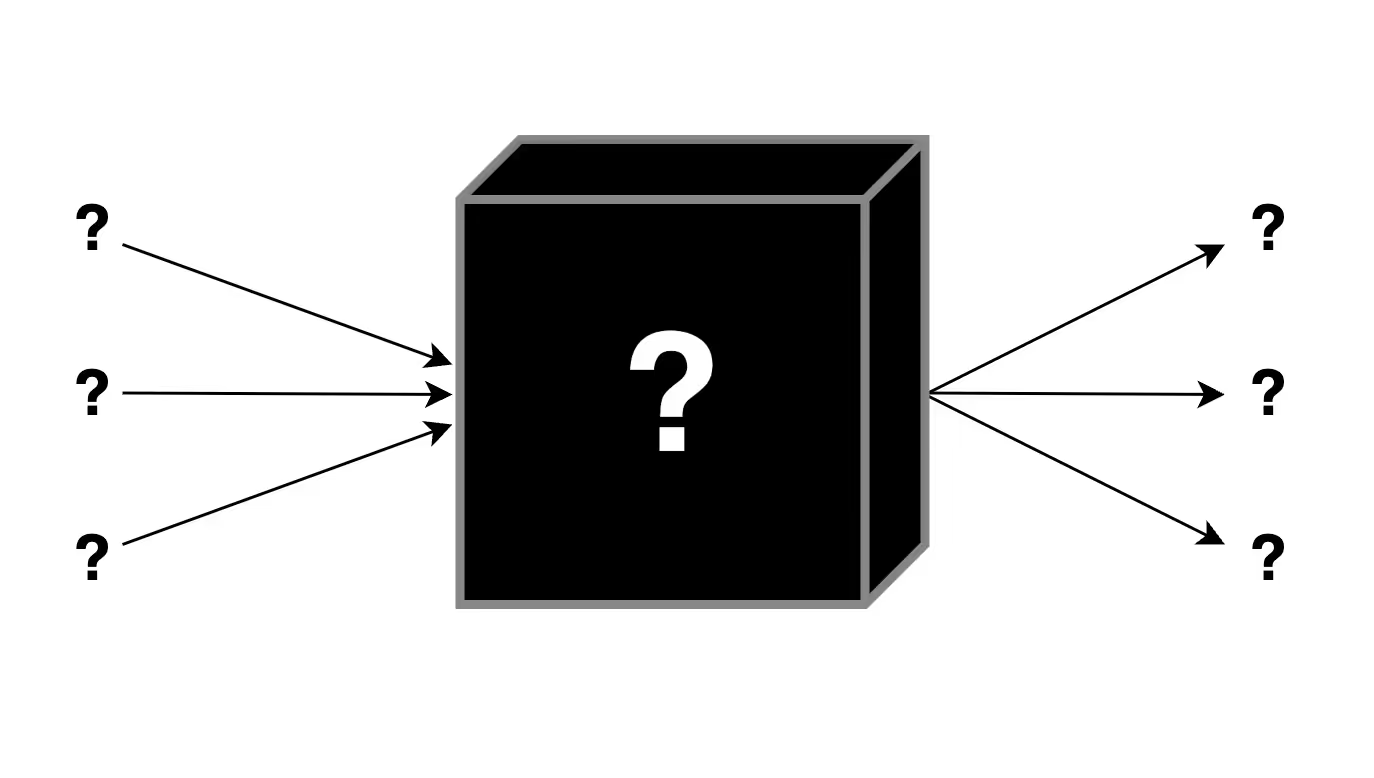
AI Patent Tools - EvaluationsIn artificial intelligence (AI) development, particularly in domains like generative AI (Gen AI), running structured evaluations - known as evals - is an incredibly useful tool. Evals test models and algorithms in development against real-world tasks to measure performance, detect errors, and improve reliability. In fields such as intellectual property (IP) law, these evals ensure that AI tools meet the high standards of accuracy and compliance required for professional use.
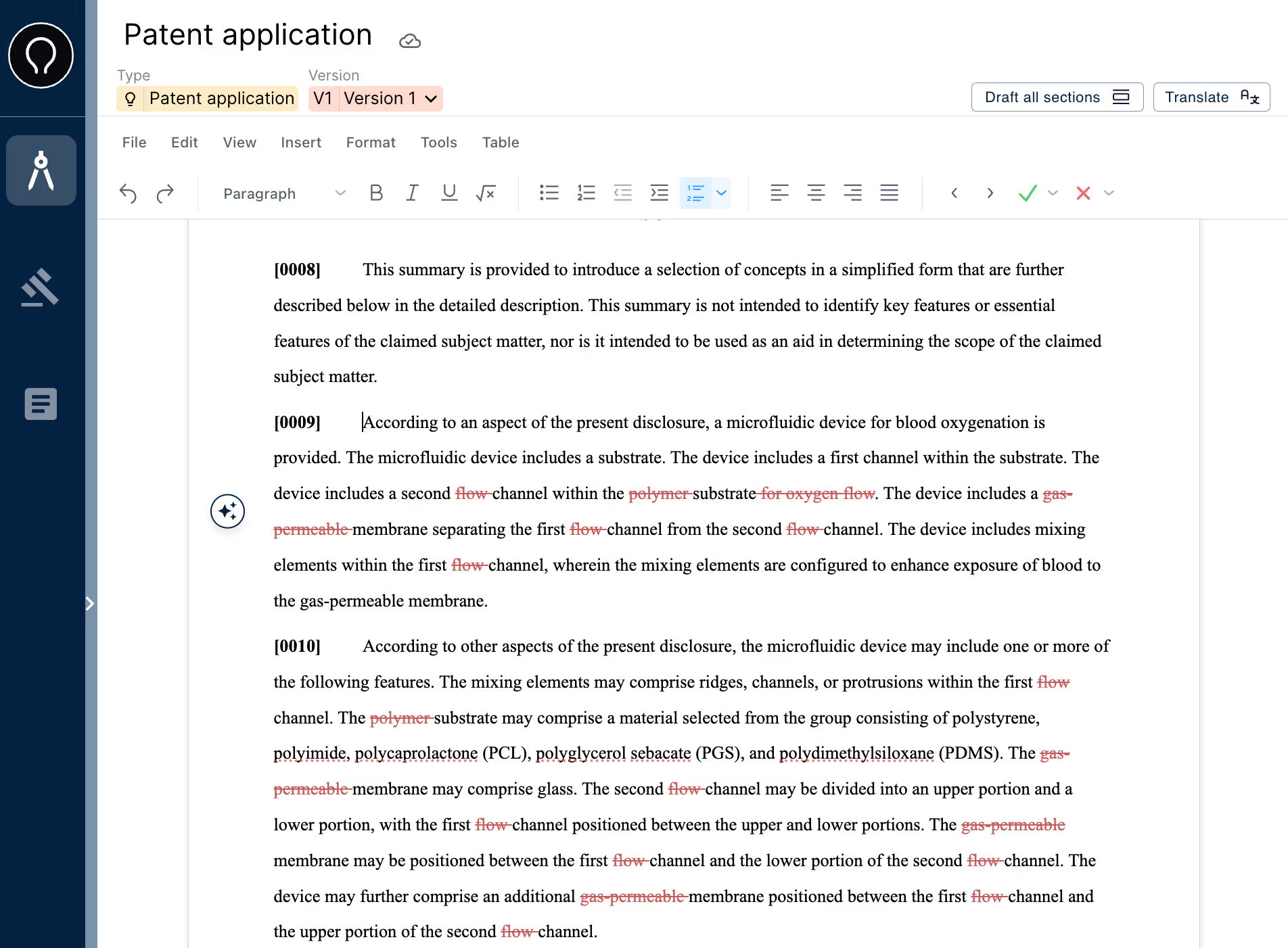
Feature Update: AI Track ChangesAs artificial intelligence (AI) becomes more integrated into professional workflows, the need for transparency in AI-assisted tasks is increasingly important. One key area where this applies is the patent industry, where accuracy and traceability are critical. To support this, we are introducing a new feature: AI Track Changes, designed to provide clear insights into how AI-generated suggestions and edits are being made to your patent applications, Office action responses, and other patent documents.
Inventive Step at the EPO - Back to RealityA recent T-decision of the Boards of Appeal ( T 1741/22 ) has provided an interesting deviation in how the EPO assesses the requirement of inventive step, from both a previous decision ( T 2681/16 ) and the EPO Guidelines for Examination.
Patent Drafting with AI: An EU AI Act PerspectiveArtificial intelligence (AI) is already having a substantial impact in the practice of Intellectual Property (IP) Law, with platforms such as Solve Intelligence's Patent Copilot assisting attorneys in drafting and prosecuting patent applications . These AI platforms can help patent attorneys realise efficiency gains and help to provide high-quality patents. Until earlier this year, the use of AI was largely unregulated across the world. Now, the picture has somewhat changed, with different countries implementing different strategies when it comes to regulating AI, to promote safety but also to remain competitive. Earlier this year, the Artificial Intelligence Act entered into force in the EU, becoming the world's first comprehensive regulation for AI. In this article we have a look at the obligations that the EU AI Act puts on AI technology providers, such as providers of AI patent drafting and prosecution tools.
Ethical Considerations of Using AI Tools for U.S. LawyersThe rapid rise of generative artificial intelligence (AI) is reshaping numerous industries, including the legal profession. For U.S. lawyers, AI tools offer tremendous potential to improve efficiency, accuracy, and speed in completing routine and complex tasks alike. However, alongside the benefits of these powerful tools come ethical considerations. This article explores these ethical challenges in detail, particularly in light of the American Bar Association’s (ABA) recent Formal Opinion 512 , which provides guidance for the ethical use of generative AI in legal practice.
Patent Drafting at the EPO - AI-related InventionsIn recent years, there has been a substantial increase in the filing of patent applications relating to AI-inventions at the EPO. In response to this, the EPO has started and continues to develop a framework for assessing the eligibility and patentability of AI inventions , with the introduction of new guidelines and evolving case law. This article outlines key considerations, common pitfalls, and best practices for drafting patent applications directed to AI inventions at the EPO.
5 Benefits of Integrating AI in Your IP PracticeThe field of intellectual property (IP) is constantly evolving, as businesses and innovators look for more efficient ways to manage and protect their ideas. As IP portfolios grow, the traditional methods of managing patents, trademarks, and copyrights can become increasingly time-consuming, resource-heavy, and prone to error. To keep up with the fast pace of innovation, IP professionals are now turning to artificial intelligence (AI) to streamline processes and deliver better outcomes.
How to Leverage Your Patent Prosecution Work with AIThe world of patent prosecution is undergoing a transformative shift, with artificial intelligence (AI) becoming a key player in streamlining and enhancing the prosecution process. Patent professionals—attorneys, agents, and paralegals—can leverage AI to improve efficiency, accuracy, and overall productivity. In this article, we’ll explore the role of AI in patent prosecution, how AI-assisted workflows can boost efficiency, and the challenges and ethical considerations that come with adopting AI solutions in this space.
Top 10 Tools Patent Attorneys Use for Efficiency in 2024The legal landscape is changing rapidly with advancements in artificial intelligence (AI), and patent law is no exception. As patent attorneys manage complex processes such as drafting, filing, and litigation, AI tools are emerging as critical resources to boost efficiency, accuracy, and strategic decision-making. AI tools for patent drafting, patent searches, and legal analytics can streamline workflows, helping attorneys focus on the more strategic aspects of their work. In this article, we’ll explore how AI is transforming the patent law industry, the key areas of impact, and the top AI tools patent attorneys are using today.
How Patent Outsourcing Can Streamline Your Firm's OperationsIn today’s fast-paced environment, law firms and businesses are under increasing pressure to keep up with the growing demands of intellectual property (IP) management . Filing patent applications and performing related IP work can be very time-sensitive, with attorneys often expected to turn around work at the last minute to meet deadlines relating to product-releases or entries to the market from competitors, for example. It can be very difficult to predict future workflow, and managing all aspects in-house can be costly and inefficient. This is where patent outsourcing comes in as a valuable solution to help streamline operations. By outsourcing patent work, firms can focus on their core competencies while benefiting from external expertise and cost savings.
AI Patent Figure Drafting: Benefits & Key Features Artificial intelligence (AI) has made its mark on numerous industries, revolutionizing processes that were once labor-intensive, error-prone, and time-consuming. In the realm of intellectual property (IP), AI is becoming an essential tool , with applications ranging from prior art searches to automating patent drafting. Among these breakthroughs, AI patent figure generation is one of the most promising, offering significant improvements in the way technical drawings are created for patent applications. Patent figures are a crucial part of the patent filing process, serving as visual representations of inventions. These drawings must be clear, accurate, and compliant with the strict requirements of patent offices around the world. Traditionally, this task required the skills of professional draftsmen or patent illustrators. However, advancements in AI patent figure tools have the potential to streamline this process, reducing time, cost, and errors while improving the overall quality and accessibility of patent drawings. This article will explore how AI tools for patent figure drafting work, their benefits, and the key features likely to shape the future of patent figure creation.
UK Innovation at a Crossroads: Bridging the Global Patent GapAs global innovation accelerates, the United Kingdom finds itself at a critical juncture. Despite ranking among the top nations in the world for innovation, UK businesses, particularly SMEs, are falling behind in securing international patent protection. A recent report from The Chartered Institute of Patent Attorneys (CIPA) reveals a concerning trend: while global patent filings hit record numbers, British companies are struggling to keep pace, risking their competitive edge in key international markets. In an increasingly interconnected world, securing international patents is not just a strategic advantage - it's a necessity for financial growth, enabling companies to maximise the commercial potential of their innovations on a global scale.
What is Patent Mapping and Claim Analysis with AI?In recent years, Artificial Intelligence (AI) has begun to play an increasingly important role in various industries, and intellectual property (IP) is no exception. One of the key areas where AI has the potential to make a significant impact is patent claim mapping and analysis, which are critical components of any robust IP strategy. These processes, which traditionally relied on manual efforts, involve identifying and linking patent claims to specific elements within a product or technology. This provides insights into the strengths and weaknesses of a company’s patent portfolio and helps shape future IP strategies. However, manual mapping and analysis are time-consuming, resource-intensive, and prone to errors. The introduction of AI into this domain is not just a technological advancement but could yet provide transformative change that has the potential to revolutionize how patents are managed and leveraged.
AI Hallucination: Risks and Prevention in Legal AI ToolsAs artificial intelligence (AI) becomes increasingly integrated into the legal industry, its potential to transform legal research, document drafting, and decision-making is clear. Generative AI tools, driven by large language models (LLMs), offer significant efficiency gains and new capabilities. However, with these advancements come notable risks, one of the most concerning being AI hallucinations. This article delves into the nature of AI hallucinations, their causes, the specific risks they pose in legal contexts, and strategies to mitigate these risks to ensure that legal AI tools remain reliable and trustworthy.
Top Intellectual Property, Legal Tech, & AI Conferences to AttendAs the legal industry continues to evolve, staying ahead of the curve with the latest advancements in intellectual property (IP), legal technology, and artificial intelligence (AI) is crucial. Attending top-tier conferences not only helps legal professionals stay updated but also provides networking opportunities, insights into future trends, and the chance to meet industry leaders. Whether you're a seasoned attorney, a tech enthusiast, or someone navigating the complexities of IP law, these events are a must-attend in 2024 and 2025.
European Patent Prosecution with Generative AIAs AI technology continues to evolve, patent prosecution has seen a transformative shift with the introduction of Generative AI tools. In the context of European patent prosecution, both European patent attorneys and the European Patent Office (EPO) are now either using or considering using AI tools to streamline what has historically been a complex and time-consuming process. Here, we look at the applications of Gen-AI to European prosecution and the benefits it can provide.
Prepare Responses to USPTO Office Actions Using Generative AI ToolsIn the ever-evolving world of patent prosecution, the role of technology cannot be overstated. As intellectual property (IP) landscapes become more complex and competitive, the need for precision, efficiency, and adaptability in handling USPTO Office actions grows increasingly vital. The introduction of generative AI tools into this arena represents a significant leap forward, offering patent professionals a powerful means to navigate the intricacies of patent law. This article delves into how generative AI is revolutionizing the preparation of responses to USPTO Office actions, outlining its practical applications, the benefits it brings, and why its adoption is becoming essential for modern patent prosecution.
Generative AI and Intellectual Property: Top Use CasesThe rapid development of artificial intelligence (AI) has sparked a myriad of debates across various industries, but perhaps none are more complex and contentious than those surrounding generative AI and intellectual property. As AI technology continues to evolve at an unprecedented pace, its implications for the world of intellectual property (IP) are profound and multifaceted. From the challenges of copyrighting AI-generated works to the nuances of patent law, this article explores the intricate relationship between generative AI and IP, highlighting key use cases and discussing the benefits of AI tools for legal teams.
Patent Claim Drafting Strategies: A Comprehensive GuidePatent claim drafting is a critical skill in the field of intellectual property law. It involves crafting precise and detailed listings of an invention's unique aspects, which are then used to define the scope of legal protection. The quality of these claims can determine the strength and value of a patent, impacting its ability to withstand legal challenges and enforce exclusivity. In this comprehensive guide, we will explore the key strategies for effective patent claim drafting, delve into common mistakes that can undermine a patent's effectiveness, and examine how artificial intelligence (AI) is transforming this complex process.
USPTO's Updated Guidance on AI InventionsThe United States Patent and Trademark Office (USPTO) has released updated guidance on patent subject matter eligibility . This update focuses on critical and emerging technologies, particularly artificial intelligence (AI). The new guidance aims to assist USPTO personnel and stakeholders in evaluating the subject matter eligibility of claims in patent applications and patents related to AI technology and inventions. Furthermore, it introduces new examples to help apply the USPTO's subject matter eligibility guidance during patent examination, appeal, and post-grant proceedings. The guidance also addresses stakeholder feedback and recent Federal Circuit decisions.
Cookie settingsBy clicking “Accept all”, you agree to the storing of cookies on your device to enhance site navigation, analyze site usage, and assist in our marketing efforts. For further details see ourManage cookie preferencesChoose which cookies we may store on your device. Essentials keep the site working and cannot be turned off.EssentialsNecessary for the site to function. Always on.Always activeAnalyticsMeasures usage and improves your experience.MarketingUsed for targeted advertising.Cookie preferences