1. Automated Analysis of Examiner Rejections
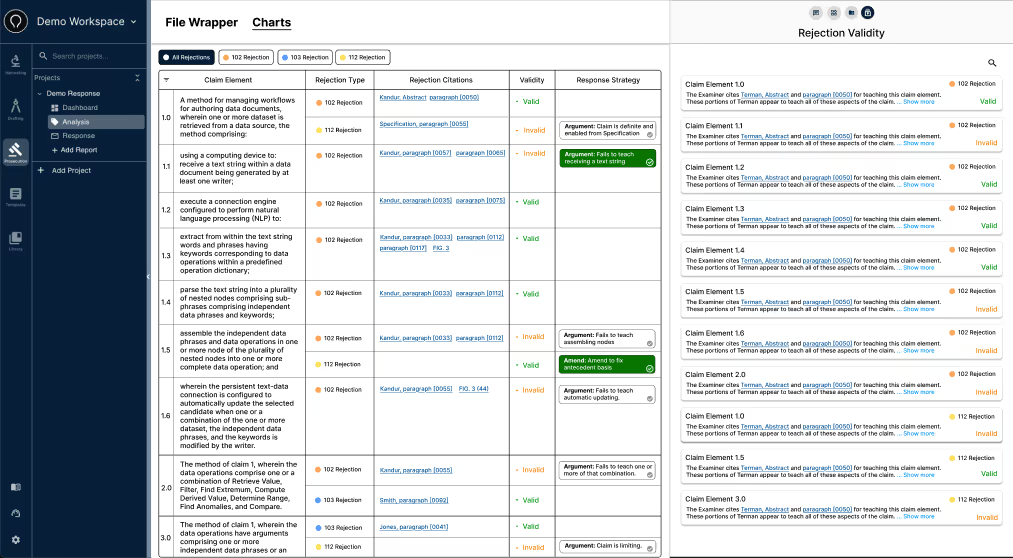
Traditionally, preparing a claim chart requires an attorney or technical expert to manually parse each element of the claim, comb through cited prior art, and map every limitation to supporting passages, an undertaking that can easily consume 5–10 billable hours per Office Action (making them impractical for patent prosecution). AI claim‑charting platforms, by contrast, leverage trained NLP models that have digested millions of patent documents, prosecution histories, and technical references.
- Limitation parsing: The AI first breaks the claim down into its constituent limitations (identifying independent vs. dependent claims, recognizing means‑plus‑function language, and distinguishing structural from functional elements).
- Prior art alignment: Next, it retrieves the Examiner’s cited references (U.S. patents, foreign publications, non‑patent literature) and automatically aligns each claim limitation with candidate passages in the art. This includes fuzzy‑match scoring and synonym detection, which helps catch semantically equivalent disclosures that a strict keyword search might miss.
- Rejection reconstruction: Because modern Examiners often combine multiple references in §103 rejections, the AI reconstructs the combination logic and shows how the Examiner believes reference A teaches limitation (a), and reference B teaches limitation (b), etc.
Once complete, the tool generates a structured claim chart in minutes rather than hours. This not only accelerates the response lifecycle but also creates a consistent audit trail, with exact citation locations and confidence scores for each mapping.
2. Instant Flagging of Issues and Gaps
The real power of AI emerges when the claim chart is used diagnostically to critique the Examiner’s rejection. Key advantages include:
- Unmapped limitations: The system automatically highlights any claim element for which it cannot find a clear antecedent in the cited art. For example, if an Examiner’s §102 rejection fails to teach “a processor configured to execute recursive tree‑traversal,” the AI will flag that limitation as unmapped or weakly supported.
- Overbroad interpretations: Under the broadest reasonable interpretation (BRI) standard, Examiners may stretch claim language. AI tools detect where the Examiner’s cited passage exhibits a meaning beyond the plain language of the claim and identifies semantic mismatches such as interpreting “module” to include structures not covered by the claim’s functional definition.
- Logical inconsistencies: By modeling each rejection step‑by‑step, the AI can surface internal inconsistencies in the Examiner’s reasoning. For instance, if the Examiner cites reference B as teaching element (c) only when combined with element (b) from reference A (but then uses element (c) standalone elsewhere) AI flags this logical gap.
These instant flags allow the practitioner to prioritize the strongest arguments and amendments, rather than spending hours sifting line‑by‑line for holes.
3. Holistic Assessment of Claim Language and Prior Art
Beyond simple mapping, modern AI claim‑charting solutions bring a semantic understanding of both claim language and the prior art corpus as a whole:
- Contextual term interpretation: AI models trained on patent corpora understand patent‑specific term usage. They can distinguish when “means for configuring” invokes 35 U.S.C. §112(f) analysis versus plain‑English grammar, or when “about 10 kilograms” should be interpreted as encompassing a tolerance range.
- Scope under different claim‑construction paradigms: While U.S. Office Actions use BRI, many practitioners think in terms of Phillips (the standard in district court). AI platforms can model both interpretations, helping the attorney anticipate how claim scope may shift in different forums or during appeal.
- Implicit disclosures and combinations: Some rejections rely on unstated assumptions, e.g., reference A discloses components that “would inherently” perform function X. AI tools leverage pattern‑recognition to surface implicit teachings across references and identify whether such inferences truly stand up.
- Corpus-wide prior art mining: When §103 rejections hinge on combinations, AI can scan billions of patents and publications to find alternate references or secondary considerations (e.g., teaching away, surprising advantages) that the Examiner did not cite, thereby fueling stronger rejoinders.
Together, these capabilities give patent professionals a holistic lens: not just line‑item maps, but an AI‑augmented understanding of claim scope, prior art nuances, and potential prosecution pathways.
4. AI‑Generated Response Strategies
Perhaps most excitingly, AI tools are starting to offer tailored response recommendations based on the issues surfaced:
- Draft amendment options
- The AI proposes specific claim amendments, thereby narrowing or re‑drafting limitations to avoid the cited art while preserving commercial scope. It even suggests alternative wording (e.g., converting functional language into structural means‑plus‑function claims).
- Argument templates and authorities
- Once critical gaps are flagged, the system assembles “argument bundles” that include relevant MPEP sections (e.g., §§2143.03(a)(1)), controlling Federal Circuit cases, and suggested phrasing to undermine the Examiner’s logic (e.g., “Reference X does not disclose limitation Y, as it fails to teach…”).
- Alternative claim‑construction positions
- Where ambiguity exists, the AI may recommend pushing for a narrower interpretation. For example, arguing that “configured to perform X” should be limited to structures expressly recited, thereby bypassing certain prior art. It can also draft examiner interview agendas to present these positions most effectively.
- Evidence and declaration planning
- For rejections that hinge on implicit disclosures or alleged obviousness combinations, the AI suggests targeted experiments or expert declarations and outlines what factual showings would most undermine the Examiner’s assumptions (e.g., show that combining references A and B yields unexpected results).
These AI‑generated strategies serve as a springboard. Instead of starting from a blank page, the attorney can refine and customize the AI’s proposals, which saves hours of initial drafting and research.
Real‑World Impact and Adoption
Firms that have integrated AI claim‑charting into their prosecution workflow report transformative gains:
- 50–70% reduction in chart‑generation time leading to faster docket clearance and more capacity for high‑value prosecution and counseling work.
- Higher allowance rates because critical gaps are caught early and the response strategy is data‑driven rather than heuristic.
- Improved consistency across teams, since the AI’s underlying models enforce uniform mapping and recommend the same legal authorities firm‑wide.
- Cost savings by shifting the bulk of charting to automation, firms can allocate associate hours to nuanced analysis, interviews, and strategic decision‑making.
The Future of AI in Patent Prosecution
Today’s Office Action responses represent just the beginning. As AI models continue to evolve, integrating full‑text search of litigation databases, improving multimodal reasoning over figures and flowcharts, and even learning from confidential docket outcomes, the role of AI in patent practice will deepen.
- Appeal briefs may be drafted with AI’s help, summarizing Examiner’s rejections versus client arguments in a unified narrative.
- Real‑time prosecution analytics will predict allowance odds based on Examiner history, technology area, and claim language.
- Integration with global filing systems will enable cross‑jurisdictional claim charting, aligning U.S., European, and PCT interpretations in a single interface.
But through it all, the goal remains the same: amplifying, not replacing, the expertise of the patent professional. AI claim‑charting tools free attorneys to do what they do best (craft creative legal arguments, engage in substantive interviews, and provide strategic counsel) while the AI handles data‑intensive mapping, semantic analysis, and preliminary drafting.
Conclusion
Artificial intelligence is ushering in a smarter, faster, and more strategic era of patent prosecution. By automating the generation of robust claim charts, flagging critical flaws in Examiner rejections, semantically analyzing claim language and prior art, and even proposing response strategies, AI tools allow patent professionals to respond to Office Actions with greater confidence and efficiency.
The takeaway? Embrace AI claim charting not as a gimmick, but as a force multiplier: a way to unlock deeper insights, save valuable time, and ultimately secure stronger patent rights for your clients. The future of patent practice isn’t just digital; it’s intelligent.

.jpeg)