Drafting patent claims is a meticulous process that requires an in-depth understanding of the invention, as well as knowledge of legal standards and technical language. AI tools have introduced significant advancements to this process, making it faster, more accurate, and more accessible.
The traditional process of drafting patent claims can be time-consuming, often requiring days or even weeks to finalize a single patent application. AI-assisted patent claim drafting tools can analyze technical data, prior art, and legal precedents in a matter of minutes, producing initial drafts much faster than manual methods.
By automating repetitive tasks, such as identifying similar claims in prior patents or formatting legal language, these tools free up time for professionals to focus on higher-value tasks, such as strategic decision-making or client consultations.
Mistakes in patent claims can be costly, potentially invalidating the patent or leading to legal challenges. AI tools excel in minimizing errors by meticulously analyzing prior art and identifying potential conflicts with existing patents. This precision reduces the likelihood of overlapping claims or drafting errors.
Moreover, AI ensures consistency across multiple claims in a single application, an area where human drafters can sometimes fall short due to fatigue or oversight. Consistent and accurate claims improve the overall quality and defensibility of a patent.
For small and medium-sized enterprises (SMEs), the cost of hiring experienced patent professionals can be prohibitive. By using AI to draft patent claims, SMEs can significantly reduce expenses without compromising on quality. Many AI tools offer scalable pricing models, making them an attractive option for businesses of all sizes.
Innovation often involves trial and error, especially in the early stages of product development. AI tools can help inventors explore different scopes of patent protection by suggesting alternative claim structures. This iterative approach supports creativity while ensuring that the patent provides robust legal coverage.
As intellectual property law becomes increasingly globalized, AI tools can assist with drafting claims that comply with the standards of multiple jurisdictions. Some advanced AI tools even offer translation features, making it easier to draft patent claims for international applications.
At Solve, we routinely run complex evaluations of our products and their ability to provide quality outputs against established benchmarks. This in turn allows us to iterate and improve on existing features and test new features, such that they perform to the high standard patent practitioners expect.
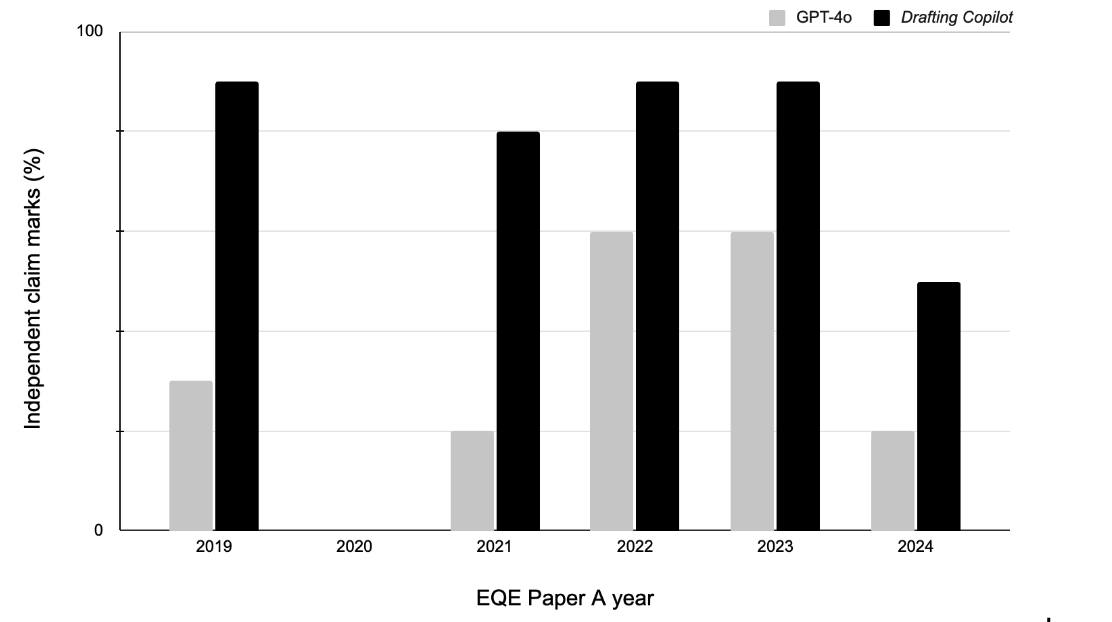
To illustrate the benefits of this approach, we conducted a test of our Patent Drafting Copilot, and specifically its ability to draft claims for a European patent application. We used the Patent Drafting Copilot to generate claims for the last 5 years of European Qualifying Examination (EQE) Paper A questions (2019-2024), and marked the independent claims according to the following criteria:
The inputs we provided to the Patent Drafting Copilot included the invention disclosure and the prior art provided in each EQE paper, with no further instruction or input.
For comparison, we provided GPT-4o with exactly the same information, as well as a simple prompt outlining the task of drafting European patent claims.
While the benefits of AI in drafting patent claims are substantial, there are important considerations to address before fully integrating these tools into the drafting process.
One of the key challenges of using AI to draft patent claims is determining authorship and accountability. Patent law in many jurisdictions requires a human inventor to be named in the application.
Additionally, ethical concerns arise regarding the potential misuse of AI tools. For instance, generating overly broad claims with the intent to stifle competition could lead to disputes and regulatory scrutiny.
Despite their advanced capabilities, AI tools are not a substitute for human expertise. Patent professionals must verify the accuracy and quality of AI-drafted claims, ensuring that they meet both legal and technical standards. In many cases, a hybrid approach—where AI drafts initial claims and professionals refine them—is the most effective strategy.
Training patent professionals to use AI tools effectively is also critical. Understanding the limitations and strengths of these tools ensures that they are used to their full potential.
Drafting patent claims often involves handling sensitive and proprietary information. It is crucial to ensure that the AI tools being used comply with strict data security protocols. Look for tools that offer end-to-end encryption, secure servers, and adherence to data privacy regulations such as GDPR.
AI tools, while powerful, are not infallible. They may struggle with emerging technologies that lack substantial prior art or with inventions that require highly nuanced legal interpretations. In such cases, human judgment becomes indispensable.
As AI technology continues to evolve, so do the standards and expectations for patent claim drafting. Professionals must stay updated on regulatory changes and best practices to ensure compliance and effectiveness in their use of AI tools.
The rise of AI-assisted patent claim drafting offers a glimpse into the future of intellectual property law. By combining the speed and efficiency of AI with the critical thinking and expertise of human professionals, the process of drafting patent claims is becoming more streamlined and accessible.
As these tools continue to evolve, they will likely play an even greater role in shaping the landscape of intellectual property. However, the most successful implementations will be those that strike a balance between leveraging AI’s capabilities and preserving the irreplaceable value of human insight.
Whether you’re a seasoned patent attorney or a first-time inventor, embracing AI-assisted patent claim drafting can open new doors for innovation and legal protection, setting the stage for a more efficient and inclusive intellectual property system.


.jpeg)