T1669/21 concerned an appeal by the patent proprietor against a decision of the Opposition Division to revoke the patent. The patent itself claimed a method for determining a condition of the refractory lining of a vessel, using a calculation model. Amongst other steps, claim 1 defined creating a calculation model based on measured or determined care data, production data, wall thicknesses, and process parameters, wherein the calculation model evaluates the data or parameters through calculations and resulting analyses.
The crux of the case revolved around this calculation model and whether it was disclosed in the patent fully enough to meet the requirements of sufficiency under Article 83 EPC.
The EPO upheld the initial revocation, finding that the patent did not disclose the invention sufficiently to allow a skilled person to carry it out without undue burden. The key points in both the patent proprietor’s argument and the EPO’s decision included the following:
Proprietor's Argument: The proprietor contended that the claim sufficiently enabled a skilled person to construct the calculation model, emphasising that advances in machine learning had made predictive modelling a well-understood discipline. The proprietor argued that a skilled practitioner would recognize the invention’s intent and could implement an appropriate model based on general machine learning principles without needing detailed instructions on model type, training methodology, or input variable configuration. Additionally, the proprietor highlighted that the claim’s terms, such as “regression analysis” and “adapted calculation model,” naturally pointed toward known machine learning approaches.
Board’s Assessment: The Board disagreed, finding that the broad language in claim 1, coupled with a lack of specificity in model parameters and selection, meant that the calculation model could even encompass analytical models as well as ML models. The patent did not disclose details for implementing an analytical model, and for this reason the Board held that the patent was not sufficiently disclosed. The Board underscored that merely mentioning ML terms like “adaptive model” and “regression analysis” did not clarify the model’s specific workings or provide sufficient guidance as to the type of model.
Proprietor's Argument: The proprietor asserted that skilled practitioners in machine learning could choose an appropriate model architecture based on general expertise and standard ML libraries, which offer diverse model options suited to various applications. They highlighted that the machine learning field has advanced to the point where model selection and training are routine, especially for tasks involving multidimensional data such as wear prediction. The proprietor maintained that the patent's references to machine learning were sufficient to indicate that a neural network could be suitable, even if a specific topology wasn’t disclosed.
Board’s Assessment: The Board held that the patent’s reliance on generic machine learning terminology, without specifying any model architecture or input and output parameters, imposed an unreasonable burden on a skilled person. The Board reasoned that machine learning models vary widely in their structures, training methods, and input and output parameters, making it necessary for the patent to provide more detailed instructions to guide the skilled person toward an effective model configuration. The Board noted that while standard machine learning libraries may offer various tools, choosing a model type suitable for wear prediction in high-temperature, high-stress environments would require specialised knowledge and effort. Thus, it found the absence of specific architectural guidance a major deficiency, considering the description of the invention too open-ended to be reliably implemented.
Proprietor's Argument: The proprietor argued that representative training data could be obtained from routine operations, asserting that machine learning's adaptability would account for any minor inconsistencies in data quality. The proprietor also posited that, due to the self-learning nature of machine learning models, even without tailored training data, the model could selectively emphasise significant variations while disregarding less relevant factors.
Board’s Assessment: The Board disagreed, emphasising that the lack of guidance on the quantity, quality, or nature of training data left too much ambiguity for a skilled person to implement the invention. Furthermore, the Board argued that depending solely on normal operational data would be inadequate, and that this limited dataset would likely lack the diversity necessary for effective training for use of a trained model across the broad scope defined in the claims.
Proprietor's Argument: The proprietor argued that machine learning’s inherent adaptability meant that the model would "learn" relevant relationships during training, uncovering predictive patterns autonomously and that specifying one working embodiment would thus unnecessarily narrow the invention’s scope.
Board’s Assessment: The Board disagreed with the proprietor’s position, stating that, while machine learning can generalise predictive patterns, the invention still required a specific and reproducible example to demonstrate feasibility. The Board contended that a concrete example would establish a useful starting point for a skilled person to implement and verify the model’s efficacy, but as no such example was provided, there was no evidence that the invention could successfully predict wear given the broad input variable categories claimed.
T1669/21 provides some useful directions for drafting AI patent applications, and certainly puts some flesh on the bones provided by the Guidelines. Here are some takeaways:
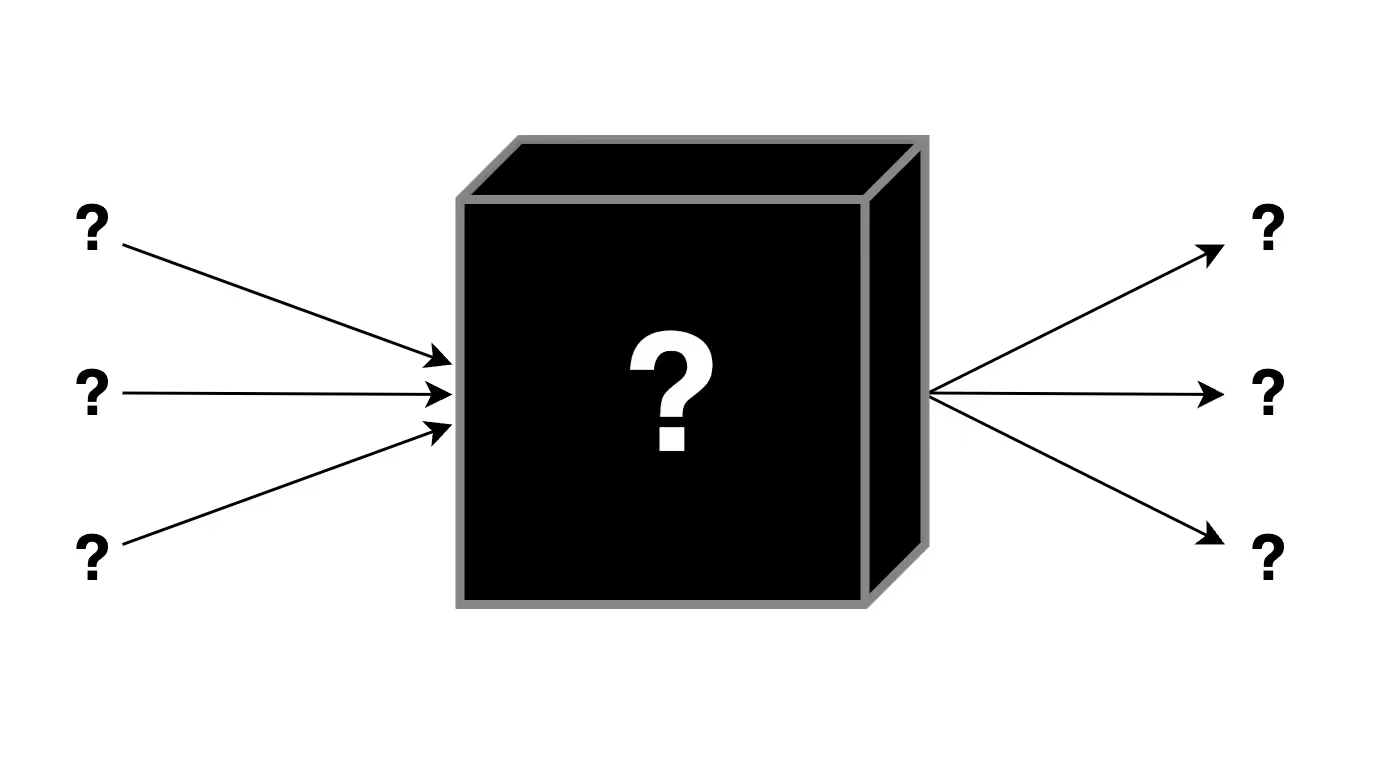
This decision underscores that patents and patent applications to AI inventions should include description beyond that of a generic "black box". Although, on the face of it, one could summarise that AI-related inventions are now subject to a higher bar compared to others when it comes to the requirements of sufficiency under Article 83 EPC, in reality this decision and the Guidelines seem to be a natural extension of the long-standing principle of ensuring that the skilled person can reproduce the invention without his own research or undue experimentation.
Here at Solve Intelligence, we take keen interest in legal developments across multiple jurisdictions, such as this decision, to ensure our platforms reflect contemporary practice requirements.

.jpeg)