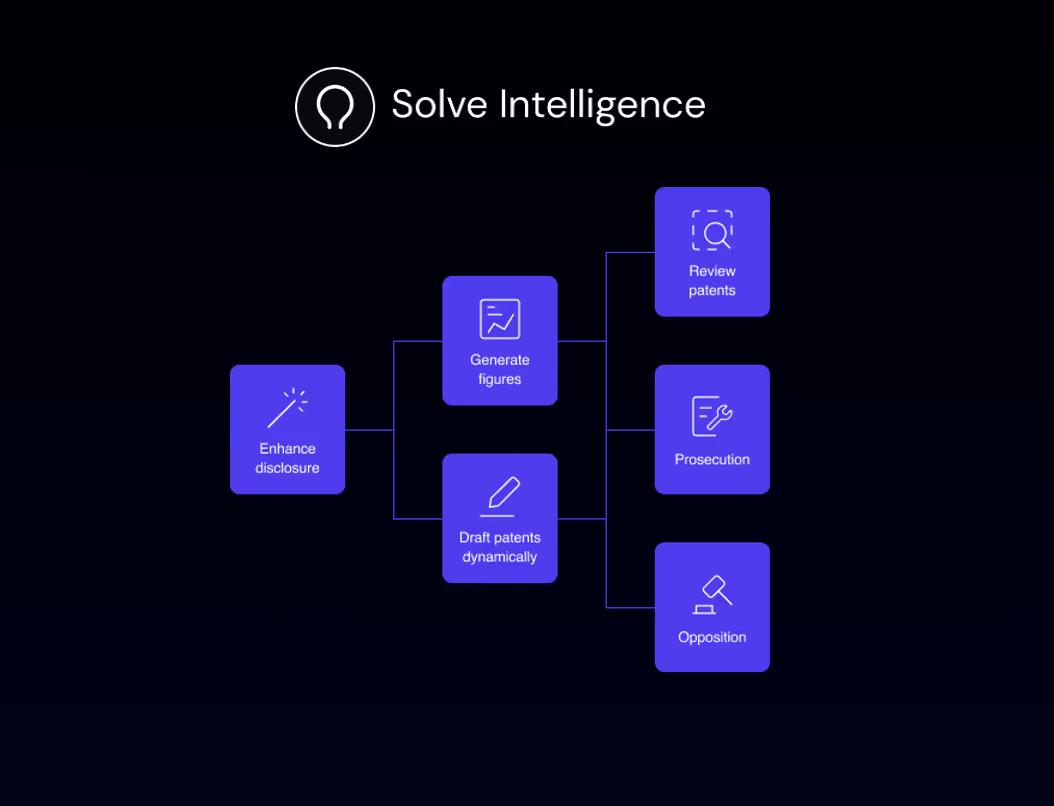
Invention Disclosures + AI
The patent application drafting process usually begins with some sort of invention disclosure. This could be an invention disclosure form, a transcript of a call with an inventor, some rough sketches of the invention, or simply some experimental data.
At the very outset, AI may be used in several ways to expedite and simplify the invention disclosure process and the patent process as a whole, including:
- Expediting invention disclosure form creation. Here, some materials or invention disclosure resources may be inputted and then AI may be used to automate and expedite the drafting of custom invention disclosure forms, thereby helping inventors with filling out their invention disclosure forms.
- Supplementing invention disclosures. AI may also be used to suggest alternative embodiments or applications, further assisting inventors and patent attorneys alike with protecting their invention and broadening the scope of their invention. Importantly, however, AI must be trained not to be inventive with its suggestions.
- Clarifying aspects of the invention. AI is also helpful with generating clarifying questions for the inventor to answer, whether that’s before an inventor interview or simply a step in expanding the invention disclosure material.
- Simplifying and expediting review of invention disclosure materials. AI may also be used to summarize and explain invention disclosure documents, thereby simplifying the review of invention disclosure documents for patent professionals.
Patentability Reviews + AI
Next, the patenting process may involve a patentability review or assessment. Here, the invention may be compared with known prior art or a patentability search may be conducted to determine relevant prior art that exists.
At this stage, AI may be helpful with the following tasks:
- Prior art document analysis. Here, AI may assist with analyzing prior art documents and suggesting the novel aspects or inventive features of the invention.
- Sample claim generation. AI may also be used at this stage to generate some sample claims, which may be reviewed by a patent professional and inventor to determine the scope and value of possible patentable aspects of the invention. Generating sample claims prior to drafting an entire patent application.
Patent Application Drafting + AI
Additionally, when it comes to drafting applications, there are numerous ways in which AI may help, including the following:
- Full application drafting. Some AI tools, including Solve’s Patent CopilotTM, can draft entire patent applications, output discrete and individual sections of a patent application, and/or convert patent applications for filing in different jurisdictions and patent offices. Here, for example, Solve’s Patent CopilotTM may generate an entire application or a section of a patent application (e.g., the claims) when prompted by an attorney or legal professional. Additionally, AI tools may be customized to draft in a particular style or tailored using example patent applications that have been previously filed.
- Patent application revisions and editing. Additionally, AI tools are capable of revising or redrafting sections of a patent application, as well as expanding or further elaborating on sections of a patent application.
- Figure editing and drafting. AI tools may also have built in figure editing and drafting capabilities. For example, Solve’s Patent CopilotTM can assist with the generation and creation of figures, including flowcharts.
- Chemical structure and data input and analysis. AI is also capable of analyzing chemical structures and raw tabular data, and generating text, including an Examples section of a patent application.
- Patent application review. AI may also be used to review patent applications, including helping with the review of patent claims, correcting antecedent basis issues, reviewing claim support and disclosure within a specification therefor, etc.
Benefits of AI for Patent Drafting
AI is being used by a wide range of legal professionals, patent drafters, and in-house teams around the world. Additionally, many users are reporting large efficiency gains from its implementations in their workflow. Here are some overviews of the potential benefits that we are seeing at Solve:
- Efficiency improvements. Significant time savings in drafting and reviewing patent applications.
- Quality maintenance. Consistent, high-quality output tailored to individual preferences, despite cost and time pressures.
- Strategic focus. More time freed up to spend on providing value-add strategic advice and decision-making, such as more time analyzing and developing higher quality claims, thereby delivering clients with a higher quality service with faster response times.
- Increased bandwidth. Ability to handle more clients and cases.
- Faster turnaround. Quicker analysis and enhancement of disclosures, and faster responses from outside counsel.
- Strategic IP management. Receive better strategic advice for IP portfolio development from outside counsel, and free up time to weigh this advice with business objectives.
- Enhanced ROI. Improved return on investment from IP due to strategic focus.
- Prolific innovation. AI aids in generating more comprehensive patent applications and invention disclosures, and frees up inventor time to spend on R&D, rather than interacting with attorneys and filling out long disclosure forms.
- Reduced barriers. Easier and less burdensome patenting process with a much-reduced back-and-forth between inventors, in-house teams, and outside counsel.
- Competitive edge. Free up the time of your IP team and outside counsel to receive more strategic patenting advice tailored to your business objectives.
Potential Risks of AI Patent Drafting
Many AI systems, including Solve’s Patent CopilotTM, have been guard-railed to prevent errors and hallucinations. Additionally, Solve’s Patent CopilotTM is designed to keep the attorney or legal professional in control during each step or use of AI. However, there are still things legal professionals should watch out for when using AI during their patent application drafting process.
First, a patent professional should always still review the claims for completeness and accuracy. Specifically, the claims should be reviewed to make sure that at least one human significantly contributed to each claim.
Second, a patent professional should still review the specification for accuracy and completeness. Most AI patent drafting tools are designed to draft the specification such that it properly supports the drafted claims. However, AI tools are not a substitute for a patent professional and patent professionals should still review the specification to ensure that it properly supports and enables aspects of the claims, thereby ensuring that they comply with the relevant jurisdiction in which patent protection is being sought.
Conclusion
Overall, AI has vast potential to help various industries and workflows in intellectual property and patent law. With that said, it must be designed and used in proper ways by legal professionals to effectuate great patent protection for inventors and clients.
If you are interested in streamlining the patent drafting process with Solve’s Patent CopilotTM, please contact us.