To turn a Paragraph IV notice into a Hatch-Waxman complaint, counsel builds the record, maps each claim to the label, and pleads jurisdiction. In a test on a real case, Exelixis v. MSN, Solve Intelligence did all three and drafted the complaint. Its draft matched the jurisdiction theory and venue split of the complaint Exelixis filed.
A Paragraph IV notice starts a 45-day clock. Brand counsel has to decide which claims to assert and file before it runs out. The complaint follows a familiar pattern, but the work behind it does not. Someone has to read the file histories and map each claim to the label. Someone has to pin down jurisdiction over a foreign generic and its U.S. affiliate. Someone has to check what the generic conceded in earlier cases.
Many litigators already draft with a frontier model such as ChatGPT or Claude. But its draft is only as good as the record you paste in. In an ANDA case, building the record is a significant portion of the work.
Solve Intelligence differs in at least three ways that matter for a complaint.
Solve Intelligence pulls the patents, the file histories, the label, and prior court filings or related case materials. It files each one in the project. It can also check how courts have construed similar claim terms, using LexisNexis patent litigation data.
Every fact in Solve Intelligence’s analysis links to its source. One click opens the document at the supporting passage, even deep inside a long file history. Steps 2 and 3 show examples.
Our team of IP practitioners helps users build their best practices into templates and skills. The complaint below started from a Hatch-Waxman Complaint template.
If you have not used AI in litigation yet, the steps below show the whole workflow. It took one project instruction and six prompts. Our EPO opposition walkthrough applies the same approach to validity work in Europe.
In January 2022, MSN Laboratories and its U.S. affiliate, MSN Pharmaceuticals, sent Exelixis a Paragraph IV notice. The notice covered U.S. Patent Nos. 11,091,439, 11,091,440, and 11,098,015 (the ’439, ’440, and ’015 patents). All three relate to the crystalline malate salt of cabozantinib, the active ingredient in Cabometyx®. MSN’s ANDA was already in litigation over earlier patents.
Exelixis received the notice on January 11, 2022. It sued in the District of Delaware on February 23, 2022. The case is Exelixis, Inc. v. MSN Laboratories Private Ltd., C.A. No. 22-228-RGA.
A fair test starts where the brand’s lawyers started. The project instruction below set the date to February 22, 2022. It also set the ground rules.
We represent Exelixis, Inc., holder of NDA 208692 for Cabometyx (cabozantinib) tablets. On January 11, 2022, Exelixis received a Paragraph IV notice from MSN … Treat today’s date as February 22, 2022. Use only project documents and sources dated on or before today’s date. …
The chat thread lists every document Solve Intelligence reads, so we could confirm it followed the date rule. Further, we turned web search off for the drafting step.
MSN’s notice letter is confidential, so we gave Solve Intelligence a stand-in. It repeats only what the filed complaint says about the letter, such as its date and the claims MSN did not contest. The draft’s notes for the reviewing partner flag the stand-in for checking against the original.
On a live matter, counsel would upload the letter itself. Under our security and confidentiality practices, customer documents are never used to train AI models or retained by third-party model providers.
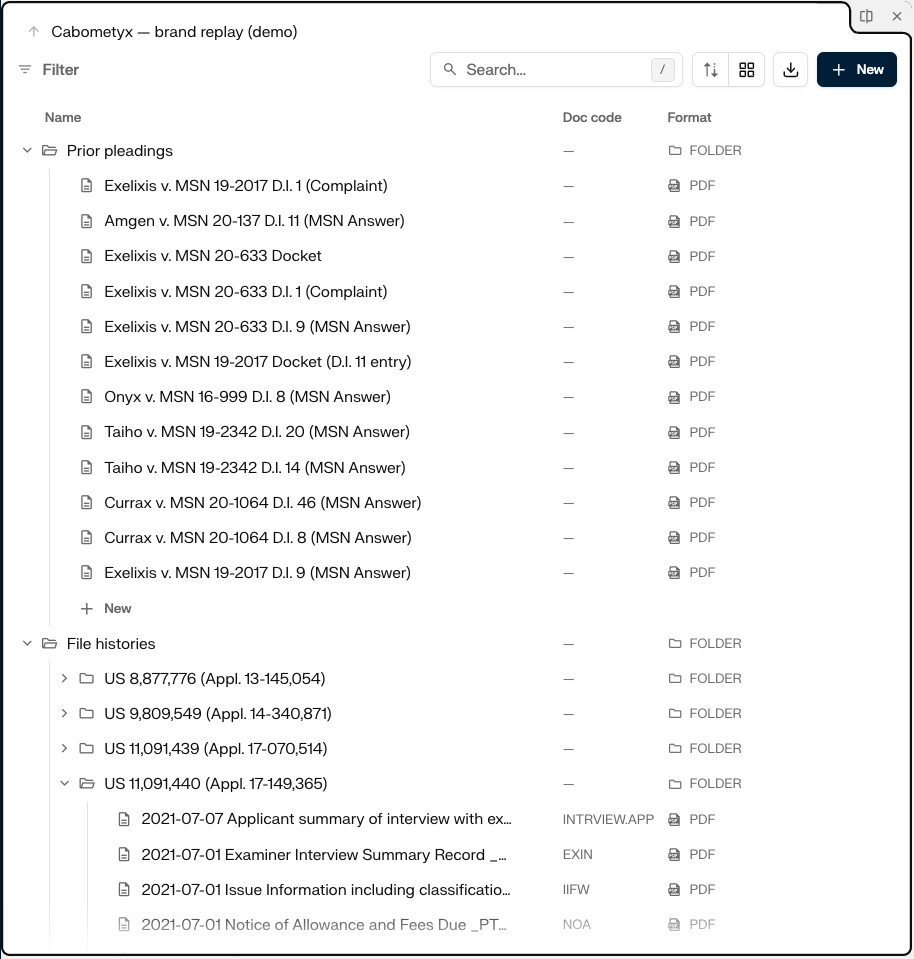
With the following set of prompts, Solve Intelligence listed the Orange Book patents for Cabometyx and pulled the three patents and the label. It then imported five file histories from the USPTO. Each landed in its own folder, labeled by date and document code. No lawyer spent time downloading files.
List every Orange Book patent and exclusivity for Cabometyx (NDA 208692) … citing the FDA edition. Pull the three certified patents into a folder named “Patents” and give each one’s title, issue date, assignee, priority chain, terminal disclaimers, and expiry. Save the Cabometyx prescribing information … to a folder named “Label.”
Import the file histories of the ’439, ’440, and ’015 patents and of U.S. 8,877,776 and 9,809,549, which share their specification, focusing on documents that may be substantively relevant to this litigation, such as office actions, responses, and amendments … File them in a folder named “File histories,” one subfolder per patent.
Jurisdiction and venue need facts about each defendant. The history between the parties matters too. Solve could pull the relevant documents with the following request.
Find all litigation between Exelixis and MSN over cabozantinib … Then research MSN Laboratories Private Limited and MSN Pharmaceuticals, Inc.: place of incorporation, principal place of business, how the two are related, their roles in ANDA No. 213878, and earlier Delaware cases in which they consented to or did not contest personal jurisdiction. Present the results as a Canvas artifact … with a citation for every fact.
Solve Intelligence returned an interactive canvas with four tabs. It found two pending cases between the parties in Delaware, consolidated in July 2020. It showed the 30-month stay in the lead case expiring on March 25, 2022, with trial set for May. The filed complaint’s first footnote recounts both cases, with the same filing dates.
The other tabs profile each MSN entity, its role in the ANDA, and its record in Delaware. Every fact carries a citation.
MSN’s earlier pleadings were not yet in the project. So we asked Solve Intelligence to pull them in and check the canvas against them.
Pull every MSN pleading the canvas cites into a folder named “Prior pleadings.” Then check each admission and jurisdictional position the canvas attributes to MSN against the pleading itself, and flag any that does not match.
Solve Intelligence saved twelve documents from six Delaware cases. They include MSN’s answers in all six cases, Exelixis’s two earlier complaints, and the dockets of the two pending cases. The canvas now cites those documents directly. Clicking a citation opens the source beside the canvas, at the supporting passage.

For each earlier Delaware case, the canvas shows whether Solve Intelligence read MSN’s own pleading. Cases known only from other plaintiffs’ complaints are marked Alleged or Unverified.
Each count needs a good-faith basis. In an ANDA case, the label does most of that work. A generic’s label must match the brand’s, apart from permitted carve-outs. So the first question is whether the brand’s label meets each claim. Solve Intelligence’s Charts tool built one chart per patent in response to the following request.
Create an Orange Book Claim Coverage Chart for each of the ’439, ’440, and ’015 patents. Use the prescribing information in “Label” as the drug label and the file histories as the prosecution history. Run it.
Each row takes one claim feature. The row quotes the claim, the label, and the specification. It then rates the coverage. The chart uses the same element-by-element format as an invalidity chart, with the label in place of prior art. Our guide to building invalidity claim charts walks through that format.
At most firms, the same analysis lives in an email thread. Here it sits in one chart, and every cell links to its source.
Two findings stand out.
Every asserted claim requires a crystalline salt. The label never says crystalline. It describes the drug only as a “white to off-white solid.” Solve Intelligence rated that feature Moderate and called it the decisive gap. It did not stop at a bare rating.
It then turned to the file history. Exelixis had overcome an obviousness rejection with a declaration. The declarant tested tablets and capsules made with fully crystalline salt. Those dissolved quickly and completely. Samples with 10 or 20 percent amorphous content dissolved slowly and incompletely. After that, the examiner withdrew the rejection.
Solve Intelligence spelled out what that record means in litigation. MSN could use it to argue that the claims exclude amorphous material, and possibly mixed-form material. The file history also holds a statement cutting the other way. Exelixis told the examiner it was “plausible that other crystalline forms” would behave similarly. So the claims reach beyond the two crystal forms the patent prefers.
Finally, Solve Intelligence said where the proof will come from. It pointed to Exelixis’s manufacturing data, such as X-ray powder diffraction (XRPD) results, to confirm that Cabometyx is crystalline. For infringement, it flagged the solid form of MSN’s drug substance as the key factual question. The answer sits in MSN’s ANDA.
Counsel usually builds that analysis by working through the file history page by page. Solve Intelligence delivered it inside the chart, one row per claim feature.

Some claims recite the racemic (DL) or the (D) form of the salt. Cabometyx is the (L) form, which its label calls (S). Solve Intelligence rated those claims Very Weak, because the label contradicts them. It noted they would matter only if MSN used another form of the salt.
Solve Intelligence then weighed the ’015 method claims. Inducement turns on what the generic’s label tells doctors to do. Claim 1 covers every labeled cancer, so no partial carve-out avoids it. Claim 3 is limited to liver cancer, which a generic could carve out of its label. It concluded that asserting claim 3 depends on whether MSN’s label keeps that indication. It flagged the point for checking against MSN’s notice letter.
Solve Intelligence drafted the complaint in response to the following one-sentence prompt. The template supplied the structure, and all files in the project including the charts, the canvas, and the prior pleadings supplied the facts and analyses.
Draft a complaint from the Hatch-Waxman Complaint template … for Exelixis, Inc. v. MSN Laboratories … concerning MSN’s ANDA for a generic Cabometyx®.
The draft pleads infringement of at least the claims MSN did not contest. That wording leaves room to add others. It pleads a count under 35 U.S.C. § 271(e)(2)(A) and a declaratory-judgment count for each patent. It ties inducement of the ’015 method claims to the kidney cancer indication. Two parts show the record at work.
MSN had already answered two complaints over the same ANDA. The draft pleads each fact about the MSN entities with a pin cite to MSN’s 2019 answer. MSN will find it hard to deny what it has already admitted.

The draft grounds jurisdiction over MSN Pharmaceuticals in its Delaware incorporation. For both defendants, it also pleads ANDA-related conduct directed at Delaware. For MSN Laboratories, it relies on Federal Rule of Civil Procedure 4(k)(2) in the alternative. Venue rests on 28 U.S.C. § 1400(b) for MSN Pharmaceuticals and § 1391(c)(3) for MSN Laboratories, a foreign entity.
The draft also cites MSN’s decision not to contest jurisdiction in the pending cases and in other Delaware suits. It concedes that MSN limited each concession to that case. It argues that the pattern still makes jurisdiction here fair. MSN cannot accuse the complaint of overstating those concessions.

Signature blocks and the case number stay in brackets. The draft ends with notes for the reviewing partner, on a separate page. Several flag points a partner would want to check.

Then we compared the draft with the complaint Exelixis filed. Both plead infringement of at least the claims MSN did not contest. That match is expected, because the stand-in letter lists those claims. The charts in Step 3 had already set aside the (DL) and (D) claims without the letter.
The jurisdiction theory matches too. So do the venue split between the two MSN entities, the alternative Rule 4(k)(2) theory, and the reliance on MSN’s earlier Delaware cases.
Both plead the facts about MSN on information and belief. The draft adds a pin cite to MSN’s own earlier answer for each one.
The differences are matters of style and judgment. The filed complaint pleads three counts, each combining both theories. Solve Intelligence’s draft pleads six. Both structures are common.
Solve Intelligence built the record, proposed the claims, and wrote the first draft. The lawyer still makes the final calls.
Courts have sanctioned lawyers who filed AI-generated citations without checking them, as our post on the honest risks of AI in patent prosecution notes. Solve Intelligence makes that check practical. Each fact in its analysis carries a citation, and one click opens the source at the supporting passage. The complaint gives a pin cite to MSN’s earlier answer for each fact about MSN. Its drafting notes flag the points a partner should check before filing.
The complaint follows a familiar pattern. The hard part is the record behind it. Solve Intelligence built that record from one project instruction and six prompts. It carried the file histories into the claim charts, the charts into the counts, and MSN’s earlier admissions into the pleading. Every fact in the analysis links to the passage that supports it.
Solve Intelligence’s Charts tool turned a Paragraph IV notice into a draft that matched the filed complaint’s jurisdiction theory and venue split. Charts is part of Solve Intelligence’s platform for life sciences patent work.
The fastest way to judge this workflow is on a case where you already know the answer. Book a demo and run these steps on a Paragraph IV case you have already litigated.
It can draft a first version for a lawyer to review. In this example, Solve Intelligence drafted the complaint from a Hatch-Waxman Complaint template, its claim charts, and MSN’s earlier filings. The lawyer then checks it against the original notice letter and signs it.
In this example, we gave Solve Intelligence the NDA number and a stand-in for the notice letter. From there, it pulled the Orange Book patents, the file histories, the label, and MSN’s prior pleadings itself. A template set the structure of the complaint.
Solve Intelligence proposes a claim set, and counsel makes the final call. In this example, its charts set aside the claims the label contradicts. The draft pleaded at least the claims MSN did not contest, which leaves room to add others. It left ’015 claim 3 to counsel, because MSN had said it would carve liver cancer out of its label.