AI can map office action rejections under §§ 101, 102, 103, and 112 against the prosecution record and controlling law, surfacing where an examiner’s position is weak. Examiner statistics add context for interview, RCE, and appeal decisions, not the merits response itself. The practitioner still verifies every citation and signs the final response.
Key takeaways
Anticipation under § 102 requires a single reference to disclose every claim limitation, arranged as claimed (MPEP 2131).
Written description under § 112(a) asks whether the application as filed shows possession of the claimed invention (Ariad v. Eli Lilly).
The USPTO’s December 5, 2025 update to MPEP 2106, following Ex parte Desjardins, directs examiners not to dismiss meaningful technical limitations as generic computer components.
Examiner statistics inform interview, RCE and appeal strategy. The arguments themselves must stand on the record, the law and the art.
Signing an Office Action response certifies a reasonable inquiry under 37 CFR 11.18(b). Relying on an AI tool’s accuracy alone does not meet that duty.
Why prosecution teams use Solve Intelligence
Solve Intelligence is purpose-built AI for patent work, trusted by more than 700 IP firms and corporations worldwide. It is built by a team of patent attorneys, AI PhDs and software developers, and backed by investors including Y Combinator, Microsoft and Thomson Reuters.
Proven in prosecution. Practitioners have created more than 32,000 Office Action responses in Solve Intelligence, across mechanical, electrical, software and AI, life sciences, medical device and standard-essential patent practices.
Grounded in the record and the law. Patent office integrations pull the file wrapper from the USPTO, EPO, JPO and other offices. Every analysis provides source citations for review.
Connected to the data you already use. Bring examiner analytics and LexisNexis® global patent litigation data, including PTAB and IPR outcomes, and your firm’s iManage or NetDocuments workspace into the same workflow.
Enterprise-grade security. Solve Intelligence has completed a SOC 2 Type II examination and holds ISO 27001 certification. Customer data is never used to train AI models or retained by third-party model providers, and regional processing options are available.
What each rejection type demands
Many substantive rejections in US Office Actions arise under four provisions: 35 U.S.C. §§ 101, 102, 103 and 112. Each calls for a different kind of analysis.
§ 101 asks whether the claims are directed to eligible subject matter. It is a legal question, informed by the claimed invention and the relevant facts.
§ 102 asks what a single reference discloses.
§ 103 asks whether the claimed invention as a whole would have been obvious to a skilled person in view of the prior art.
§ 112 covers the disclosure (written description and enablement) and claim clarity (definiteness).
In each case, the aim is to overcome the rejection while keeping commercially useful claim scope.
AI drafts the first pass, the practitioner decides the argument
AI can take on the time-consuming parts of analysis and drafting. It can digest the file history, map every claim element against the examiner’s citations, spot where a reference has been stretched and produce a first-pass response in the firm’s own voice.
Those outputs still need technical and legal judgment. The practitioner decides what to argue, what to amend and whether to appeal, based on the record and the client’s objectives.
This post shows how to use Solve Intelligence to analyze and respond to each of the four rejection types. It also covers two sources of context that strengthen an AI-assisted response: the prosecution record, pulled directly from the patent registers, and examiner statistics, including more than 20 years of USPTO application and Office Action data in Solve Intelligence.
Start with the record, not the rejection
Before drafting, gather the current entered claims, the as-filed disclosure and the prosecution history. The rejection shows what the examiner thinks today. The file wrapper shows how they got there, what has already been argued, and how earlier amendments and arguments shape your options.
Solve Intelligence’s patent office integrations retrieve the available file-wrapper documents and prosecution history directly from the USPTO, EPO, DPMA, IP Australia, WIPO, JPO and other offices. Create a prosecution project from an application number, and Solve Intelligence pulls together the available record: prior Office Actions, earlier claim sets, interview summaries, restriction elections, IDS submissions and the art of record. Family analysis brings prior arguments, amendments and examiner positions from related applications into view before you draft.
That context matters in a different way for each statute:
§ 101. See which judicial exception the examiner identifies, how they treat the additional limitations, and whether the latest action responds to the applicant’s earlier arguments.
§§ 102 and 103. See whether a reference has been recharacterized or a new ground introduced. That history helps you test whether a later action was properly made final under MPEP 706.07(a).
§ 112. The original specification, claims and drawings anchor the written description and new matter analysis. Evidence of what a skilled person would understand can help explain that disclosure. Later amendments cannot supply missing as-filed support.
Family-wide consistency. An argument to the EPO about a feature’s technical effect, or a characterization of a reference in a parent US case, can support the current response or undermine it. US amendments and arguments can also affect claim construction and prosecution history estoppel.
Practical notes
Map the rejection history. Before drafting, ask Solve Intelligence for a round-by-round timeline of every rejection, by statute and claim, with the examiner’s rationale and the applicant’s response at each step. Repeat rejections, dropped arguments and shifting rationales show up immediately.
Check the record is current. Confirm that the most recent documents in the project match the transaction history in Patent Center. If an interview summary, advisory action or after-final amendment has just been filed or entered, the strategy may already have moved on.
Look across the family. Ask whether any family member has been granted or allowed over the same or overlapping art. Allowed claims in a parallel case can suggest amendments, but check US support, the applicable law and the client’s desired scope first. Also review material information from counterpart proceedings for disclosure under 37 CFR 1.56.
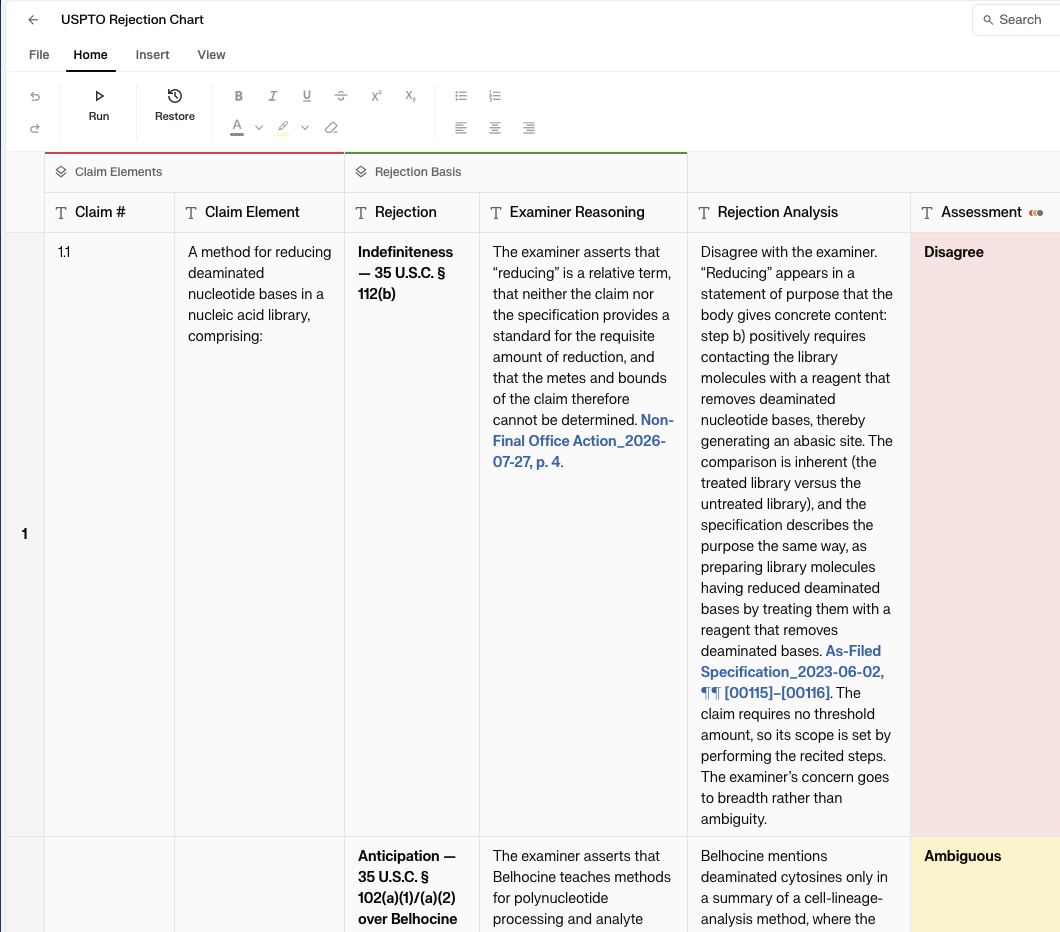
Solve Intelligence maps every rejection, claim element by claim element.
Know your examiner: putting examiner statistics to work
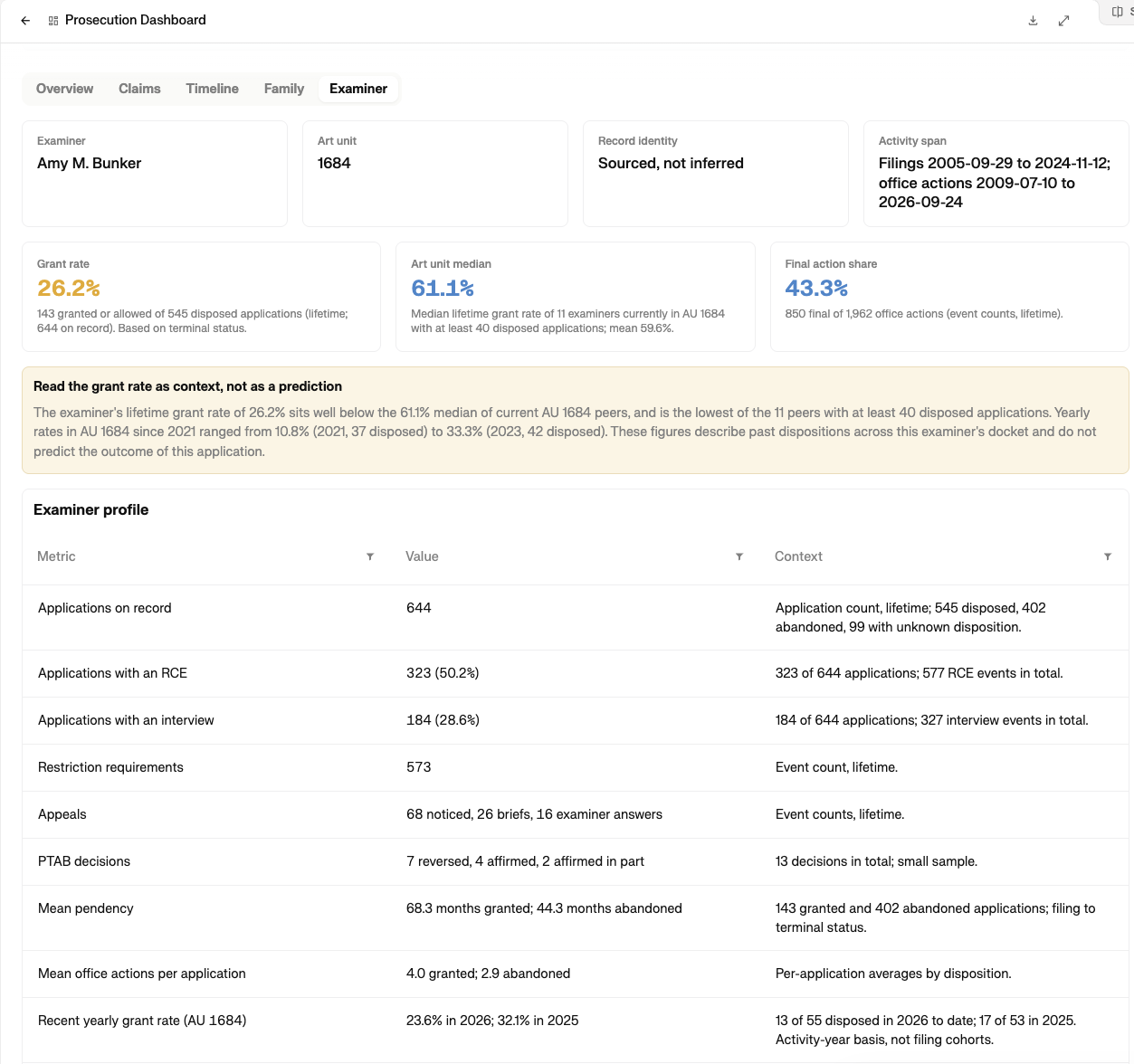
Solve Intelligence draws on more than 20 years of USPTO application and Office Action data. Users can compare examiner and art-unit allowance rates, pendency, prosecution activity, and rejection patterns to inform response strategy and client expectations. Juristat subscribers can also access Juristat through Solve Intelligence’s integration.
The same rejection can call for a different response depending on who wrote it. Examiner statistics add context to decisions about interviews, budgets and escalation. They complement your own experience with the examiner. They cannot tell you whether an argument or amendment will succeed in this case.
Assess an Examiner’s profile before choosing whether to interview, file an RCE or appeal.
The table below links each statistic to the decision it can inform.
Statistic
What it tells you
Decision it informs
Allowance rate vs art unit and technology center
How far this examiner sits from their peers
Client expectations on cost and timeline
Office Actions and RCEs to allowance
Historical Office Action and RCE counts among allowed cases
Response planning and possible RCE budget
Allowance rate with vs without an interview
Association between interviews and outcomes, subject to selection effects
Whether to interview before filing the response
PTAB outcomes on appeal (affirmed, reversed, affirmed-in-part)
Outcomes among the subset of cases taken to appeal
RCE versus notice of appeal after a final rejection
Rejection mix (§§ 101, 102, 103, 112) vs art unit
Which statutes the examiner leans on
Which issues deserve closer preparation
Time to allowance and pendency
Historical timing for comparable cases
Continuation and portfolio timing; separate PTA analysis
Practical notes
Pull the profile at the first Office Action, not the final. It is most useful for setting strategy and client expectations before the first response. If the data show frequent RCEs before allowance, explain that pattern in the reporting letter. Budget for the possibility without treating it as inevitable.
Use interview data to decide when to pick up the phone. If the issues would benefit from discussion, request an interview under MPEP 713. Bring focused arguments and, if useful, a proposed amendment. Solve Intelligence can draft the agenda and a one-page claim chart for the call from the same analysis. Keep in mind that higher allowance rates in interviewed cases do not prove the interviews caused the difference.
Bring the numbers to the RCE-versus-appeal decision. A meaningful sample of PTAB reversals, or of prosecution reopened after appeal, can inform the choice. The strength of the record, the need for further amendment or evidence, the client’s budget and timing remain decisive.
Compare the rejection mix with the art unit. A higher § 101 rejection rate can justify closer preparation, but may reflect the examiner’s docket. It is not, by itself, a reason to narrow otherwise defensible claims.
Ask the AI to show its reasoning. Try this prompt: “Given this examiner’s statistics and the history of this application, compare the available response, interview, RCE and appeal options. For each recommendation, identify the legal merits, data periods, sample sizes and limitations behind it.” Keep recommendations grounded in the case record separate from those based only on historical trends.
Reading the numbers responsibly
Examiner statistics describe the past. They do not predict this case. Check the sample size behind any percentage, and compare recent and longer-term data where dockets have changed. Watch for selection effects: interviewed and appealed cases may differ systematically from the rest of the docket.
As a rule, keep examiner statistics out of the merits response. They shape the strategy. The arguments must stand on the record, the law and the art.
§ 101: test the examiner's framework, then build the record
Start by testing the rejection against MPEP 2106 and the controlling case law. For a technological-improvement argument, tie the claim limitations to the improvement the specification describes.
Two recent USPTO developments matter here. First, the USPTO’s advance notice of changes to MPEP 2106, effective December 5, 2025, addresses the precedential Appeals Review Panel decision in Ex parte Desjardins. It directs examiners not to evaluate claims at such a high level of generality that meaningful technical limitations are dismissed as generic computer components. Second, on September 29, 2026, Director Squires issued a memorandum with a flowchart and best practices for Subject Matter Eligibility Declarations (SMEDs) under 37 CFR 1.132, supplementing the April 2026 applicant guidance. Neither displaces controlling judicial precedent.
Where AI helps
Deconstruct the rejection step by step. Ask Solve Intelligence to map the examiner’s reasoning onto Step 1, Step 2A Prong One, Step 2A Prong Two and Step 2B, and to flag each gap. Common gaps include a failure to identify the alleged abstract idea and its grouping (or to explain use of the tentative abstract idea procedure), a claim summarized so broadly that its technical limitations drop out, and additional elements dismissed without analysis. Another is a “well-understood, routine, conventional” finding without the support that MPEP 2106.07(a) requires. Assess the additional elements individually and in combination. Conventionality belongs in Step 2B, not in the Step 2A Prong Two practical-application analysis.
Mine the specification for the improvement. The specification must disclose the invention in sufficient detail for a skilled person to recognize the technological improvement, and the claims must reflect that improvement. Solve Intelligence can surface passages describing the technical problem and its solution, map each to a claim limitation, and propose amendments with pinpoint support. Support does not require verbatim wording. But copying words from separate passages does not establish support for their claimed combination.
Challenge mental-process characterizations. For data-heavy, real-time or machine-learning claims, have Solve Intelligence explain why specific limitations cannot practically be performed in the human mind. Ask it to identify the facts a declarant would need to establish that point. Using a computer or processing more data does not settle the question on its own. Test what the claim actually requires, and address any other exception the examiner asserts.
Decide whether a SMED is worth filing, and outline it. The September 2026 memo recommends considering a separate eligibility declaration early in prosecution. The declaration should identify the issue it addresses and support its opinions with facts. Testimony from a disinterested declarant may carry more weight, although independence is not a filing requirement. Ask Solve Intelligence to draft an outline and identify supporting literature for you to verify. The declarant must substantiate the facts, and a declaration cannot add missing disclosure to the application.
Life sciences claims need a different lens. For nature-based compositions, assess whether the claimed product has markedly different characteristics from its natural counterpart. Consider the combination as a whole, not isolated components. The Federal Circuit took that whole-composition approach inREGENXBIO v. Sarepta (Fed. Cir. Feb. 20, 2026), reversing a component-by-component ineligibility ruling for recombinant host cells. For diagnostics, assess any disclosed treatment or sample-preparation limitations on their own merits. Adding routine testing or token treatment language does not automatically make a claim eligible, and changing the claim type may give up valuable diagnostic coverage.
Bringing in the examiner
Use an interview to pin down the disputed eligibility step and the facts that could resolve it. A higher § 101 rejection rate calls for preparation, not an automatic amendment. Any amendment or SMED should address the actual deficiency while keeping useful scope. Ask Solve Intelligence to compare the examiner’s rejection patterns with the art unit’s, then review the relevant Office Actions to understand the context behind those figures.
§ 102: make the examiner prove every element, arranged as claimed
Anticipation has a demanding standard. A single reference must disclose every limitation, arranged as in the claim, expressly or inherently. It must also provide an enabling disclosure of the claimed subject matter (MPEP 2131; Net MoneyIN v. VeriSign, 545 F.3d 1359 (Fed. Cir. 2008); In re Donohue, 766 F.2d 531 (Fed. Cir. 1985)).
AI can help test the examiner’s mapping, but claim construction and technical context remain critical. During examination, patents and printed publications are generally presumed enabling, so a nonenablement challenge needs a reasoned basis (MPEP 2121).
Where AI helps
Build the element-by-element chart first. Ask Solve Intelligence to break each rejected claim into limitations and map the examiner’s pinpoint citations against each one. Then have it check every citation against the reference itself. Solve Intelligence’s Office Action review flags citations that point to the wrong paragraph, describe a different embodiment or do not say what the Office Action says they say. Verify each flag before you rely on it.
Test the "arranged as in the claim" requirement. Check whether the reference actually teaches the claimed combination. Separate passages can describe one arrangement, but unrelated embodiments cannot simply be stitched together to rebuild the claim. Explain the missing relationship; multiple citations alone do not prove the examiner erred.
Pressure-test inherency. An inherency assertion needs evidence or technical reasoning showing that the feature necessarily flows from the reference, not merely that it might (MPEP 2112). Ask the AI to list every inherency assertion and the basis offered for each.
Check claim construction against the specification. The broadest reasonable interpretation must stay consistent with the specification (MPEP 2111). Solve Intelligence can surface definitions and context to challenge an unreasonable reading. Do not import limitations from a preferred embodiment into a broader claim.
Check the reference’s prior-art status. First, determine whether AIA or pre-AIA law applies. For AIA cases, distinguish § 102(a)(1) public disclosures from § 102(a)(2) US patent documents, and verify the relevant dates and priority support on both sides. Then assess any applicable § 102(b)(1) or (b)(2) exception, including derivation, inventor-originated disclosures and common ownership where relevant. Use Rule 130 evidence where appropriate. In pre-AIA cases, consider a Rule 131 declaration to antedate the reference. The US grace period does not exclude every disclosure made within one year.
Rank amendment options before choosing one. For each claim, have Solve Intelligence list features that appear in the specification but not in the reference, with paragraph-level support. Rank them by commercial relevance, scope given up, support for the combination and exposure to a further § 103 rejection. Take care with combinations. Disclosing an antibody and a dosing interval in separate embodiments does not necessarily support that antibody at that interval.
Bringing in the examiner
If the anticipation mapping is defective, consider an argument-only reply that preserves claim scope. A new ground of rejection generally prevents the next action from being made final. Exceptions include a new ground necessitated by amendment or by certain IDS submissions (MPEP 706.07(a)). Even so, an amendment does not make every new ground properly final. Use an interview to test your proposed distinction. A favorable indication is useful, but it does not guarantee allowance.
§ 103: dissect the rationale, not just the references
Obviousness requires factual findings and an explanation of why the claimed invention would have been obvious to a skilled person. KSR gives examiners a flexible approach. The USPTO’s Updated Guidance for Making a Proper Determination of Obviousness (89 Fed. Reg. 14449, Feb. 27, 2024) makes clear that this flexibility does not excuse examiners from articulating reasoning grounded in evidence.
Common sense can support a reasoned inference, but it cannot replace analysis with a conclusory statement. If the examiner takes official notice of a material fact, consider whether a timely, specific traversal is warranted (MPEP 2144.03).
Where AI helps
Break each ground into its factual and reasoning parts. For each rejection, have Solve Intelligence set out what the primary reference teaches and lacks, what each secondary reference adds, the stated reason to combine, and the basis for a reasonable expectation of success. Evaluate the reasoning as a whole, not whether it uses particular headings or phrases (In re Kahn; MPEP 2143). Remember that modifying a single reference can also support a § 103 rejection.
Read the whole reference, not just the cited paragraph. The best § 103 arguments often sit outside the examiner’s citations. Look for a passage that disparages the claimed approach, a design constraint the modification would violate, or a principle of operation the combination would change. A stated preference for another approach is not necessarily teaching away. Ask Solve Intelligence to search each reference in full for actual discouragement (MPEP 2145). Ask it, too, for modifications that would make the primary reference unsatisfactory for its intended purpose or change its principle of operation (MPEP 2143.01).
Challenge analogous art. Ask whether each applied reference is from the same field of endeavor or reasonably pertinent to the inventor’s problem (MPEP 2141.01(a)). A different field alone is not enough. Explain why the reference is also not reasonably pertinent to the problem, from the skilled person’s perspective.
Do not let dependent claims be swept up. A grouped discussion can hide whether each additional limitation was addressed. Have the AI check each dependent limitation against the cited art. An unaddressed limitation exposes a gap in the rejection; it does not necessarily mean the claim is allowable. If you want separate review on appeal, develop separate substantive arguments and carry them into the appeal brief.
Marshal objective indicia early. Unexpected results, commercial success and long-felt need must be tied to the claimed invention, with evidence commensurate in scope with the claims (MPEP 716). In chemistry and life sciences, Solve Intelligence can extract comparative data from the specification’s examples, check it against the claimed scope and outline a Rule 132 declaration. For a lead-compound theory, test the choice of starting compound, the proposed modification and the expectation of success. Not every chemical obviousness rejection follows that framework.
Stress-test the amendment before filing it. Before committing to a distinguishing feature, run a patentability search on the amended claim in Solve Intelligence. Use the results to reassess both patentability and scope. No search can guarantee that all relevant art has been found.
Bringing in the examiner
Appeal may be the right route when a developed record exposes a material defect in the rejection and further amendment would give up valuable scope. If this examiner’s § 103 rejections are often reversed, or prosecution is often reopened after an appeal brief, those trends can inform the choice. They do not show that an appeal will be faster or cheaper.
A pre-appeal brief request for review is filed with a notice of appeal; it does not replace one (MPEP 1204.02). If you need further evidence or another amendment, consider whether an RCE is the better route.
§ 112: let the specification do the arguing
Section 112 analysis starts with the application as filed, read through the eyes of a person of ordinary skill in the art. It asks three separate questions:
Written description: does the as-filed disclosure reasonably convey possession of the claimed invention? (Ariad v. Eli Lilly, 598 F.3d 1336 (Fed. Cir. 2010) (en banc))
Enablement: does it teach the skilled person to make and use the full claimed scope without undue experimentation? (Amgen v. Sanofi, 598 U.S. 594 (2023))
Definiteness: during examination, is the claim ambiguous, vague or otherwise unclear? (MPEP 2173.02)
Keep the three analytically separate. AI can organize the disclosure and identify gaps, and technical evidence may help explain what the skilled person would understand.
Where AI helps
Build a support map for every limitation and every amendment. Ask Solve Intelligence to cite as-filed support, paragraph by paragraph, for each claim element and for the claimed combination. Identify support in the as-filed specification, claims, and drawings, and explain any reliance on implicit disclosure or the skilled person’s understanding. Run the same check on every amendment proposed elsewhere in the response, so that overcoming § 103 does not create a new matter objection or a fresh § 112(a) rejection.
Test genus claims against what is actually disclosed. For written description of a functionally defined genus, check whether the disclosure provides a representative number of species, or structural features common to the genus that let a skilled person recognize its members. Enablement is a separate question: Amgen addresses enablement across the full claimed scope, including the burden of identifying functional antibodies. Solve Intelligence’s sequence and antibody analysis can map disclosed sequences and CDR combinations for support review. Narrower sequence-based claims still need support and enablement for the particular combination and any claimed variants.
Answer enablement with the Wands factors, not adjectives. Have the AI map the specification against each factor in MPEP 2164.01(a): claim breadth, the nature of the invention, the state of the prior art, the level of ordinary skill, predictability, guidance, working examples and the quantity of experimentation needed. Declaration evidence can explain why the original disclosure enables the claimed scope. It cannot cure an enabling disclosure that was missing at filing.
Triage definiteness issues. Flag antecedent-basis problems and inconsistent terms across the claim set. Then separate genuine uncertainty from wording that is clear in context. Terms of degree are not inherently indefinite, so look for an objective standard in the disclosure or the art that makes their scope ascertainable (MPEP 2173.05(b)).
Decide deliberately on § 112(f). Generic placeholders such as “module”, “unit” or “mechanism for” can trigger means-plus-function treatment under Williamson v. Citrix. For computer-implemented functions under § 112(f) that require special programming, the specification generally must disclose a corresponding algorithm (MPEP 2181). Ask the AI to locate the linked structure or algorithm for your review. If it is missing, accepting § 112(f) treatment will not cure the indefiniteness. Instead, consider an amendment, supported by the original disclosure, that recites sufficient structure.
Bringing in the examiner
Minor § 112(b) issues can often be resolved quickly with a phone call and an authorized examiner’s amendment. Confirm the exact wording, its entry and the interview record. For substantive § 112(a) issues, use the support map to isolate the disputed disclosure or scope. An interview does not replace a required written reply.
Putting it together: an end-to-end workflow
Order matters. Assemble the record first. Then identify the disputed limitations and legal issues, weigh the client’s scope priorities and the procedural options, and only then draft. Examiner data can inform the choice of route.
An interview informs the written response, and every route needs practitioner verification. RCE and appeal options depend on procedural posture. An RCE generally requires that prosecution be closed, and an appeal ordinarily requires that a claim has been twice rejected. Interviews do not suspend response deadlines.
Practical notes
Answer every ground. A non-final reply must distinctly address every ground of objection and rejection under 37 CFR 1.111(b). Before filing, ask Solve Intelligence to check the draft against the Office Action for completeness. The check should cover every rejected claim, objections, § 112(f) interpretations and other requirements, including restriction or double patenting where raised.
Generate the claim listing, then proof it. Amendments must follow 37 CFR 1.121, with a status identifier for every claim and amendment markings where required. Ask Solve Intelligence to draft the full listing, then check it against the last entered claim set. New claims appear without underlining. Canceled and not-entered claims are identified without reproducing their text.
Mind the after-final clock. For a final action with the usual three-month reply period, a first reply within two months can reduce extension fees if the advisory action is mailed after month three. It does not guarantee an earlier advisory action, and the six-month maximum still applies (MPEP 706.07(f)). An after-final reply alone does not stop abandonment, so docket any further action needed to keep the application pending.
Report while the analysis is fresh. Use the same project to draft the client reporting letter. Cover the rejections, the recommended route, the examiner context, and the cost and timeline of each option.
Guardrails: the practitioner still signs the response
The USPTO does not prohibit AI in prosecution. There is no general obligation to disclose AI use merely because a tool assisted, although disclosure may still be required when the use bears on a material issue or an Office requirement.
The USPTO’s guidance on AI-based tools in practice before the Office (89 Fed. Reg. 25609, Apr. 11, 2024) is equally clear that existing duties apply in full. Signing a response certifies a reasonable inquiry under 37 CFR 11.18(b), and relying on an AI tool’s accuracy is not, by itself, a reasonable inquiry. The duty of candor under 37 CFR 1.56 and the confidentiality obligations of 37 CFR 11.106 also apply.
Build four habits into every AI-assisted response:
Verify every citation: Solve Intelligence grounds its analysis in citations to the file wrapper, the cited references, the MPEP and case law. Check each one against the original source and confirm it supports the point it is cited for. Verify quoted claim language and technical assertions too.
Own the strategy: The AI can recommend whether to argue, amend, interview or appeal, and show its reasoning. The decision, and the client conversation about it, remain yours.
Use statistics for internal strategy: Examiner data shapes how you respond. It does not belong in what you tell the examiner.
Know where the data goes: Before uploading client information, including nonpublic applications, check access controls, retention, model-training use and your confidentiality obligations.
The same discipline across every rejection type
Sections 101, 102, 103 and 112 ask different questions, but a strong response to each follows the same discipline. Start with the complete record. Test the rejection against the claims, the law and the evidence. Preserve useful scope, and verify the response before it is filed.
Solve Intelligence brings these pieces together in one place. It pulls file wrappers from the patent registers, grounds its analysis in the legal frameworks and case law, drafts in your own style and draws on examiner statistics. That leaves practitioners more time for the judgment calls that determine a patent’s scope and value.
AI for patents. Join thousands of legal professionals around the world using Solve Intelligence’s Patent Copilot™ for drafting, prosecution, invention harvesting and more.
FAQs
Can AI draft a full response to a § 101, 102, 103 or 112 rejection?
Yes, as a first pass. Solve Intelligence can map each rejection against the record, flag unsupported citations and weak reasoning, propose amendments with as-filed support, and draft the arguments and claim listing in your firm’s style. The practitioner then decides the strategy, verifies every citation and signs the response, which certifies a reasonable inquiry under 37 CFR 11.18(b).
Do I need to tell the USPTO that I used AI?
Not as a general rule. The USPTO’s April 2024 guidance does not create a general obligation to disclose AI use merely because a tool assisted. Disclosure may still be required where the use bears on a material issue or an Office requirement, and the duties of candor, reasonable inquiry and confidentiality apply in full.
Should examiner statistics appear in my Office Action response?
Ordinarily, no. Use them for internal strategy, such as deciding whether to interview, budgeting for RCEs and choosing between an RCE and an appeal. The arguments in the response must stand on the record, the law and the art. Before relying on any figure, check its sample size and possible selection effects.
What should I check before filing an AI-suggested claim amendment?
Confirm as-filed support for every limitation and for the claimed combination, so the amendment does not introduce new matter or a fresh § 112(a) rejection. Then run a patentability search on the amended claim, weigh the scope you would give up, and check the claim listing against the last entered claim set under 37 CFR 1.121.
MORE STORIES
October 23, 2026How to Turn a Paragraph IV Notice into a Hatch-Waxman ComplaintA worked example on Exelixis v. MSN shows how Solve Intelligence builds the record, charts each claim, and drafts a Hatch-Waxman complaint.Read article
September 22, 2026What Your Patent Must Disclose When AI Predicts the MoleculeAI-discovered drug candidates come with a confidence score, not proof of binding. See what USPTO and EPO patent offices actually require you to disclose.Read article
No items found.
Cookie settingsBy clicking “Accept all”, you agree to the storing of cookies on your device to enhance site navigation, analyze site usage, and assist in our marketing efforts. For further details see our
Manage cookie preferencesChoose which cookies we may store on your device. Essentials keep the site working and cannot be turned off.EssentialsNecessary for the site to function. Always on.Always activeAnalyticsMeasures usage and improves your experience.MarketingUsed for targeted advertising.Cookie preferences