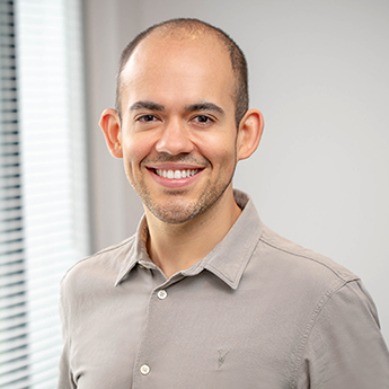
Christian Berrios, PhD

Christian Berrios, PhD

Legal & Product Engineer

Christian is a registered U.S. patent agent with over six years of experience in the patent profession. He previously worked at Stener, Kessler, Goldstein & Fox, one of the largest IP boutique law firms in the U.S., and also worked as an in-house patent agent at Singular Genomics, a DNA sequencing company. 

Christian also obtained his Ph.D. in Virology at Harvard University, where his doctoral research focused on viral oncology, and holds a B.S. in Microbiology and Genetic Biology, from Purdue University.

His expertise in patent prosecution, freedom-to-operate analysis, and patent portfolio management across a broad range of biotechnology areas will help us continue building the most capable AI tools for every stage of the patent process.

Related articles

How Successful Patent Practitioners Are Putting AI to Work

The most effective patent practitioners are already using AI patent drafting to draft faster, catch claim inconsistencies earlier, and free up hours for the strategic work that actually wins allowances.

Key takeaways

  • AI patent drafting tools can reduce application drafting time by up to 80 percent, with Solve Intelligence customers consistently reporting 50 percent or greater efficiency gains across drafting and prosecution 
  • Roughly 9 out of 10 utility patent applications receive at least one office action rejection, so prosecution efficiency matters as much as drafting speed 
  • Solo attorneys use AI to match larger law firms on turnaround speed and client capacity
  • The strongest reported results come from iterative AI–attorney collaboration, with practitioners directing the process and owning the final work product
AI for Patents

Automated Patent Proofreading: QA Framework for §112

The final review before a U.S. patent filing should not be another linear read-through. Rather, it should be a controlled quality-assurance step: a systematic check of the relationships among the claims, specification, and drawings while the full range of corrective options is still available.

Done well, pre-filing QA catches errors that are inexpensive to fix at the drafting desk but costly after filing. Done poorly, it can leave the applicant facing an avoidable rejection, a narrowing amendment, a priority problem, or a validity challenge years later.

Key Takeaways:

  • Pre-filing is the best time to correct disclosure, claim, and drawing defects without creating new-matter or priority complications.
  • Antecedent basis gaps, contradictory claim dependencies, and terminology drift are the most common pre-filing defects, and all are correctable before filing.
  • Section 112(a) review is substantive, not clerical: a broad range or functional limitation may warrant scrutiny even when the claim reads cleanly.
  • Automated patent proofreading identifies candidate defects for attorney review but does not substitute for legal judgment on claim scope, support, or strategy.
AI for Patents

How to Build an Invalidity Claim Chart: A Practical Guide

An invalidity claim chart is a structured document that maps, for example, each limitation of a patent claim against prior art to show the patent should never have been granted. If you’re defending against infringement allegations, preparing an IPR petition, opposing a European patent, or advising a client on patent risk, knowing how to build one correctly is non-negotiable.

Key Takeaways:

• A well-built invalidity chart maps every claim limitation to prior art, element by element, with pinpoint citations to the exact column, line, page, or figure.

• When IPRs reach a final written decision, the PTAB now finds every challenged claim unpatentable around 70% of the time; and the chart is a key component of getting a petition instituted in the first place.

• Solve Intelligence’s Charts generates fully cited, limitation-by-limitation invalidity charts in minutes rather than days, flags weak limitation coverage candidly, and lets attorneys inspect the reasoning behind every mapping.

AI for Patents

Solve Intelligence Awarded Technology Solution of the Year

The leading in-house and outside counsel life sciences patent teams have voted Solve Intelligence as the winner of the Technology Solution of the Year Award at the 2026 Life Sciences Patent Network (LSPN) Spring Meeting in Boston, recognising our impact on the way life sciences and chemistry IP teams draft, prosecute, and analyse patents.

No items found.

Validating AI Output in Patent Practice: Solve Intelligence at ABA-IPL 2026

The American Bar Association’s Intellectual Property Law Section Spring Conference (ABA-IPL) remains one of the premier annual gatherings for IP professionals, bringing together practitioners, in-house counsel, academics, and policymakers to explore the latest developments shaping the field. 

Solve Intelligence was invited not only to attend, but to share their expertise on the concluding panel as leaders in AI.

No items found.

How to use AI in patent practice: USPTO guidance and compliance tips

As Artificial Intelligence (AI) and large language models (LLMs) increasingly integrate into legal practices, the U.S. Patent and Trademark Office (USPTO) issued guidance to assist patent attorneys with adopting AI tools in patent drafting, prosecution, and other areas of patent law.

In this article, we summarize the key compliance requirements from the USPTO's guidance and explain how Patent Copilot™ helps practitioners meet these obligations while leveraging AI's benefits.

AI for Patents
Legal News