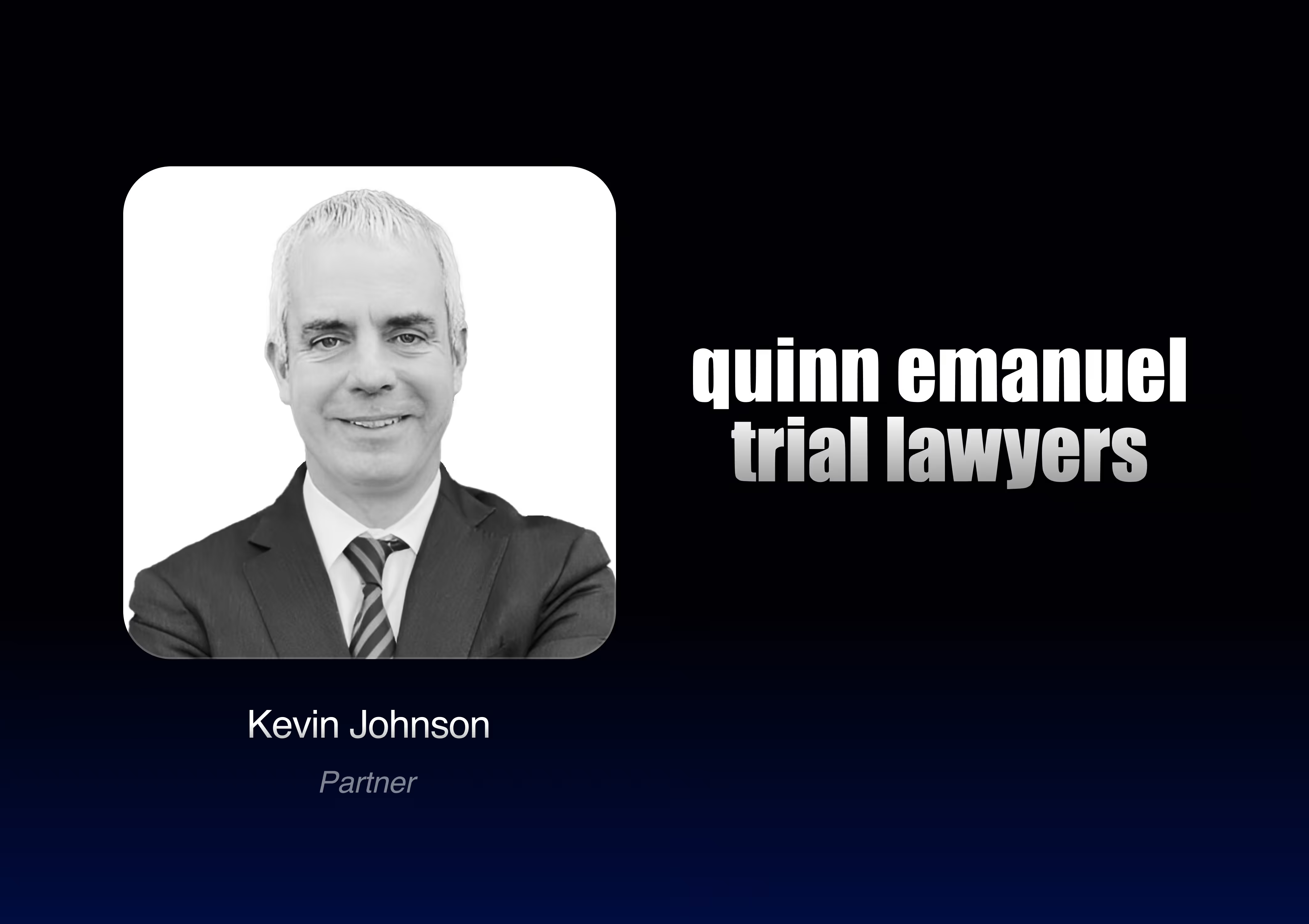
Kevin Johnson to join Solve Intelligence’s Customer Advisory Board

We’re excited to welcome Kevin Johnson, partner at Quinn Emanuel, to Solve Intelligence’s Customer Advisory Board.

Kevin Johnson to join Solve Intelligence’s Customer Advisory Board

Kevin is a seasoned patent litigator with an electrical engineering degree from Cornell and a distinguished track record representing leading global companies including Samsung, Sony, MediaTek, Natera, and Salesforce. His practice spans high-stakes litigation in patent infringement, trade secret, and licensing disputes across Federal and state courts, as well as the International Trade Commission. Kevin has represented clients ranging from Fortune 50 corporations to fast-growing tech companies, with experience covering smartphones, semiconductors, medical devices, biotech, and more. Notably, in 2020, he secured a $1.1 billion jury verdict for Caltech in a patent infringement case and one of the largest patent verdicts in U.S. history.

“Kevin and his team at Quinn Emanuel are a global force in the world of patent litigation. We are grateful to have Kevin join our Customer Advisory Board and work with his team to bring that same expertise to our litigation products. Whether it's infringement detection, claim charting, or claim construction analysis, Kevin and his team have unparalleled expertise and insights that will be invaluable in revolutionizing Solve's patent litigation products."

Chris Parsonson, CEO & Co-founder, Solve Intelligence

Solve Intelligence is honored to have a powerhouse like Kevin Johnson join our Customer Advisory Board. His extensive experience and invaluable insights will be instrumental in shaping the future of our product development.

Check out the rest of our Customer Advisory Board here.

AI for patents.

Be 50%+ more productive. Join thousands of legal professionals around the World using Solve’s Patent Copilot™ for drafting, prosecution, invention harvesting, and more.

Related articles

UK Supreme Court aligns UK software patentability with EPO approach

The UK Supreme Court’s Emotional Perception decision moves UK practice closer to the EPO for computer implemented inventions, including AI. Claims with ordinary hardware will usually avoid the “computer program as such” exclusion, but only technical features can support inventive step. In practice, applicants should focus arguments and evidence on technical contribution and inventive step.

Key takeaways

  1. UK moves closer to EPO, inventive step becomes the main battleground.
  2. Ordinary hardware avoids exclusion, but may not support inventiveness.
  3. Only technical features count at inventive step, not business aims.
  4. Neural networks are treated as software, no special treatment either way.
  5. Draft around technical contribution, measurable effects, and system level impact.

Kicking Off 2026: New Investors, New Customers, New Product Features

A lot has happened in the last two months. We wanted to take a moment to share what we've been building, who's joined us, and where we're headed next.

Since we started Solve, the goal has been simple: help IP teams do their best work by combining real-world patent expertise with deep AI research, intuitive UX, and state-of-the-art security. The momentum we're seeing across the business tells us the market agrees as 400+ IP teams across 6 continents now use Solve.

Here's what's new.

Reflections from AUTM: What Tech Transfer Offices Really Need in 2026

Last week, my colleagues and I attended the annual meeting of AUTM, the global association for technology transfer professionals. For anyone building in the intellectual property (IP) space, it’s one of the most important rooms you can be in.

The three-day conference brings together high education decision-makers from around the world who are shaping how intellectual property is evaluated, protected, and commercialized. This year’s conversations revealed something important: the question is no longer if AI will influence tech transfer, but instead about how institutions will integrate it.

PTAB Case Studies of AI Disclosure Requirements: Part I

Artificial intelligence (AI) is a fast-evolving field with new technical methods, systems, and products constantly being developed. This growth has also been reflected in the dramatic increase in patent filings for AI-related inventions. According to Patents and Artificial Intelligence: A Primer from the Center for Security and Emerging Technology, more than ten times as many AI-related patent applications were published worldwide in 2019 than in 2013, and the increasing trend has only continued since.

Although AI-related patent applications have been on the rise, explicit guidance on patentability requirements have only recently begun to be published by patent offices around the world. Indeed, as a burgeoning field of technology, AI inventions have unique features, such as the importance of training data and the lack of explainability and predictability of trained AI models, that differentiate such innovations from traditional types of computer-implemented inventions (CII). 

These features raise questions about the interpretation of disclosure requirements, among other patentability requirements, for AI-related inventions. For example, how much information, such as source code, training data sets, or machine learning model architectures, should be provided to satisfy the written description and enablement requirements of Title 35 of the U.S. Code § 112(a) or analogs in other patent jurisdictions?

As we await further official guidance from the U.S. Patent & Trademark Office (USPTO) on disclosure requirements for AI-related inventions, we can gather initial indications from recent patent prosecution decisions from the Patent Trial & Appeal Board (PTAB) on such issues. In this article, we study a selection of PTAB appeals decisions for applications for AI-related inventions rejected under § 112. To set the background, we first review a classification of AI inventions and USPTO guidelines on disclosure requirements for computer-implemented inventions. After analyzing three case studies, we conclude with general takeaways and best practices, which emphasize that applicants must disclose specific algorithms and implementation details, not just desired outcomes, to satisfy written description requirements.