How Patent Outsourcing Can Streamline Your Firm's Operations

In today’s fast-paced environment, law firms and businesses are under increasing pressure to keep up with the growing demands of intellectual property (IP) management. Filing patent applications and performing related IP work can be very time-sensitive, with attorneys often expected to turn around work at the last minute to meet deadlines relating to product-releases or entries to the market from competitors, for example. It can be very difficult to predict future workflow, and managing all aspects in-house can be costly and inefficient. This is where patent outsourcing comes in as a valuable solution to help streamline operations. By outsourcing patent work, firms can focus on their core competencies while benefiting from external expertise and cost savings.

How Patent Outsourcing Can Streamline Your Firm's Operations

What is Patent Outsourcing?

Patent outsourcing refers to the practice of delegating various patent-related tasks, such as patent drafting, filing, prosecution and research, to third-party service providers. This approach is adopted by both in-house legal teams within corporations and private practice law firms. It allows organizations to tap into external expertise, reduce costs, and manage fluctuating workloads effectively.

For in-house legal teams, patent outsourcing can relieve the pressure of handling large volumes of patent work internally, particularly during periods of increased demand, such as the time leading up to product releases. Companies often face waves of new inventions or innovations that require patent protection, but their internal resources might not be sufficient to handle the surge. Outsourcing patent work in these cases enables businesses to maintain operational efficiency without the need to expand their permanent legal staff. Additionally, in-house teams may outsource highly specialized patent tasks that require deep technical expertise not available within the company.

Law firms, ranging from sole practitioners to larger firms, also benefit from patent outsourcing. Small law firms may lack the resources to handle a high volume of patent applications or may need additional support for complex patent cases. For larger firms, outsourcing patent tasks like patent intelligence or patent filings can free up time for their internal teams to focus on higher-level legal strategy, client relations, and business development. Moreover, outsourcing allows them to take on more clients without overwhelming their in-house resources.

On the other side, firms that offer patent outsourcing services include independent legal consultants, specialized IP outsourcing firms, and even larger law firms that provide outsourced services to other firms. These service providers cater to varying needs, from basic administrative support to highly technical patent drafting, including the use of AI patent drafting tools to improve accuracy and efficiency.

Companies and law firms often choose to outsource for several reasons:

  • To manage fluctuating demand: Patent filing and prosecution demand often comes in waves. Firms can quickly scale up or down by outsourcing, allowing them to meet client needs without adding permanent staff.
  • To gain access to specialized knowledge: Patent outsourcing partners often have experts in niche fields, such as biotechnology, software, or artificial intelligence, which helps ensure that patent applications are drafted with the necessary technical depth.
  • To reduce operational costs: Outsourcing can significantly reduce the financial burden associated with hiring, training, and retaining a full in-house team, particularly when the demand for patent services is inconsistent.

In both the corporate and legal practice environments, outsourcing allows teams to maintain agility, enhance expertise, and meet deadlines without compromising on quality.

Benefits of Patent Outsourcing

There are numerous potential advantages to outsourcing patent work, including:

  1. Cost Efficiency: Patent outsourcing allows firms to reduce operational costs by leveraging external resources at a fraction of the cost of maintaining a large in-house team. Outsourced patent services, especially those using AI patent tools, can provide excellent value without compromising on quality.
  2. Access to Specialized Expertize: By outsourcing patent filings and patent drafting tasks, firms gain access to professionals with specialized knowledge in various technical and legal fields. These experts have experience across different industries, ensuring high-quality patent applications that meet regulatory requirements.
  3. Scalability: As businesses grow or experience seasonal surges in workload, outsourcing provides the flexibility to scale up or down without having to hire additional full-time staff. This is especially useful for firms looking to handle larger volumes of patents without overburdening their internal team.
  4. Faster Turnaround Time: A specialized patent outsourcing partner often has streamlined processes in place, leading to faster patent application drafting and filings. When combined with technologies like AI patent drafting, the entire process becomes more efficient, reducing the time some historically laborious tasks would take to complete.
  5. Improved Patent Intelligence: A key aspect of maintaining a competitive edge in the IP landscape is the ability to stay informed. Patent outsourcing partners can provide valuable patent intelligence through searches, competitive analysis, and market trends. This information helps firms make strategic decisions regarding their IP portfolio.

Common Patent Tasks to Outsource

Not all patent-related work needs to be handled in-house. Below are common tasks that can be outsourced:

  • Patent Drafting: Creating detailed patent applications is a time-consuming task that requires technical and legal expertise. Outsourcing patent drafting ensures high-quality applications while freeing up your internal resources.
  • Patent Filings: The patent filing process can be complex and varies across jurisdictions. By choosing to outsource patent filings, firms ensure timely and accurate submissions, reducing the risk of errors or missed deadlines.
  • Patent Intelligence and Research: Understanding the competitive landscape and staying informed on industry trends is crucial for patent strategy. Outsourcing patent research and intelligence gathering allows firms to leverage specialized knowledge for better decision-making.
  • Patent Prosecution Support: Once a patent application is filed, it usually goes through an examination process with patent offices. Outsourcing this process ensures that any back-and-forth communication, responses to office actions, and amendments are handled by experts who are well-versed in navigating these procedures.

Selecting the Right Patent Outsourcing Partner

Choosing the right patent outsourcing partner is critical to ensure quality and reliability. Here are some key factors to consider when selecting an outsourcing provider:

  • Technical Expertise: You may choose to select an outsourcing partner based on their deep understanding of the relevant technical fields in which you are filing patents. This may help to maintain or even improve quality of the work you outsource.
  • Experience in Your Jurisdiction: Patent laws and regulations vary by country. It can be useful to make sure the provider is familiar with the specific legal requirements and practices in the jurisdictions where you operate or plan to file patents.
  • Use of Technology: Some leading patent outsourcing partners often leverage technology to improve efficiency and accuracy. With the advent of AI patent drafting and prosecution tools, some outsourcing firms may deliver faster results with fewer errors.
  • Cost Transparency: Clearly defined pricing structures may be useful to avoid unexpected costs. A good outsourcing partner will provide transparent pricing and detailed project scopes.

With the rise of AI technologies, firms are increasingly turning to AI patent drafting and prosecution platforms to perform their work more efficiently. This technology can help firms manage patent workloads internally, reducing the need to outsource certain patent tasks altogether. However, even when firms choose to outsource, AI tools allow service providers to offer quicker and more cost-effective solutions, making outsourcing a more attractive option for firms looking to reduce costs and increase turnaround time.

Conclusion

Patent outsourcing offers a strategic way for firms to streamline their operations, reduce costs, and enhance the quality of their IP portfolio management. Whether you need support for patent filings, patent drafting, or gaining valuable patent intelligence, partnering with the right outsourcing provider can drive greater efficiency and sharpen your firm's competitive edge. The integration of advanced technologies, particularly AI tools, can offer an additional layer of innovation in IP management which may be a factor when thinking about outsourcing.

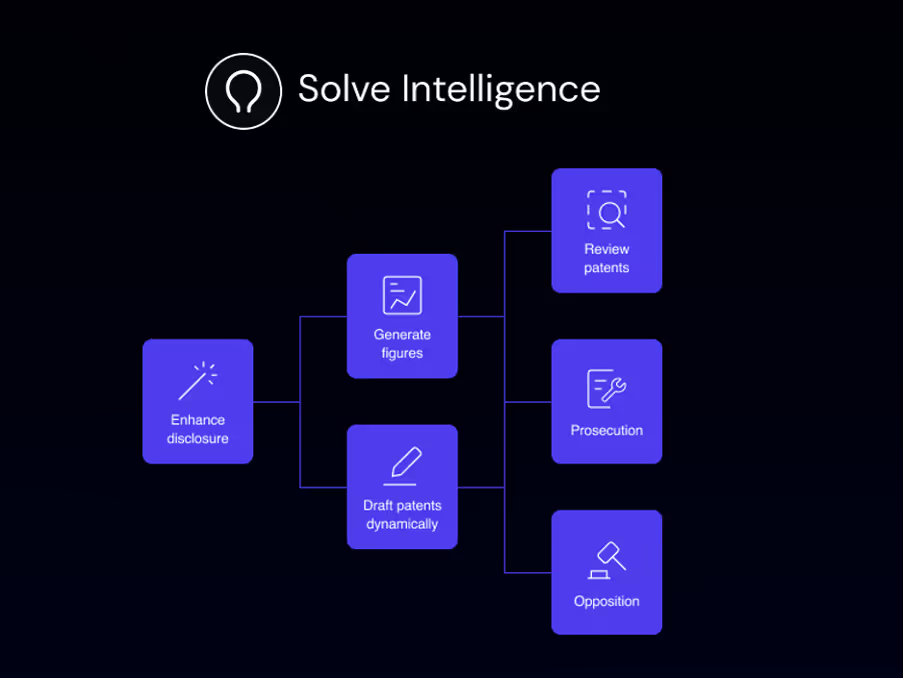
Here at Solve Intelligence, we are committed to building AI-powered platforms that assist with every aspect of the patenting process while keeping patent professionals at the helm of these powerful tools. In this way, we give patent practitioners the control needed to reap AI's benefits while mitigating its associated challenges. Our Patent Copilot™ helps with patent drafting, patent filing, patent prosecution, office action analysis, patent portfolio strategy and management, and future patent infringement analyses. At each stage, our Patent Copilot™ works with the patent professional, keeping them in the driving seat, thereby equipping legal professionals, law firms, companies, and inventors with the tools to help develop the full scope of protection for their inventions.

AI for patents.

Be 50%+ more productive. Join thousands of legal professionals around the world using Solve’s Patent Copilot™ for drafting, prosecution, invention harvesting, and more.

Related articles

The Honest Risks of Using AI in Patent Prosecution

AI is changing how patent prosecution gets done, and the upside is real. So are the downsides: hallucinated citations, confidentiality exposure, export-control pitfalls, and prosecution-history estoppel. This is an honest account of the risks of AI patent software in prosecution, and what actually reduces each one.

Key takeaways

  • Anyone presenting AI-assisted content to the USPTO must reasonably review it; relying on the tool's accuracy alone is not enough.
  • Courts have already sanctioned attorneys for AI-hallucinated citations, and similar risk applies to office-action responses and PTAB briefs.
  • The USPTO warns that AI tools on foreign servers can raise export-control, foreign-filing-license, and national-security problems.
  • Grounded citations, exposed reasoning, zero data retention, and attorney oversight are what materially reduce AI risk in patent prosecution.

Maiwald Chooses Solve Intelligence for Selected AI-Supported IP Workflows

Solve Intelligence is proud to share that Maiwald, one of Germany’s largest and most progressive intellectual property firms, works with Solve Intelligence on selected AI-supported workflows in its patent and legal practice groups. Following an evaluation period during which selected functionalities were assessed for approved internal use cases, Maiwald and Solve have formed an enterprise partnership for 2026.

The rollout reflects the same careful approach Maiwald brings to its client work. Solve enables customers in Europe to process data on servers located within Europe and holds recognized information-security certifications. In addition, Solve offers contractual commitments designed to protect confidential professional information in line with applicable statutory confidentiality obligations and professional conduct requirements. Against that background, any use of AI-supported tools took place only within approved governance structures and under applicable professional, contractual, confidentiality and data-protection requirements.

That balance of innovation and professional judgment is characteristic of Maiwald. The firm has spent decades setting a standard for IP work in Europe: rigorous prosecution, a formidable contentious practice, and interdisciplinary teams of patent attorneys and attorneys-at-law working side by side. The firm approached AI the same way, methodically, with a clear sense of where it adds leverage and where an experienced attorney’s judgment remains irreplaceable. 

PTAB Case Studies of AI Disclosure Requirements: Part II

This article is the second of a series of Patent Trial & Appeal Board (PTAB) case studies (see Part I), which aims to inform applicants’ approach to satisfying the written description and enablement requirements for patenting artificial intelligence (AI) and machine learning technologies.

How Much of Your Patent Practice Should You Codify?

Both in-house teams and outside counsel can let a purpose-built platform carry the shared foundation for their patent work. They can then focus their limited time on the standards and judgment that set their work apart. AI has made this division of labor more valuable by raising the payoff for turning a practice into templates, instructions, and review criteria that run at scale. Let’s call that codification. The platform can encode a great deal of best practice out of the box, and a team can add its own custom templates and instructions on top. The real question is how much to add and how much to leave to the platform. There is no fixed formula because the right balance changes as the team’s practice, the law, and the technology evolve.

Key takeaways

• AI has raised the payoff for codifying patent practice. Codification now guides AI-assisted drafting and review directly, not just junior training.

• A purpose-built patent platform can encode a large body of best practice out of the box, so a team can begin with that foundation rather than write its own.

• Solve Intelligence maintains its shared foundation across more than 700 IP teams, keeping it current far more efficiently than any single team could alone.

• The strategic choice is how much of your own practice to codify on top; scarce expert time should go to the standards and judgment that differentiate your work.

• A named professional still signs off on every filing, so accountability for the result never shifts to the AI.