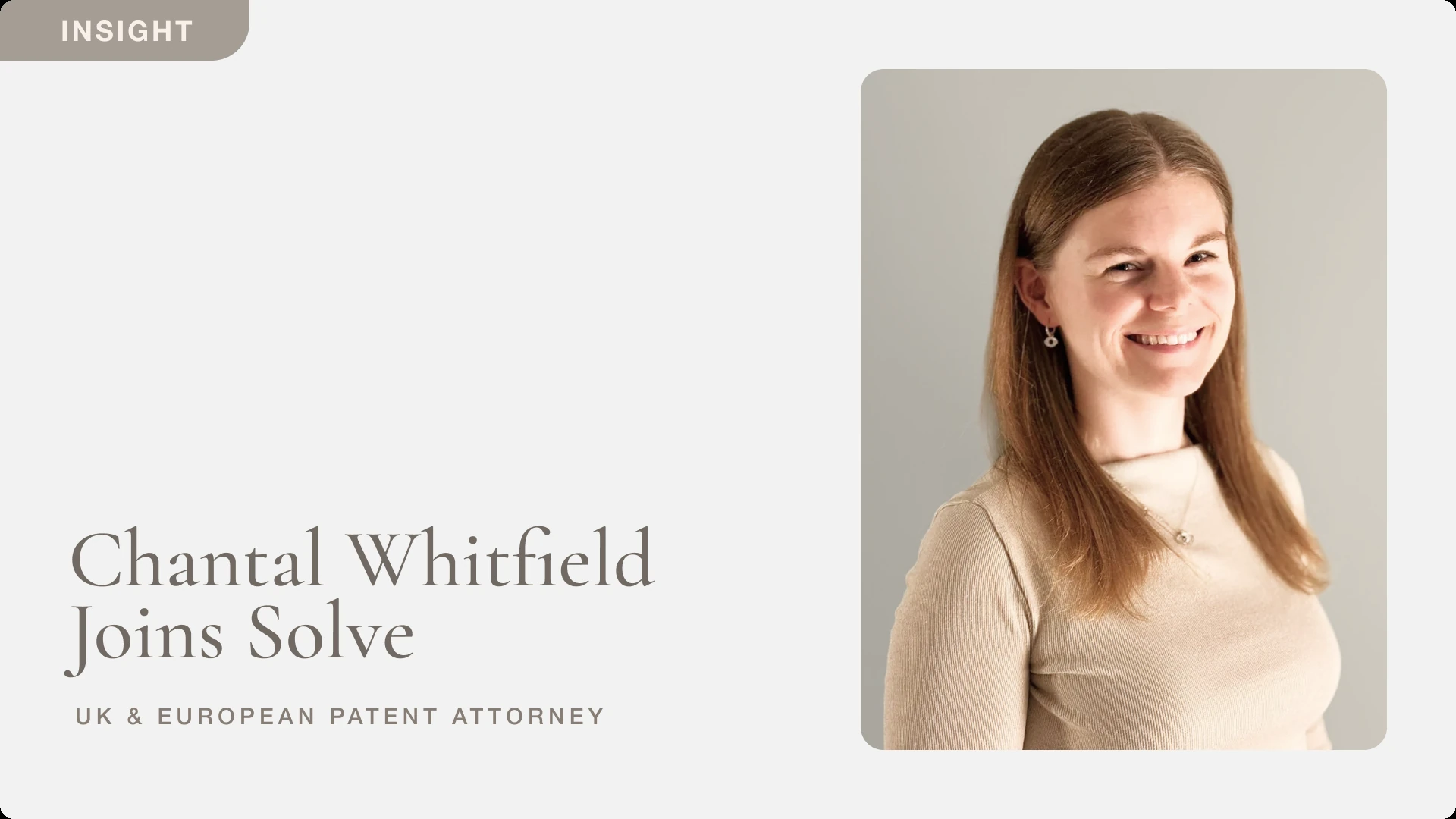
Chantal Whitfield Joins Solve Intelligence

We’re excited to welcome Chantal Whitfield to Solve Intelligence! 

Chantal Whitfield Joins Solve Intelligence

Chantal joins us as a dual-qualified European and UK Patent Attorney with over seven years of experience in the patent profession. Before Solve, Chantal was an Associate in the chemistry team at Carpmaels & Ransford, a leading European IP law firm. Chantal brings significant experience prosecuting and defending patent families at the European Patent Office, particularly in the small molecule pharmaceutical sector. 

Chantal holds an MSci in Chemistry from Imperial College, London, with first class honours, and spent time during her degree studying and conducting research at École Polytechnique Fédérale de Lausanne.

At Solve, Chantal will help continue with the development of our products, and in particular our ability to handle projects in the small molecule sector.

Please join us in welcoming Chantal to the team!

AI for patents.

Be 50%+ more productive. Join thousands of legal professionals around the World using Solve’s Patent Copilot™ for drafting, prosecution, invention harvesting, and more.

Related articles

How to use AI in patent practice: USPTO guidance and compliance tips

As Artificial Intelligence (AI) and large language models (LLMs) increasingly integrate into legal practices, the U.S. Patent and Trademark Office (USPTO) issued guidance to assist patent attorneys with adopting AI tools in patent drafting, prosecution, and other areas of patent law.

In this article, we summarize the key compliance requirements from the USPTO's guidance and explain how Patent Copilot™ helps practitioners meet these obligations while leveraging AI's benefits.

UK Supreme Court aligns UK software patentability with EPO approach

The UK Supreme Court’s Emotional Perception decision moves UK practice closer to the EPO for computer implemented inventions, including AI. Claims with ordinary hardware will usually avoid the “computer program as such” exclusion, but only technical features can support inventive step. In practice, applicants should focus arguments and evidence on technical contribution and inventive step.

Key takeaways

  1. UK moves closer to EPO, inventive step becomes the main battleground.
  2. Ordinary hardware avoids exclusion, but may not support inventiveness.
  3. Only technical features count at inventive step, not business aims.
  4. Neural networks are treated as software, no special treatment either way.
  5. Draft around technical contribution, measurable effects, and system level impact.

Kicking Off 2026: New Investors, New Customers, New Product Features

A lot has happened in the last two months. We wanted to take a moment to share what we've been building, who's joined us, and where we're headed next.

Since we started Solve, the goal has been simple: help IP teams do their best work by combining real-world patent expertise with deep AI research, intuitive UX, and state-of-the-art security. The momentum we're seeing across the business tells us the market agrees as 400+ IP teams across 6 continents now use Solve.

Here's what's new.

Reflections from AUTM: What Tech Transfer Offices Really Need in 2026

Last week, my colleagues and I attended the annual meeting of AUTM, the global association for technology transfer professionals. For anyone building in the intellectual property (IP) space, it’s one of the most important rooms you can be in.

The three-day conference brings together high education decision-makers from around the world who are shaping how intellectual property is evaluated, protected, and commercialized. This year’s conversations revealed something important: the question is no longer if AI will influence tech transfer, but instead about how institutions will integrate it.