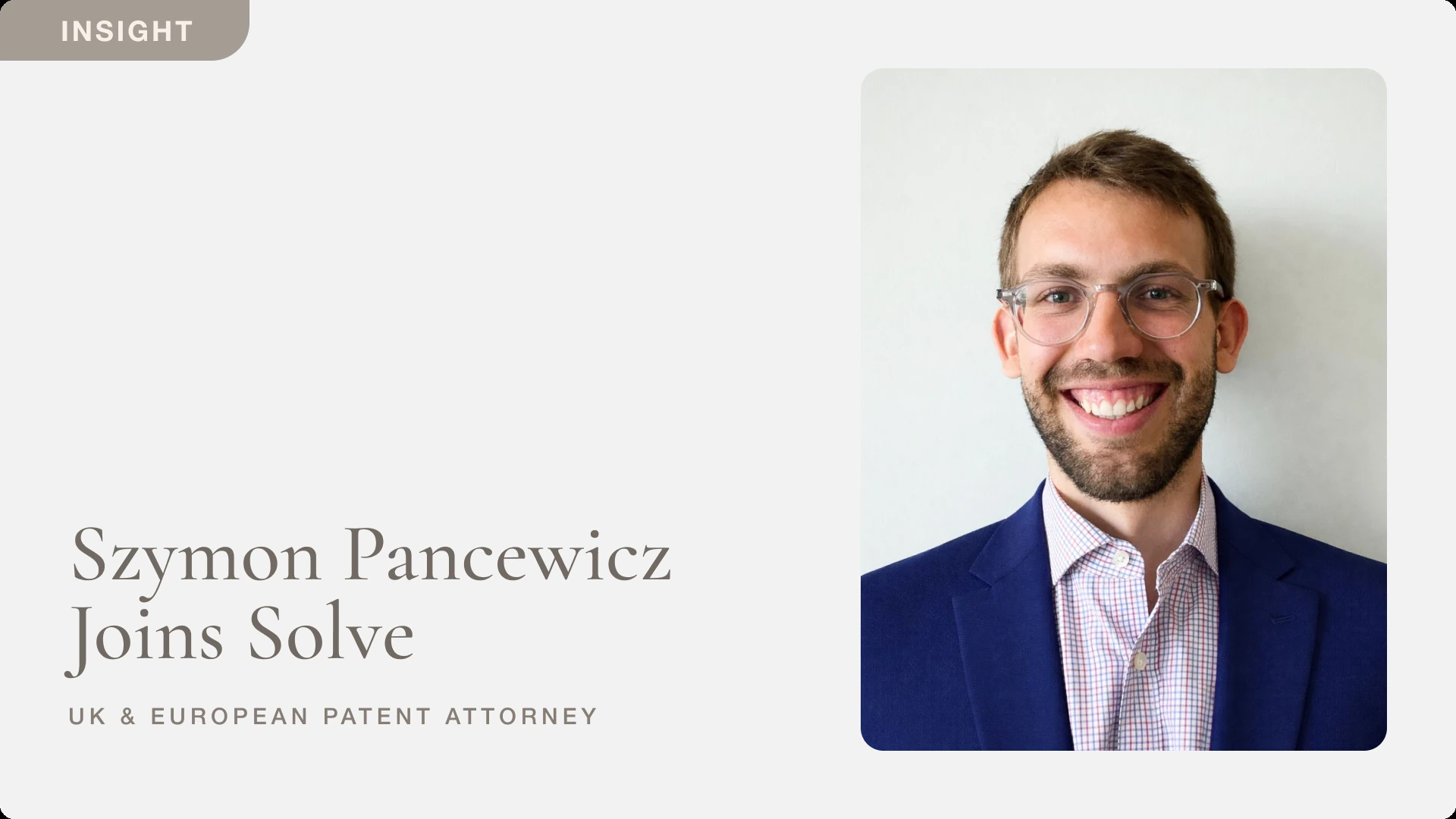
Szymon Pancewicz Joins Solve

We’re excited to welcome Szymon Pancewicz to Solve Intelligence!

Szymon Pancewicz Joins Solve

Szymon joins our Legal & Product Engineering team from D Young & Co, as a European and UK Patent Attorney. He previously practised at another leading UK private practice firm, Mathys & Squire, and holds a degree in Information and Computer Engineering from the University of Cambridge.

With over six years of experience spanning patent drafting and prosecution, freedom-to-operate analyses, and registered designs, Szymon brings a strong blend of legal and technical expertise. His background also includes a secondment at Imperial College London and hands-on experience in patent enforcement, which he will leverage to help develop our Invention Harvesting and Claim Charts products. As a native Polish speaker, he adds to Solve’s international reach.

At Solve Intelligence, Szymon will apply his broad skillset to support our mission of building the go-to platform for every stage of the IP process.

Please join us in welcoming Szymon to the team!

AI for patents.

Be 50%+ more productive. Join thousands of legal professionals around the World using Solve’s Patent Copilot™ for drafting, prosecution, invention harvesting, and more.

Related articles

EPO G 1/26: How the Coated Steel Strips Case Tests Article 123(2)

At Solve Intelligence, we build AI tools purpose-built for patent prosecution and opposition workflows. European teams, including cross-Atlantic firms like HG, use Solve Intelligence to stay ahead of EPO doctrine shifts as they happen. In this article, we cover the three referred questions in G 1/26, the practical implications for prosecution and opposition teams, and what to do before the decision lands.

Key takeaways

  • G 1/26 asks whether G 1/24's rule to consult the description extends from patentability assessment to Article 123(2) added matter.
  • The underlying case (T 873/24) turns on whether "ratio of titanium to nitrogen in excess of 3.42" means a weight ratio or a molar ratio.
  • The referral poses three sets of questions: admissibility under Article 112(1), the reach of the description in claim interpretation, and the consequences for Article 123(2).
  • If the Enlarged Board extends G 1/24 to Article 123(2), description-based narrowing applies to added-matter assessment across all European proceedings.

Built for IP: How Banner Witcoff Is Raising the Bar on Patent Work with Solve Intelligence

"We viewed our choice of AI platform as significant to the future of our patent practice. After extensively evaluating many products, we concluded that Solve Intelligence best met the needs of our attorneys and our clients." Laura Brutman, Shareholder, Banner Witcoff

Patents and Standards 2026: When SEP portfolios outgrow human review

The 8th UCL Patents and Standards conference brought together all the key standard essential patent (SEP) players on both the holder and implementer sides. 

By the end of day two, one technical question kept resurfacing across panels that were nominally discussing other topics. How does anyone actually assess essentiality and validity at the scale modern declared portfolios now reach? At Solve Intelligence, this is the question we have built our platform to answer.

Key takeaways

  • At today's portfolio scales, AI is a precondition for SEP essentiality and validity assessment, not an enhancement of human review.
  • Streaming standards are fully in SEP territory, bringing implementers with no licensing history into the same mapping problems as in cellular standards.
  • SEP disputes default to parallel multi-jurisdiction proceedings, requiring position alignment across every forum before the first filing.

Why Patent Practice Needs Purpose-Built AI: Reflections from Code with Claude

Anthropic's Code with Claude convened the global community of developers, founders, and researchers building applied AI on Claude. Solve Intelligence was invited to speak from the stage on what we have learned building AI for patent professionals, and the conference was a useful reminder of why domain-specific software matters in high-stakes legal work.