
Prior Art Search: 7 AI Tools Ranked for Patent Professionals
Discover 7 top AI tools for smarter prior art search, ranked and reviewed for patent professionals seeking innovation and accuracy
.avif)
Smarter Prior Art Search: 7 AI Tools Ranked for Patent Professionals
Before drafting a patent application, every attorney needs to answer one key question: has this been done before?
Prior art searching is foundational to patentability. But as the volume of patent filings grows across jurisdictions and languages, traditional keyword-based search tools often fall short. That's where AI is changing the game.
A new wave of AI-powered tools is helping attorneys uncover relevant prior art faster, more comprehensively, and with less manual effort. For patent professionals evaluating an invention before deciding to move forward, choosing the right tool can make a huge difference.
How We Evaluated the Tools
We looked at seven leading AI-powered tools used for prior art search in the context of utility patents, particularly for attorneys working across the US and Europe. Each tool was evaluated against five criteria:
- Ease of Use – Is the interface intuitive for attorneys? Is there a steep learning curve?
- Broad Coverage – Does it search across global jurisdictions (including USPTO and EPO)?
- Semantic Search – Does the tool use AI/NLP to understand ideas and concepts, beyond exact keywords?
- Integration with Drafting – Is the tool embedded in or integrated with patent drafting workflows?
- Multilingual Support – Can it retrieve relevant results from non-English jurisdictions?
Each metric was scored 0, 0.5, or 1, with a total score out of 5.
7 AI Tools That Make Prior Art Search Smarter
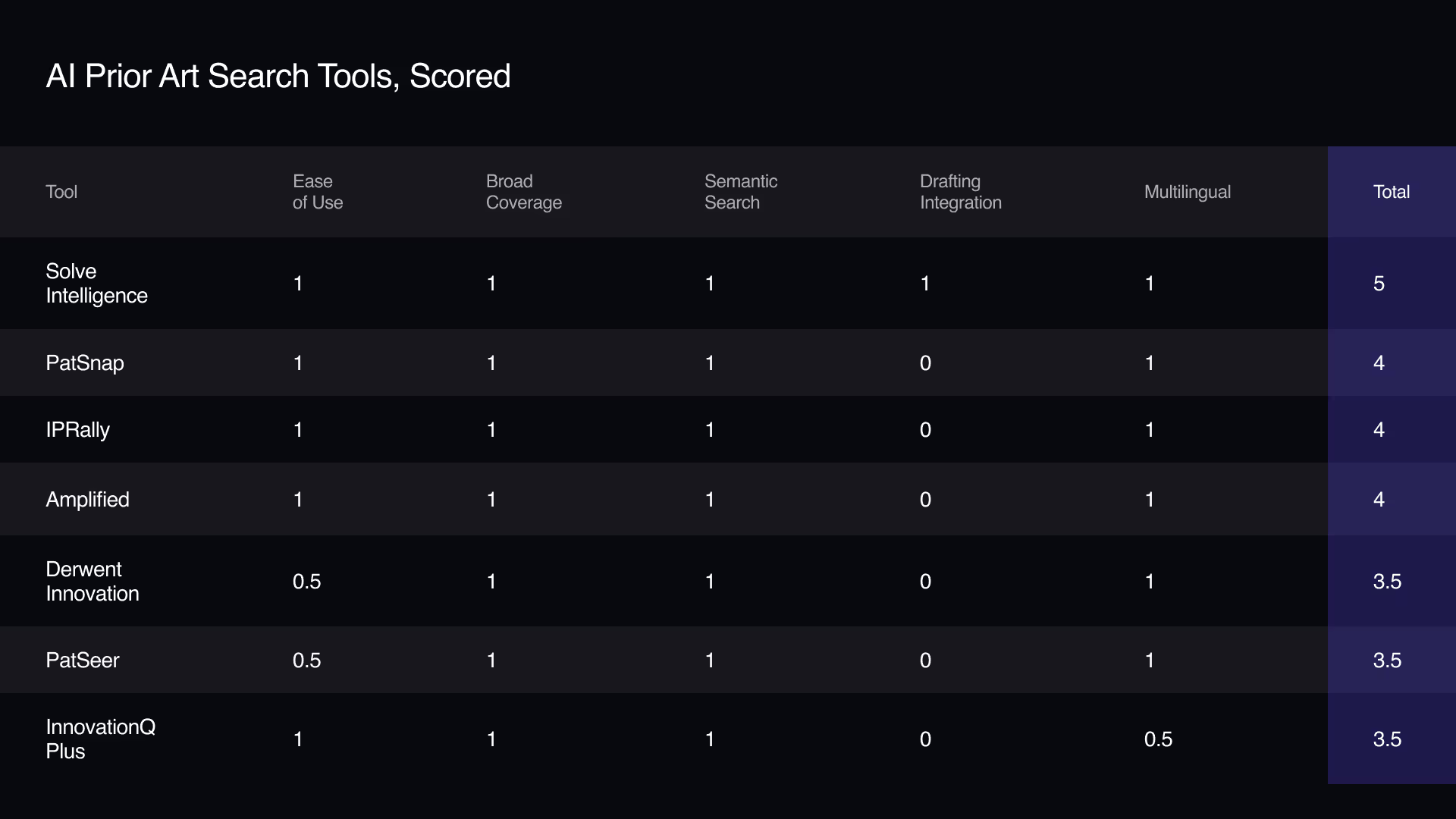
1. Solve Intelligence – 5/5
Best for: Seamless prior art search during patent application drafting
Solve Intelligence is purpose-built for patent attorneys drafting applications or responding to office actions. While the platform is primarily known for AI-assisted drafting, it also includes a semantic prior art search capability that spans 170+ million patent publications across 107 jurisdictions.
What sets it apart is workflow integration. The tool uses AI to generate a semantic summary of your invention and surfaces relevant prior art within the drafting flow. The prior art is then extracted into the platform, and the AI will automatically identify novelty and non-obviousness over the prior art in later steps when helping attorneys draft the patent application within Solve Intelligence’s platform. Though non-patent literature (NPL) search isn’t yet available, it’s on the roadmap.
Score: 5/5
2. PatSnap – 4/5
Best for: All-in-one platform with analytics
PatSnap offers semantic search across patents and NPL (e.g., IEEE). You can input a natural-language description, and its AI surfaces conceptually similar inventions. It also provides patent landscapes, prior art scoring, and tech trend analysis.
While it isn’t integrated into drafting tools, it excels in data coverage and semantic intelligence.
Score: 4/5
3. IPRally – 4/5
Best for: Graph-based semantic reasoning
IPRally takes a unique approach by representing inventions as knowledge graphs. This lets it find prior art by matching technical features and relationships, not just words. Attorneys can view and compare graph structures for transparency.
It’s not tied to any drafting tools, but it’s strong on precision and explainability.
Score: 4/5
4. Amplified – 4/5
Best for: High recall with a simple UX
Amplified uses full-text semantic search and AI relevance ranking. Users can search with plain language or entire disclosures and compare documents side-by-side. It’s intuitive and efficient, though not integrated with drafting platforms.
Score: 4/5
5. Derwent Innovation (Clarivate) – 3.5/5
Best for: Enterprise-grade search with editorial quality
Derwent combines AI with human-curated abstracts via the Derwent World Patents Index (DWPI). Its semantic search delivers high recall, and its editorial summaries help users quickly assess relevance.
A slight learning curve and lack of drafting integration lower its score.
Score: 3.5/5
6. PatSeer – 3.5/5
Best for: Analysts who want Boolean + semantic power
PatSeer blends traditional search control with modern AI. It features re-ranking and recommendation engines and supports custom classification. While powerful, it’s not especially intuitive and lacks drafting integration.
Score: 3.5/5
7. InnovationQ Plus (IP.com) – 3.5/5
Best for: Patent + literature discovery
InnovationQ Plus stands out for its integration with technical literature like IEEE. Its proprietary Semantic Gist engine excels at interpreting technical ideas, and it includes visual tools like semantic maps.
However, it lacks integration with drafting workflows and multilingual support is limited.
Score: 3.5/5
From Search to Draft: Why It Matters
Finding the right prior art is just the beginning. What happens next, drafting a patent application that stands up to scrutiny, requires the same level of precision, context awareness, and efficiency.
That’s why we built Solve Intelligence: to help patent professionals streamline their end-to-end workflow. With semantic prior art search embedded directly into our drafting platform, attorneys can move from search to claims with confidence and speed.
Interested in how AI can support your team from search through drafting, and then responding to office actions? Book a demo with Solve Intelligence to learn more.
AI for patents.
Be 50%+ more productive. Join thousands of legal professionals around the World using Solve’s Patent Copilot™ for drafting, prosecution, invention harvesting, and more.

.png)
.png)
