Dina Blikshteyn to join Solve Intelligence’s Customer Advisory Board

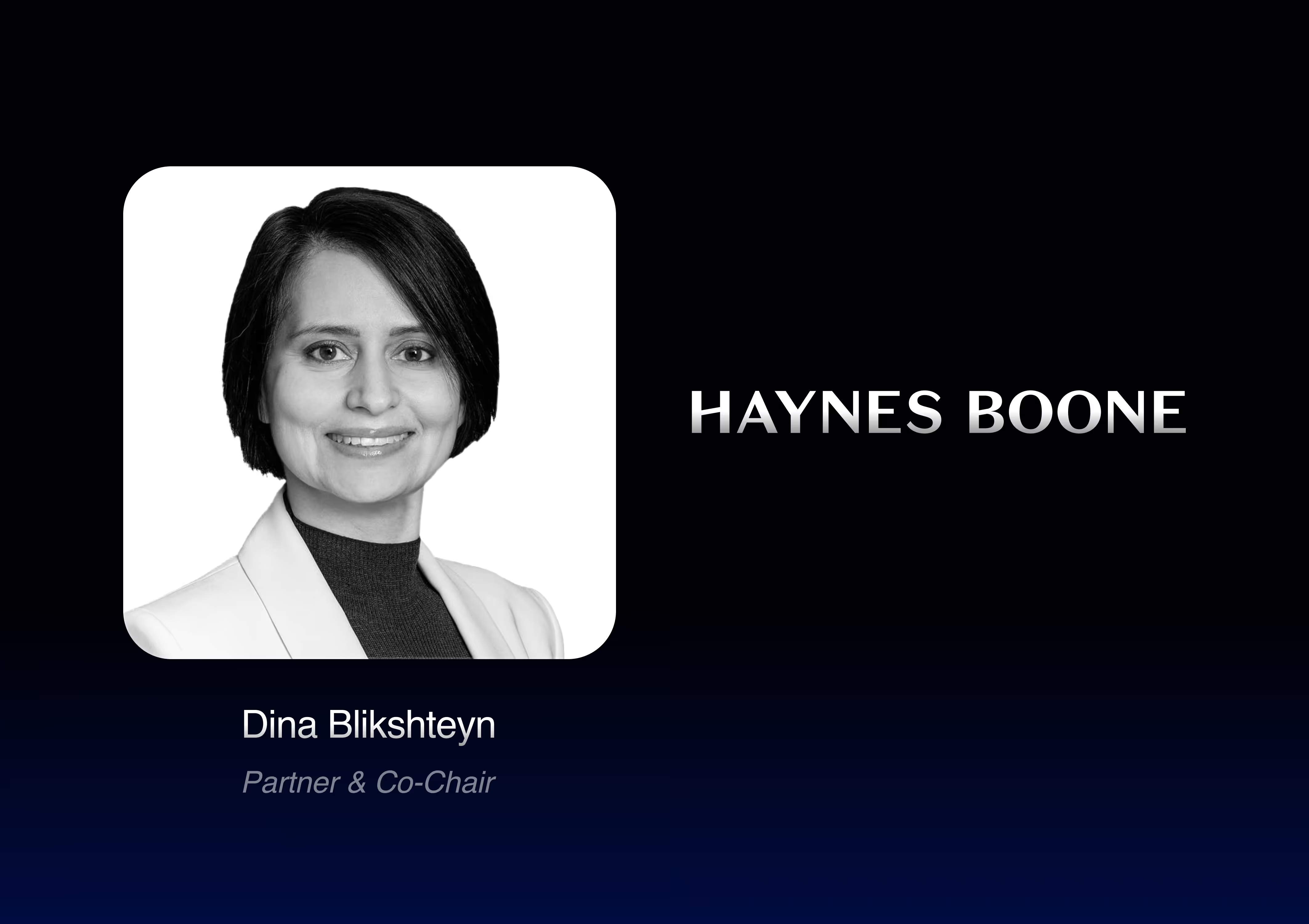
We are excited to welcome Dina Blikshteyn, partner at Haynes Boone, to Solve Intelligence's Customer Advisory Board.

Dina Blikshteyn to join Solve Intelligence’s Customer Advisory Board

Dina is a seasoned intellectual property attorney based in Haynes Boone's New York office, where she serves as co-chair of the firm's artificial intelligence practice. Her expertise spans post-grant proceedings before the U.S. Patent and Trademark Office, AI counseling, and preparing and prosecuting domestic and international patent applications across cutting-edge technology sectors.

With a unique blend of legal expertise and technical background, Dina regularly counsels clients on artificial intelligence and machine learning, cybersecurity, cloud computing, financial trading systems, telecommunications, and numerous other emerging technologies. Prior to her legal career, she developed high-frequency trading systems for domestic and international financial exchanges, bringing real-world technical experience to her IP practice.

Dina is a recognized thought leader in AI and intellectual property, regularly speaking and writing on the intersection of artificial intelligence and patent law.

"I’m excited to join Solve’s Customer Advisory Board at a time when AI and Solve are at the forefront of transforming the legal industry. The team is building groundbreaking AI software that will undoubtedly empower IP professionals to work smarter, faster, and focus on legal expertise. I’m eager to help shape the company’s vision, ensure its innovations remain cutting-edge, and make a bold, positive impact on the IP community."

Dina Blikshteyn, Partner, Haynes Boone

"We are thrilled to have Dina join Solve's Customer Advisory Board. Her dual expertise in AI and intellectual property, combined with her hands-on technical background, makes her an invaluable advisor as we continue to develop AI-powered solutions for the IP community. Her insights will be particularly valuable as we enhance our capabilities for post-grant proceedings and continue developing new features that serve the evolving needs of IP professionals."

Justin Doop, GC, Founding Member of Legal & Product, and Facilitator of Solve's CAB, Solve Intelligence

We look forward to Dina's invaluable contributions to Solve Intelligence's strategy and future product roadmap.

Check out the rest of our Customer Advisory Board here.

AI for patents.

Be 50%+ more productive. Join thousands of legal professionals around the World using Solve’s Patent Copilot™ for drafting, prosecution, invention harvesting, and more.

Related articles

Reflections from IPWatchdog: Masterclass on AI Prompt Engineering for Patent Workflows

On February 5, 2026, Solve Intelligence hosted a masterclass with IPWatchdog on AI prompt engineering for patent workflows. Nearly 750 practitioners registered from across the world.

The level of experience in the room was striking: 75% of attendees had more than 11 years of patent experience, and over 40% had more than 20 years. A clear indication that decision-makers are staying on top of the latest trends and educational content on AI.

Key insights

  • Senior patent decision-makers are actively learning AI with 750 registrants and deep experience
  • AI is broadly permitted with most respondents reporting approval or active policy evaluation
  • Prompt engineering drives ROI with templates and structured instructions improving output quality

Watch the recording and download the slides

The recording covers the full prompt engineering framework for patent workflows, a live demonstration of prompting in action within Solve Intelligence across drafting, prosecution, and claim charting workflows, and a Q&A with the panel.

Download the slides here.

Client confidentiality in the age of AI: best practices for patent professionals

AI can improve the quality and efficiency of patent work - but it can also create new confidentiality and privilege risks if you don’t control what data is shared, where it’s stored, and who can access it. The good news: you can turn “AI risk” into a repeatable review process that your leadership, IT/security, and risk teams can sign off on with confidence.

This guide gives you a practical framework and a due diligence checklist, that you can use to evaluate AI tools for patent workflows without compromising client confidentiality.

Key takeaways

  • In patent work, confidentiality failures can jeopardise patent rights—treat inputs as high-risk.
  • Risk is more than training: retention, access, logs, human review, and subprocessors matter.
  • Use data tiers: Tier 0–1 OK; Tier 3 ‘default no’ unless explicitly approved and controlled.
  • Make it auditable: approved use cases, human review, matter separation, and vendor diligence.

For further information, read the full guidance below.

Level Up Your IP Strategy - Senior IP & Patent Leaders, see AI in action.

Solve Intelligence will be presenting a live product demo at the upcoming private workshop hosted by HG Law and organised by Cosmonauts.

📅 Wednesday, 4 March 2026:

Workshop: 2:30 PM - 6:00 PM | COMO Metropolitan London Hotel, London, UK

Dinner: 6:00 PM - 9:00 PM | COYA Mayfair, London, UK

This session is designed for Heads of IP, Patent Directors, and innovation leaders who want to level up their IP strategy by seeing AI applied in patent drafting, preparation, and prosecution.

Register Here.

How to Talk to Clients About Using AI in Patent Drafting

Artificial intelligence is no longer a theoretical issue in patent drafting, and many firms are already using AI-assisted workflows in some form. The harder question now isn’t whether to use AI, but how to talk to clients about using it.

Key insights

  • Focus on better drafting quality, enforceability, and fewer avoidable downstream problems.
  • Walk through data handling so confidentiality and retention protections are easy to trust.
  • Explain inventorship stays human and the attorney remains responsible for every word.
  • Keep the process clear and documented so expectations stay aligned from day one.

For some clients, AI usage signals efficiency and modernisation. For others, it raises immediate concerns about confidentiality, inventorship, and quality control. Those concerns are legitimate, so the key is to approach conversations about AI in a way that is structured, transparent, and grounded in professional responsibility.

In practice, the most effective discussions with clients will focus on outcomes rather than technology.

This article provides a structured framework to use when talking to clients about using AI, such as Solve Intelligence’s Patent Drafting CopilotTM, in patent drafting.