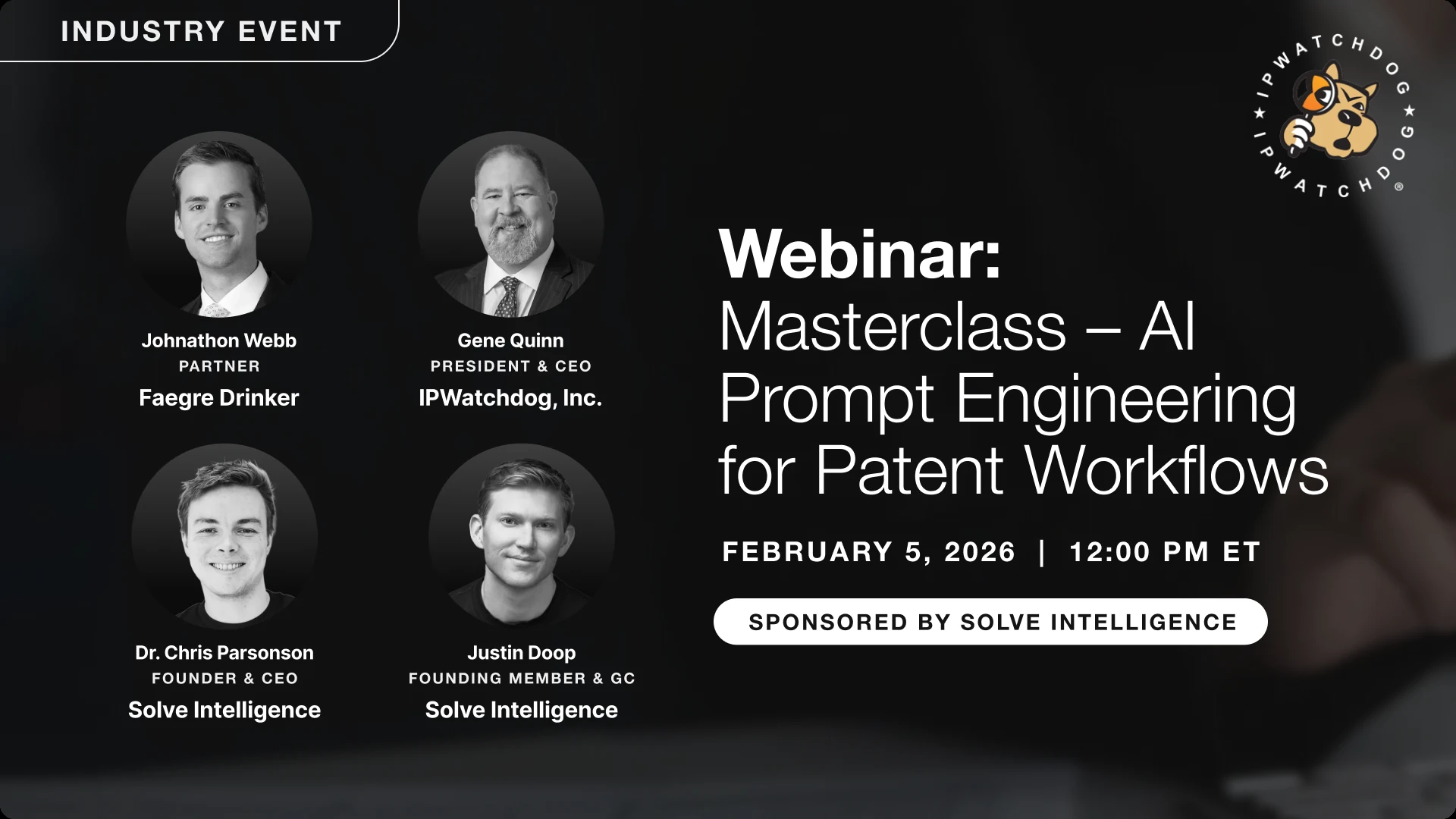
Webinar: Masterclass – AI Prompt Engineering for Patent Workflows

As AI adoption in patent practice continues to accelerate, a critically important question emerges—How do you get AI to deliver the work product you need and the quality you want?

Please join Solve Intelligence and IPWatchdog on Thursday, February 5, at 12 PM ET for a detailed examination of the practical application of AI prompting for patent practice. This webinar is designed for patent attorneys and in-house counsel who want to move beyond experimentation and understand how prompt engineering can be used as a repeatable skill, enabling more efficient, higher-quality patent work across AI-enabled workflows.

Register here.

Webinar: Masterclass – AI Prompt Engineering for Patent Workflows

Solve Intelligence CEO Chris Parsonson, General Counsel & U.S. Patent Attorney Justin Doop, and Partner at Faegre Drinker Johnathon Webb, will focus on how sophisticated prompts are written in practice to support high-value tasks such as customizing claims, drafting specifications, performing structured review, responding to Office Actions, and generating and iterating on claim charts.

Chris and Justin will begin with a concise overview of what industry research teaches about effective prompting, including context-setting, constraints, structured outputs, and iterative review. They will then provide examples showing how prompt design directly impacts efficiency, quality, and practitioner control over the output. Finally, they will demonstrate those principles live through attorney-led examples inside Solve Intelligence.

AI for patents.

Be 50%+ more productive. Join thousands of legal professionals around the World using Solve’s Patent Copilot™ for drafting, prosecution, invention harvesting, and more.

Related articles

AI Assistance vs. Inventorship: Ethical Guidelines for Patent Attorneys

AI is now a daily tool for many patent attorneys—from drafting assistance to prior art searches. But questions about inventorship and ethics persist. Courts and patent offices worldwide continue to grapple with whether AI can be considered an inventor, and the recent November 2025 USPTO guidance has brought fresh clarity to this evolving area.

This article explores where the line is drawn between AI as a tool and AI as an inventor, and how attorneys can use AI responsibly while meeting their professional obligations. The revised USPTO guidance may be found here.

Khurana & Khurana Adopts Solve Intelligence to Scale Patent Practice

We are delighted to announce that Khurana & Khurana (K&K) is deploying Solve Intelligence across their extensive global practice. Professionals at K&K leverage Solve Intelligence to analyze prior art, formulate response strategies, and draft patent applications more efficiently. The platform is designed to keep legal professionals firmly in control throughout the entire process, allowing them to use AI as an extension of their legal expertise.

How to Generate SEP Claim Charts with Solve Intelligence: A Practical Guide

SEP claim charting can be a bottleneck in patent licensing and portfolio management: too time-consuming and expensive to perform rigorously at scale, yet too important to skip. Solve Intelligence is changing this equation, allowing practitioners to generate high-quality claim charts in minutes rather than hours, while surfacing insights that might otherwise be missed.

How to Run a Due Diligence Checklist on AI tools for Patent Practice for Law Firms

This article provides a practical, structured due diligence checklist your firm can use to help move from abstract concerns about AI risk to a clear, repeatable evaluation, which reduces risk, aligns stakeholders, and speeds up internal approval.