This pilot programme will expand options for Australian applicants by giving them access to thorough search reports and detailed written opinions from the EPO early in the international phase.
The quality of drafting at the PCT stage has always had a direct impact on the usefulness of the international search report and strategic decisions that follow. With the launch of this pilot programme, the importance of high-quality drafting for Australian applicants will be emphasised.
Last autumn, Solve Intelligence wrote about the importance of drafting patents for local jurisdictions even when prosecution strategies are multi-jurisdictional in the article AI for Patents in Every Jurisdiction. The announcement of the EPO-IP Australia pilot programme highlights a slightly different perspective though: the importance of drafting patents for unfamiliar jurisdictions.
All patent practitioners know that drafting conventions that work well in one jurisdiction may create friction in another. This is exacerbated, particularly when applications are searched or examined by offices with strict clarity and support requirements such as the EPO.
Common challenges include:
These challenges do not disappear during the international phase; rather, they will be amplified when the EPO conducts the international search and issues the written opinion.
AI is becoming an increasingly valuable drafting companion for patent practitioners. Used well, it can accelerate the early stages of application preparation, reduce time spent on repetitive drafting tasks, and help practitioners maintain consistency across claims and the specification.
Just as importantly, AI can act as a quality check. It can be used to surface potential clarity issues, ensure terminology is used consistently, and ensure a robust disclosure. In the context of international filings, this can lead to stronger applications in the international phase and fewer avoidable issues later in prosecution.
For Australian applicants and patent practitioners looking to succeed in the EPO–IP Australia PCT pilot programme, AI-augmented drafting tools could make all the difference.
Solve Intelligence's Patent Copilot is specifically designed to support jurisdiction-aware drafting from the start. Rather than merely offering generic drafting assistance, it incorporates office-specific conventions into its workflows to help practitioners draft high-quality patent applications tailored to the expectations of different patent offices.
Solve Intelligence's Patent Copilot employs jurisdiction-specific AI algorithms that form “region drafters”. Each region drafter is configured to reflect the requirements, conventions, and best practices of the relevant patent office.
Practitioners can choose their target jurisdiction from one of two dropdown menus, which will load the appropriate region drafter for their target jurisdiction, and support their drafting for the chosen target jurisdiction. Additionally, users are also given the option to set the user interface and the AI output in their desired language.
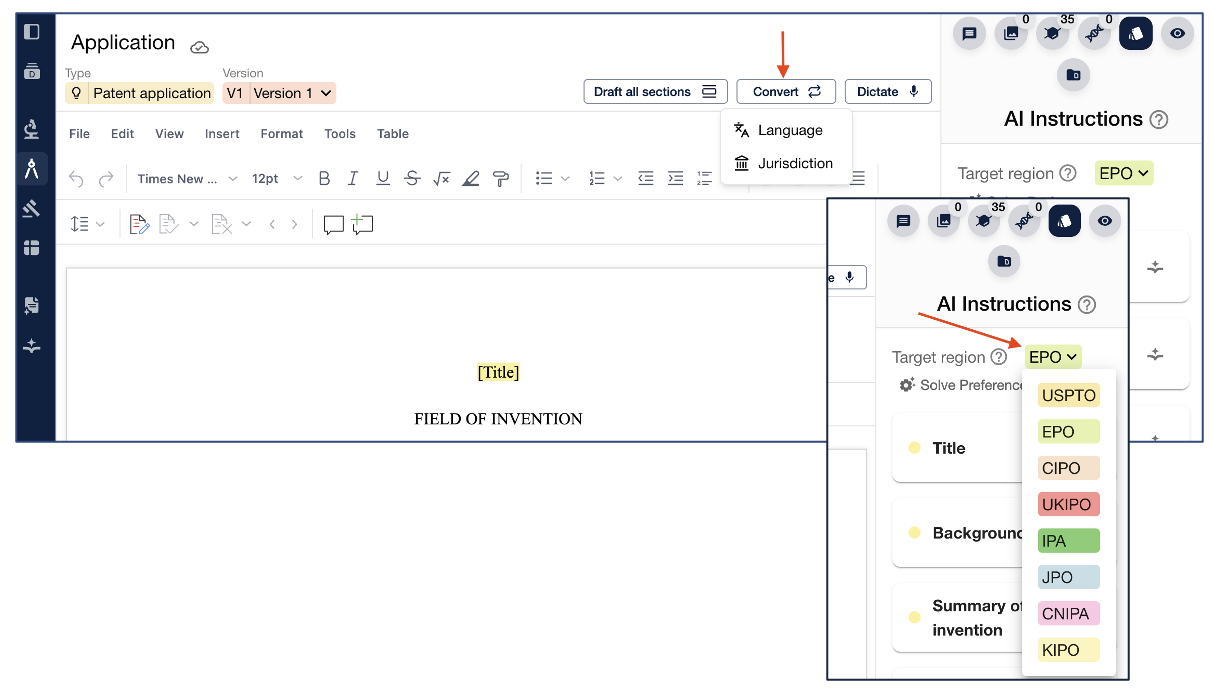
For example, with the EPO-focused region drafter loaded, the underlying AI algorithm will ensure that the claims are drafted using the two-part form where necessary and with multiple dependencies, thus reducing the risk of formal objections in the written opinion and improving the support for claim amendments further down the line. Amongst others, Solve's Patent Copilot also has an IP Australia-focused region drafter, making it uniquely positioned to support patent professionals and applicants seeking patent protection in both regions.
The EPO–IP Australia PCT pilot highlights the strategic value of high‑quality, jurisdiction‑aware PCT drafting. At Solve Intelligence, patent attorneys are working together with engineers to build products that achieve this, that patent professionals across the globe can use in their practice every day.
To learn more, get in touch with us to request a demo.


.webp)