Joshua Davenport to join Solve’s Customer Advisory Board

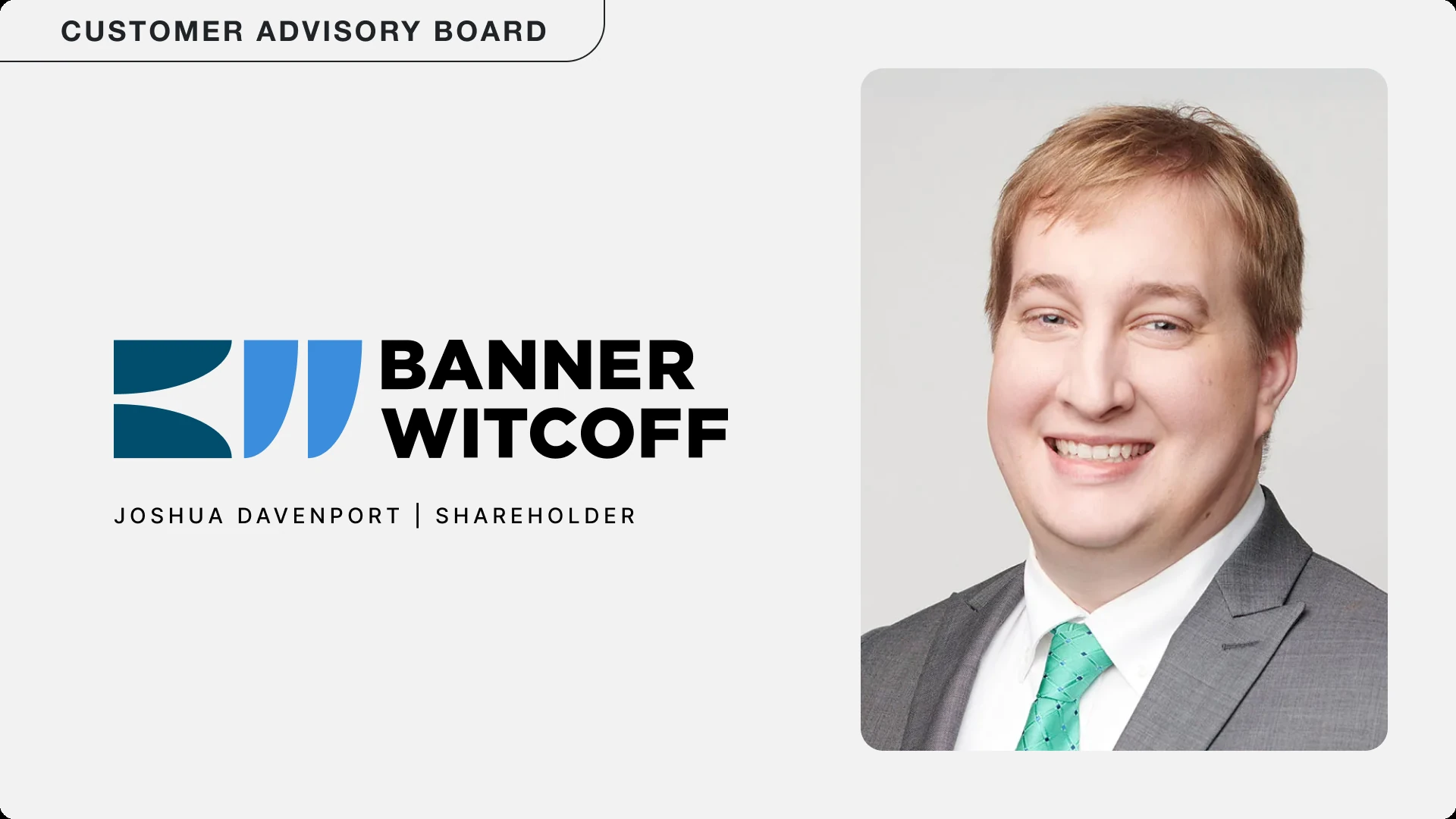
We are excited to welcome Joshua Davenport, Shareholder at Banner Witcoff, to Solve Intelligence’s Customer Advisory Board.

Joshua Davenport to join Solve’s Customer Advisory Board

Joshua represents clients across a wide range of intellectual property matters, including patent prosecution, litigation, and counseling. With a background in electrical engineering, he brings deep technical fluency to complex patent work spanning cutting-edge industries such as artificial intelligence, cellular networks, green energy, video games, finance infrastructure, carrier networking, and television broadcast systems.

Joshua’s practice is built around applying IP law to sophisticated technical issues, particularly in high-stakes disputes where clear strategy and technical precision matter most. He has also argued many cases before the Patent Trial and Appeal Board (PTAB) and has been recognized among the top filers of inter partes review petitions, reflecting extensive experience in post-grant practice.

In addition to his day-to-day client work, Joshua is an active voice in the evolving conversation around AI and legal practice, frequently speaking on developments in generative AI and how it impacts modern patent prosecution. This combination of real-world litigation and prosecution experience, paired with a forward-looking view of AI, makes him a fantastic fit for Solve’s mission to help IP professionals do their best work with AI-powered tools.

“Today’s AI solutions are most effective when leveraged as a tool for creating human workflows that weren’t previously possible. By understanding lawyers, not just technology, Solve is truly innovating on what the practice of law looks like, and I’m excited to collaborate with them in helping think through what’s next in our field.”
Joshua Davenport, Shareholder, Banner Witcoff
“Joshua’s mix of technical depth, PTAB experience, and practical insight into how AI is reshaping patent practice makes him an exceptional addition to our Customer Advisory Board. We’re excited to learn from his perspective as we continue building AI tools that improve the way patent professionals draft, prosecute, and manage high-value IP.”
Chris Parsonson, CEO & Co-founder, Solve Intelligence

We look forward to Joshua’s invaluable insights and contributions as Solve Intelligence continues to advance its AI-driven solutions for the IP community.

Check out the rest of our Customer Advisory Board here.

AI for patents.

Be 50%+ more productive. Join thousands of legal professionals around the World using Solve’s Patent Copilot™ for drafting, prosecution, invention harvesting, and more.

Related articles

EPO Guidelines 2026: Key Changes Including G 1/24, G 1/23, and AI

The European Patent Office has published a preview of its Guidelines for Examination, effective April 2026. This update incorporates the landmark Enlarged Board decisions G 1/24 (claim interpretation) and G 1/23 (products on the market), alongside a significant change of practice for selection inventions, new rules on colour drawings, and the EPO's first formal guidance on artificial intelligence.

Drafting for the EPO: How AI Can Make the New EPO–IP Australia PCT Pilot a Success

The EPO and IP Australia are launching a new PCT pilot programme on 1 March 2026 which will allow Australian applicants to designate the EPO as their International Searching and Preliminary Examining Authorities (ISA and IPEA). 

Given the EPO’s rigorous approach to clarity and support requirements, for this pilot programme to succeed, Australian applicants and patent practitioners will have to adapt to draft international applications with EPO-specific requirements in mind.

The launch of this pilot programme will add a new layer of complexity — (and opportunity) for patent practitioners. In a landscape where jurisdictional nuance can shape international search and examination outcomes, AI‑augmented tools such as Solve Intelligence's Patent CopilotTM are becoming increasingly valuable.

Webinar: Masterclass – AI Prompt Engineering for Patent Workflows

As AI adoption in patent practice continues to accelerate, a critically important question emerges—How do you get AI to deliver the work product you need and the quality you want?

Please join Solve Intelligence and IPWatchdog on Thursday, February 5, at 12 PM ET for a detailed examination of the practical application of AI prompting for patent practice. This webinar is designed for patent attorneys and in-house counsel who want to move beyond experimentation and understand how prompt engineering can be used as a repeatable skill, enabling more efficient, higher-quality patent work across AI-enabled workflows.

Register here.

AI Assistance vs. Inventorship: Ethical Guidelines for Patent Attorneys

AI is now a daily tool for many patent attorneys; from drafting assistance to prior art searches. But questions about inventorship and ethics persist. Courts and patent offices worldwide continue to grapple with whether AI can be considered an inventor, and the recent November 2025 USPTO guidance has brought fresh clarity to this evolving area.

This article explores where the line is drawn between AI as a tool and AI as an inventor, and how attorneys can use AI responsibly while meeting their professional obligations.