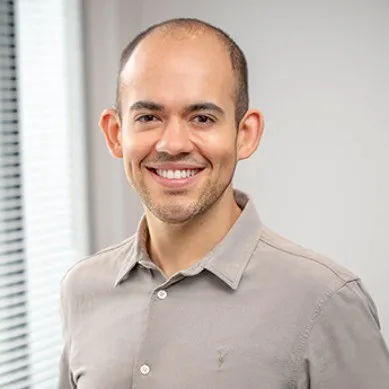
Christian is a registered U.S. patent agent with over six years of experience in the patent profession. He previously worked at Stener, Kessler, Goldstein & Fox, one of the largest IP boutique law firms in the U.S., and also worked as an in-house patent agent at Singular Genomics, a DNA sequencing company. 

Christian also obtained his Ph.D. in Virology at Harvard University, where his doctoral research focused on viral oncology, and holds a B.S. in Microbiology and Genetic Biology, from Purdue University.

His expertise in patent prosecution, freedom-to-operate analysis, and patent portfolio management across a broad range of biotechnology areas will help us continue building the most capable AI tools for every stage of the patent process.
How Successful Patent Practitioners Are Putting AI to WorkThe most effective patent practitioners are already using AI patent drafting to draft faster, catch claim inconsistencies earlier, and free up hours for the strategic work that actually wins allowances. Key takeaways AI patent drafting tools can reduce application drafting time by up to 80 percent, with Solve Intelligence customers consistently reporting 50 percent or greater efficiency gains across drafting and prosecution Roughly 9 out of 10 utility patent applications receive at least one office action rejection, so prosecution efficiency matters as much as drafting speed Solo attorneys use AI to match larger law firms on turnaround speed and client capacity The strongest reported results come from iterative AI–attorney collaboration, with practitioners directing the process and owning the final work product
Automated Patent Proofreading: QA Framework for §112The final review before a U.S. patent filing should not be another linear read-through. Rather, it should be a controlled quality-assurance step: a systematic check of the relationships among the claims, specification, and drawings while the full range of corrective options is still available. Done well, pre-filing QA catches errors that are inexpensive to fix at the drafting desk but costly after filing. Done poorly, it can leave the applicant facing an avoidable rejection, a narrowing amendment, a priority problem, or a validity challenge years later. Key Takeaways: Pre-filing is the best time to correct disclosure, claim, and drawing defects without creating new-matter or priority complications. Antecedent basis gaps, contradictory claim dependencies, and terminology drift are the most common pre-filing defects, and all are correctable before filing. Section 112(a) review is substantive, not clerical: a broad range or functional limitation may warrant scrutiny even when the claim reads cleanly. Automated patent proofreading identifies candidate defects for attorney review but does not substitute for legal judgment on claim scope, support, or strategy.
Cookie settingsBy clicking “Accept all”, you agree to the storing of cookies on your device to enhance site navigation, analyze site usage, and assist in our marketing efforts. For further details see ourManage cookie preferencesChoose which cookies we may store on your device. Essentials keep the site working and cannot be turned off.EssentialsNecessary for the site to function. Always on.Always activeAnalyticsMeasures usage and improves your experience.MarketingUsed for targeted advertising.Cookie preferences