Announcing Solve Intelligence's Customer Advisory Board

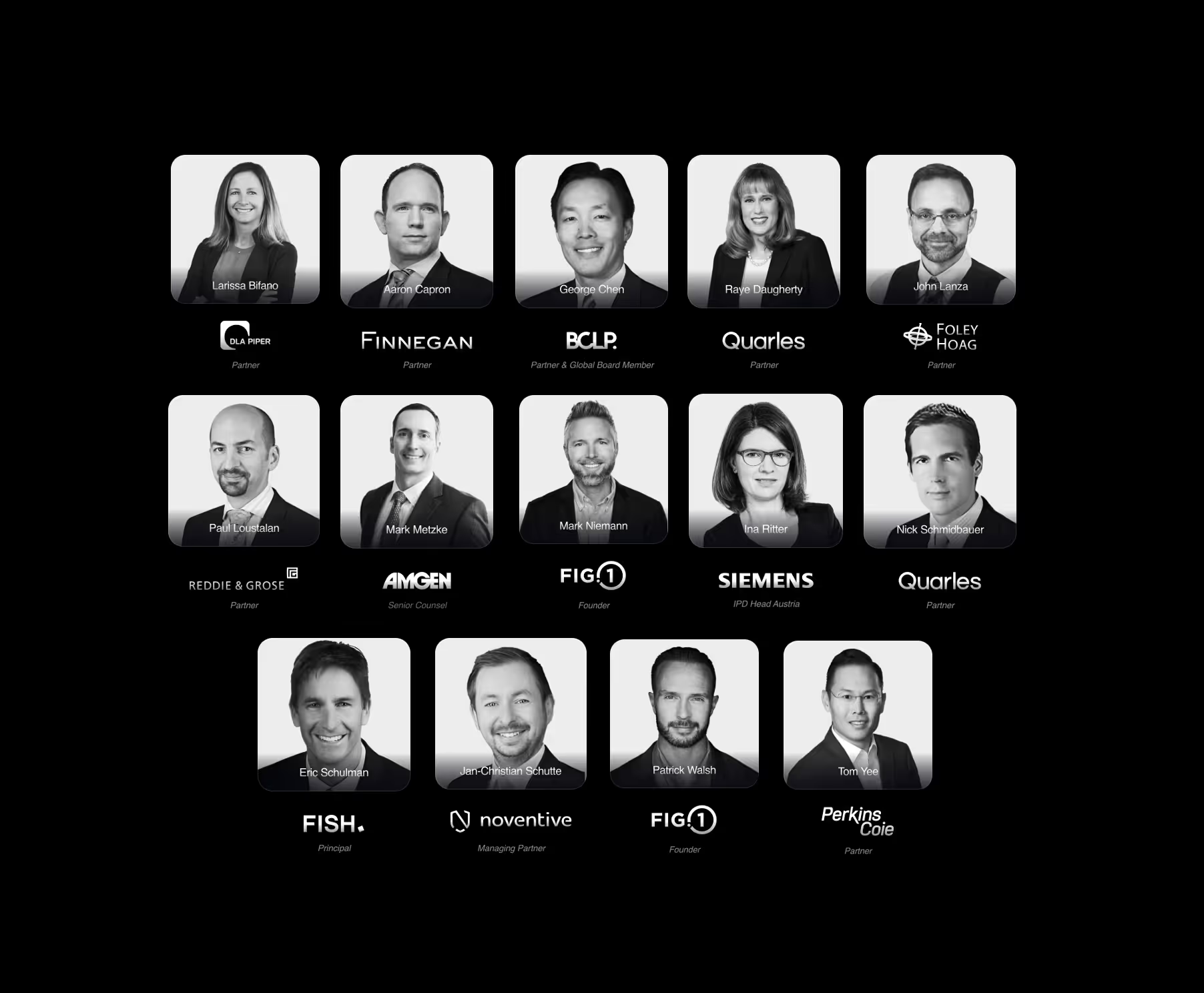
We are excited to announce the formation of our Customer Advisory Board, bringing together distinguished intellectual property practitioners who are at the forefront of the patent space to help advise Solve on building the go-to AI platform for IP professionals.

Announcing Solve Intelligence's Customer Advisory Board

Close collaboration with IP practitioners has always been a founding principle of Solve, and as artificial intelligence continues to transform the practice of patent law, we believe this close collaboration will become increasingly vital. The formation of the Customer Advisory Board represents our commitment to building solutions that not only leverage cutting-edge technology but also address the practical challenges patent attorneys face in daily practice.

Coming from leading law firms, corporate IP departments, and boutique practices, the CAB’s collective expertise spans multiple technological domains—from life sciences to software, and from telecommunications to mechanical engineering—and multiple jurisdictions. Their collective expertise and experience will be invaluable in providing strategic guidance on feature and product development, workflow optimization, and insight on our customer’s evolving and changing needs. By working closely with experienced practitioners, we can better anticipate the challenges faced during patent drafting and prosecution, ensuring our software remains an indispensable tool for IP professionals, inventors, and the entire intellectual property community.

We are honored to work with this accomplished group of IP practitioners and look forward to the insights and perspectives they will bring to Solve Intelligence as we continue to build our platform to serve the entire intellectual property community.

AI for patents.

Be 50%+ more productive. Join thousands of legal professionals around the World using Solve’s Patent Copilot™ for drafting, prosecution, invention harvesting, and more.

Related articles

Client confidentiality in the age of AI: best practices for patent professionals

AI can improve the quality and efficiency of patent work - but it can also create new confidentiality and privilege risks if you don’t control what data is shared, where it’s stored, and who can access it. The good news: you can turn “AI risk” into a repeatable review process that your leadership, IT/security, and risk teams can sign off on with confidence.

This guide gives you a practical framework and a due diligence checklist, that you can use to evaluate AI tools for patent workflows without compromising client confidentiality.

Key takeaways

  • In patent work, confidentiality failures can jeopardise patent rights—treat inputs as high-risk.
  • Risk is more than training: retention, access, logs, human review, and subprocessors matter.
  • Use data tiers: Tier 0–1 OK; Tier 3 ‘default no’ unless explicitly approved and controlled.
  • Make it auditable: approved use cases, human review, matter separation, and vendor diligence.

For further information, read the full guidance below.

Level Up Your IP Strategy - Senior IP & Patent Leaders, see AI in action.

Solve Intelligence will be presenting a live product demo at the upcoming private workshop hosted by HG Law and organised by Cosmonauts.

📅 Wednesday, 4 March 2026:

Workshop: 2:30 PM - 6:00 PM | COMO Metropolitan London Hotel, London, UK

Dinner: 6:00 PM - 9:00 PM | COYA Mayfair, London, UK

This session is designed for Heads of IP, Patent Directors, and innovation leaders who want to level up their IP strategy by seeing AI applied in patent drafting, preparation, and prosecution.

Register Here.

How to Talk to Clients About Using AI in Patent Drafting

Artificial intelligence is no longer a theoretical issue in patent drafting, and many firms are already using AI-assisted workflows in some form. The harder question now isn’t whether to use AI, but how to talk to clients about using it.

Key insights

  • Focus on better drafting quality, enforceability, and fewer avoidable downstream problems.
  • Walk through data handling so confidentiality and retention protections are easy to trust.
  • Explain inventorship stays human and the attorney remains responsible for every word.
  • Keep the process clear and documented so expectations stay aligned from day one.

For some clients, AI usage signals efficiency and modernisation. For others, it raises immediate concerns about confidentiality, inventorship, and quality control. Those concerns are legitimate, so the key is to approach conversations about AI in a way that is structured, transparent, and grounded in professional responsibility.

In practice, the most effective discussions with clients will focus on outcomes rather than technology.

This article provides a structured framework to use when talking to clients about using AI, such as Solve Intelligence’s Patent Drafting CopilotTM, in patent drafting.

How to use AI in patent practice: USPTO guidance and compliance tips

As Artificial Intelligence (AI) and large language models (LLMs) increasingly integrate into legal practices, the U.S. Patent and Trademark Office (USPTO) issued guidance to assist patent attorneys with adopting AI tools in patent drafting, prosecution, and other areas of patent law.

In this article, we summarize the key compliance requirements from the USPTO's guidance and explain how Patent Copilot™ helps practitioners meet these obligations while leveraging AI's benefits.