Our First Customer Advisory Board Meeting

In September 2025, we brought together our Customer Advisory Board (CAB) for an in-person meeting at the Hotel Del Coronado in San Diego, just ahead of the IPO Annual Meeting.

Our CAB represents some of the most influential voices in IP. Collectively, the group manages over 160,000 active patents while prosecuting more than 20,000 applications annually. Our CAB members span the full spectrum of practice areas, from software and electrical to mechanical, life sciences, and pharmaceuticals. The composition is 80% private practice and 20% in-house IP teams, giving us a well-rounded perspective on the challenges and opportunities facing the profession when it comes to AI integration.
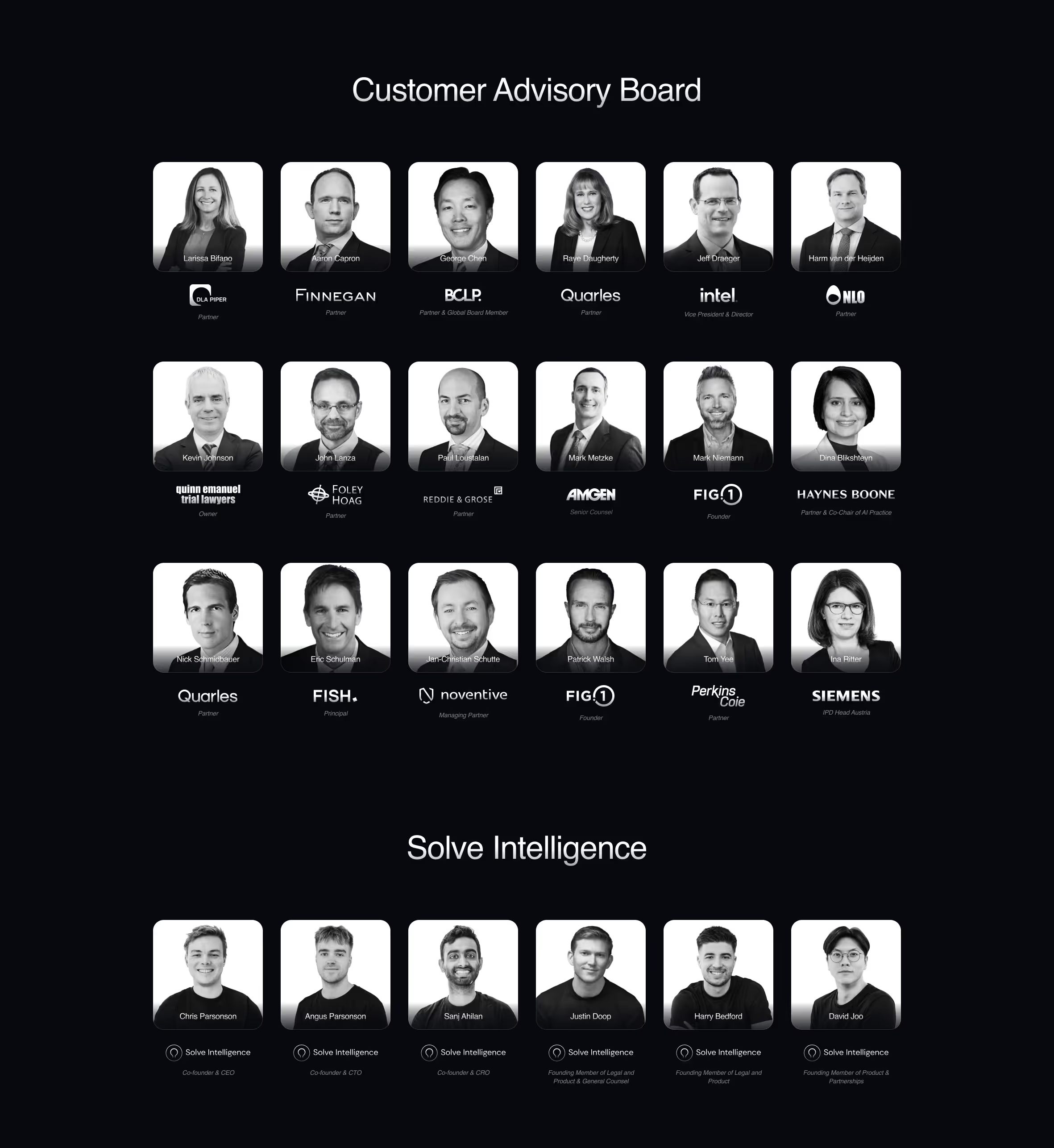
Our First Customer Advisory Board Meeting

Our CAB members have been heavily involved from the outset, supporting Solve Intelligence to build the go-to platform for patent professionals. Members collect and share feedback on existing products, test new products, and help shape our roadmap so that Solve Intelligence can continue to deliver meaningful value in patenting workflows.

During the meeting, we reflected on our journey from our founding in June 2023 to now supporting over 350 IP teams across 6 continents. We also explored some of the exciting trends we're observing:

  • In-house adoption has surged 175% since January 2025, driven in large part by corporate teams asking their outside counsel to advise on the best AI products on the market and align on AI strategies. 
  • AI customization is proving essential to successful AI adoption and the leading IP teams are already tailoring these tools to fit their unique needs.
  • Solve is increasingly becoming a core component of daily workflows for patent professionals.

Thousands of applications have now been drafted and prosecuted using Solve Intelligence. This is just the beginning and we share the vision that, within the decade, every in-house and outside counsel team will be collaborating on Solve Intelligence.

AI for patents.

Be 50%+ more productive. Join thousands of legal professionals around the World using Solve’s Patent Copilot™ for drafting, prosecution, invention harvesting, and more.

Related articles

Solve Intelligence Acquires Palito.ai to Unify AI Patent Litigation and Prosecution in One Platform

Solve Intelligence has acquired Palito.ai, a Munich-based startup specialising in AI-powered patent litigation and prior art analysis.

The acquisition deepens Solve’s investment in patent litigation, adding Palito's strengths in validity analysis, case law research, and European patent workflows to Solve’s existing Charts product. The result is a single platform where IP professionals can handle invalidity claim charts, SEP claim charts, freedom-to-operate and clearance analyses, infringement mappings, claim construction analyses, portfolio analyses, and more.

Solve Intelligence is an AI platform for IP professionals, covering patent drafting, prosecution, and litigation. Palito.ai is a Munich-based startup specialising in AI-powered validity analysis and European patent litigation workflows.

At a glance:

  • Solve Intelligence acquires Munich-based Palito.ai
  • Adds validity analysis, prior art research, EPO/UPC/German court workflows
  • New Munich office established
  • Existing Charts users get expanded litigation capabilities

The Shift Has Already Happened: How Legal's Relationship with AI Changed

Two years ago, the dominant argument in the legal industry was whether AI had any place in the profession at all. That debate is over.

Analysts are now calling 2026 the year AI moves from an “interesting tool” to “operational infrastructure”. The speed at which that narrative has changed tells you everything about where the industry is heading.

Key takeaways

  • The legal profession's central question has moved from "can we trust this?" to "how do we integrate this properly?"
  • AI adoption across IP practice has risen from 57% in 2023 to 85% in 2025.
  • Firms are not just trialling AI tools, they are expanding its use across full workflows. Practitioners using Solve Intelligence grew ~560% in 2025 alone.
  • Clearer regulatory guidance has removed one of the most significant psychological barriers to adoption.
  • The profile of firms now adopting AI has changed: these are not early experimenters, but some of the most demanding legal professionals in the world.

Solve Intelligence Ranked #1 IP Platform by the World's Leading Law Firms

Solve Intelligence has been ranked the number one intellectual property platform in the latest Legal AI survey published by SKILLS (the Strategic Knowledge & Innovation Legal Leaders Summit). The study surveyed 130 leaders at the world's top law firms about their legal AI product usage across every major practice area, scoring platforms based on live deployments, active pilots, and tools under consideration. In the Patents/IP category, Solve Intelligence placed first with a weighted score of 67, making it the most widely-used platform in the category. See the full report here.

The Hidden Cost of Ignoring AI in Patent Practice

As patent practitioners, the choice to “do nothing” about AI is not a neutral act. 

Law firms or in-house counsel that delay the adoption of AI may believe they are minimizing risk, but oftentimes they are taking on a different set of less visible, long-term risks. 

These hidden costs can accumulate quickly, from compounding inefficiencies in traditional patent drafting workflows to missed revenue opportunities that remain untapped without leveraging AI-driven capabilities.

So, what can patent practitioners do to stay ahead of the game? Here is what the Solve Intelligence team has seen speaking with thousands of practitioners.

Key takeaways

  • Waiting to adopt AI is itself a strategic decision with compounding costs.
  • Manual patent workflows create time, quality, and knowledge bottlenecks that grow over time.
  • Firms already experimenting with AI gain operational insight that late adopters cannot shortcut.
  • Low-risk entry points let practitioners build confidence without compromising legal judgment.