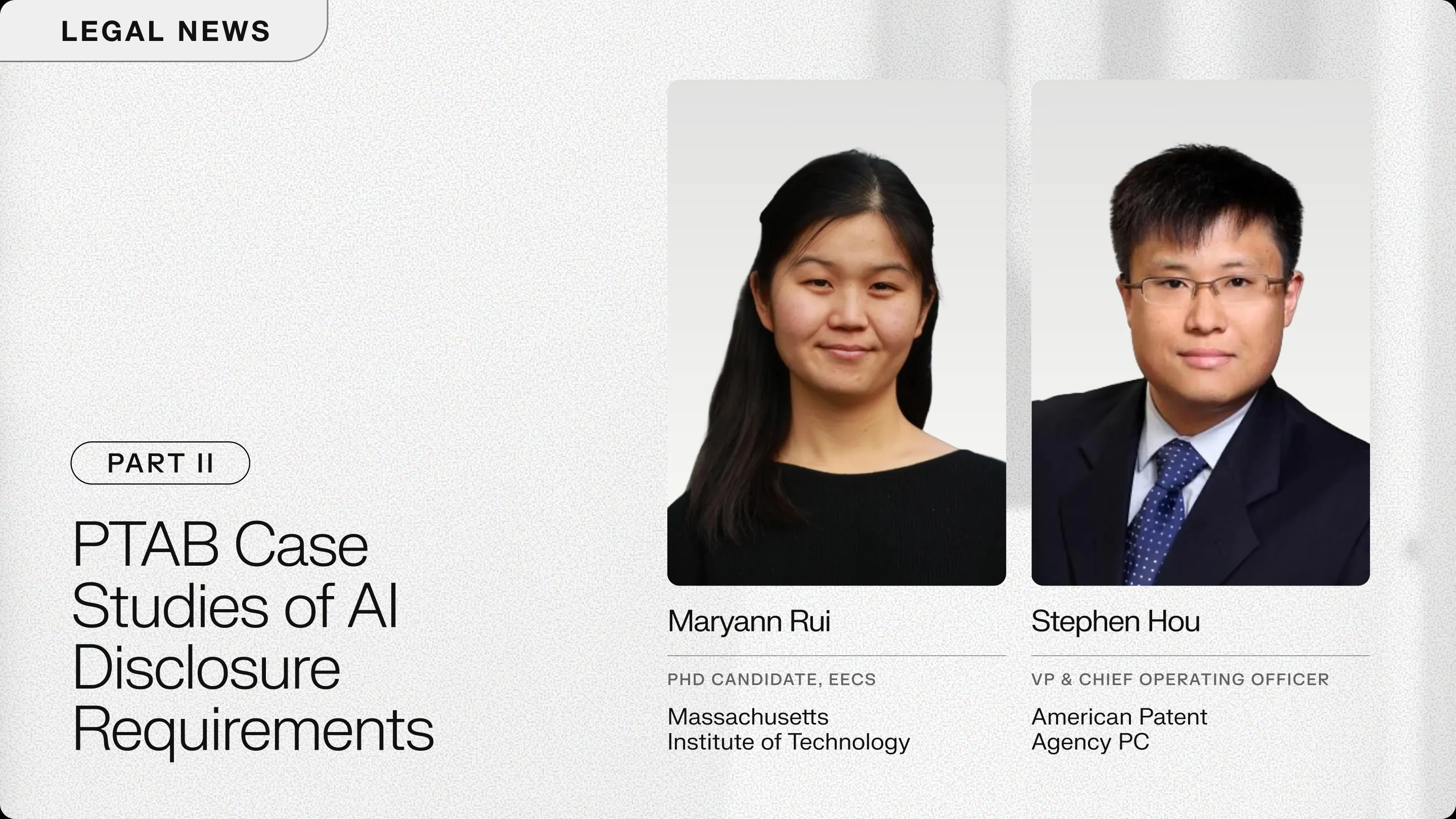
August 3, 2026PTAB Case Studies of AI Disclosure Requirements: Part IIThis article is the second of a series of Patent Trial & Appeal Board (PTAB) case studies (see Part I ), which aims to inform applicants’ approach to satisfying the written description and enablement requirements for patenting artificial intelligence (AI) and machine learning technologies.Read article
February 16, 2026PTAB Case Studies of AI Disclosure Requirements: Part IArtificial intelligence (AI) is a fast-evolving field with new technical methods, systems, and products constantly being developed. This growth has also been reflected in the dramatic increase in patent filings for AI-related inventions. According to Patents and Artificial Intelligence: A Primer from the Center for Security and Emerging Technology, more than ten times as many AI-related patent applications were published worldwide in 2019 than in 2013, and the increasing trend has only continued since. Although AI-related patent applications have been on the rise, explicit guidance on patentability requirements have only recently begun to be published by patent offices around the world. Indeed, as a burgeoning field of technology, AI inventions have unique features, such as the importance of training data and the lack of explainability and predictability of trained AI models, that differentiate such innovations from traditional types of computer-implemented inventions (CII). These features raise questions about the interpretation of disclosure requirements, among other patentability requirements, for AI-related inventions. For example, how much information, such as source code, training data sets, or machine learning model architectures, should be provided to satisfy the written description and enablement requirements of Title 35 of the U.S. Code § 112(a) or analogs in other patent jurisdictions? As we await further official guidance from the U.S. Patent & Trademark Office (USPTO) on disclosure requirements for AI-related inventions, we can gather initial indications from recent patent prosecution decisions from the Patent Trial & Appeal Board (PTAB) on such issues. In this article, we study a selection of PTAB appeals decisions for applications for AI-related inventions rejected under § 112. To set the background, we first review a classification of AI inventions and USPTO guidelines on disclosure requirements for computer-implemented inventions. After analyzing three case studies, we conclude with general takeaways and best practices, which emphasize that applicants must disclose specific algorithms and implementation details, not just desired outcomes, to satisfy written description requirements.Read article
Cookie settingsBy clicking “Accept all”, you agree to the storing of cookies on your device to enhance site navigation, analyze site usage, and assist in our marketing efforts. For further details see our
Manage cookie preferencesChoose which cookies we may store on your device. Essentials keep the site working and cannot be turned off.EssentialsNecessary for the site to function. Always on.Always activeAnalyticsMeasures usage and improves your experience.MarketingUsed for targeted advertising.Cookie preferences